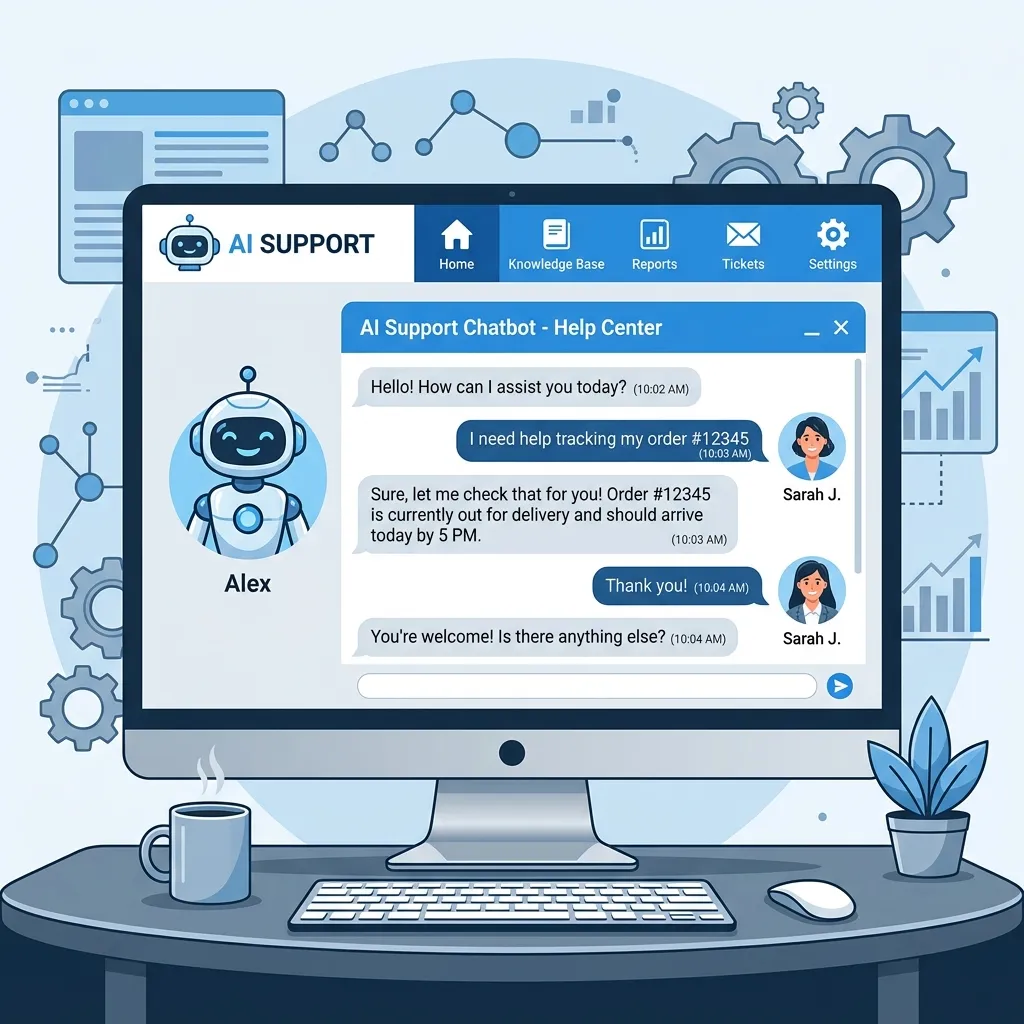
The short version: AI chatbots for customer service handle 60% to 80% of routine inquiries autonomously, cutting response times to seconds and reducing support costs. They integrate directly with CRMs to execute workflows like order tracking and refund processing, escalating complex issues to human agents.
Customers no longer measure good service against your competitors — they measure it against the fastest, most convenient experience they've had anywhere, from any brand. That's the pressure driving one of the biggest shifts in customer experience today: the rise of the AI chatbot for customer service.
What used to be a clunky, rule-based widget that could only answer "yes" or "no" questions has evolved into something far more capable. Modern AI customer service chatbots understand natural language, pull real answers from your knowledge base and business systems, resolve issues end-to-end, and hand off to a human only when it genuinely makes sense.
This guide breaks down exactly what an AI chatbot for customer service does, the tangible benefits it delivers, how the technology actually works under the hood, and real-world use cases you can model your own strategy on — plus the gaps most "top 10 benefits" articles gloss over, like cost structure, data readiness, and when not to automate.
What Is an AI Chatbot for Customer Service?
An AI customer service chatbot is a software application that uses natural language processing (NLP) and machine learning to understand customer questions and respond automatically, without needing a human agent for every interaction. Unlike the decision-tree bots of the past — the ones that trapped you in "Please select option 1, 2, or 3" loops — today's conversational AI for support can interpret intent, context, and even sentiment, then take real action: checking an order status, updating an account, processing a return, or escalating a sensitive complaint to a live agent with full conversation history attached.
The distinction matters because it explains why adoption has accelerated so quickly. Businesses using AI chatbots have reported average increases in customer satisfaction of roughly two-thirds compared with pre-automation baselines, largely because response times drop and answers become more consistent across chatbot deployments, where average response times have been cut by roughly half.
Key Benefits of AI Chatbots in Customer Service
1. 24/7 Availability Without 24/7 Staffing Costs
Customers don't stop needing help at 6 p.m. A customer service automation tool doesn't take breaks, holidays, or sick days. It can answer a billing question at 2 a.m. or triage a shipping complaint on a Sunday, closing the gap between when a problem occurs and when it gets resolved — without you needing to run a round-the-clock call center.
2. Faster Response and Resolution Times
Speed is consistently the top driver of customer satisfaction. Cost data backs this up too: each AI chatbot interaction typically costs a fraction of what a live agent interaction costs, largely because automated interactions run roughly $0.50–$0.70 each compared with $6–$15 for a human agent conversation. That efficiency lets support teams reroute budget toward the complex, high-value conversations that genuinely need a person.
3. Lower Operational Costs at Scale
Cybersecurity and operational audits show that AI chatbots reduce the overall cost of running a support function. Industry research suggests that AI chatbots can lower contact center operating costs by around 30%, largely by absorbing the repetitive, low-complexity tickets that otherwise consume agent hours — password resets, order tracking, FAQ lookups, and appointment confirmations.
4. Consistency and Reduced Human Error
An AI chatbot for customer service gives the exact same accurate answer every time, pulled directly from your approved knowledge base or policy documents. That consistency reduces the risk of an undertrained or fatigued agent giving conflicting information — a common, quiet source of customer churn.
5. Scalability During Demand Spikes
Flash sales, product launches, and service outages create sudden surges in support volume. A chatbot scales instantly to handle thousands of simultaneous conversations, something no staffing plan can match without significant overtime costs or hiring lead time.
6. Personalization at Scale
Modern AI-powered customer support tools integrate with CRM and order-management systems, so the chatbot can greet a returning customer by name, reference their order history, or recommend a relevant product — the kind of personalized touch that used to require a human who remembered you.
7. Valuable Data and Insight Generation
Every chatbot conversation is a data point. Analyzing chat logs reveals recurring pain points, product gaps, and FAQ trends long before they'd surface in a quarterly survey, giving product and support teams a live feed of what customers actually struggle with.
How AI Chatbots Work: The Technology Behind the Conversation
Understanding how AI chatbots work helps you evaluate vendors and set realistic expectations. Most modern conversational AI for support runs on four layered components:
Natural Language Processing (NLP) and Natural Language Understanding (NLU)
When a customer types a message, NLP breaks the sentence into structured data the system can interpret, while NLU determines the underlying intent — is this a complaint, a question, or a request to cancel? This is the layer that lets a chatbot understand "my package hasn't shown up" and "where's my order?" as the same intent, even though the wording is completely different.
Large Language Models (LLMs) and Generative AI
The newest generation of AI chatbots for customer service is built on large language models, the same technology behind tools like ChatGPT. Rather than matching a message to a pre-written script, an LLM-based chatbot generates a contextually appropriate response in real time, drawing on your company's documentation, past conversations, and live system data. This is why the terms "chatbot" and "AI agent" have effectively converged in 2026 — today's bots can reason through multi-step problems rather than just retrieving canned answers.
Knowledge Base and Retrieval-Augmented Generation (RAG)
To avoid making things up ("hallucinating"), well-built chatbots use retrieval-augmented generation: the system searches your actual help center articles, policies, and product data first, then generates a response grounded in that retrieved content. This is the single biggest factor separating a reliable enterprise chatbot from a database of static answers.
Integrations and Action-Taking
A chatbot that can only talk is limited. The real value comes from integrations — with your CRM, order management system, payment processor, or ticketing platform — that let the bot actually resolve issues: issuing a refund, rebooking an appointment, or updating a shipping address, not just explaining how to do it.
Human Handoff and Escalation Logic
The best-designed AI chatbots know their limits. Clear escalation triggers — sentiment detection, repeated failed attempts, or explicit requests for a human — route the conversation to a live agent with full context attached, avoiding the frustrating experience of repeating yourself.
Real-World Use Cases of AI Chatbots in Customer Service
E-Commerce: Order Tracking and Returns
Retail brands deploy chatbots to instantly answer "where's my order?" questions, initiate returns, and recommend related products — a high-volume, repetitive workload that's ideal for automation and directly reduces email backlog.
Banking and Financial Services
Banks use AI chatbots to handle balance inquiries, flag suspicious transactions, and guide customers through card activation, all within secure, compliant conversation flows. Financial services remains one of the fastest-adopting sectors precisely because of this repetitive, rules-heavy query volume.
Telecommunications
Telecom providers route billing disputes, plan upgrades, and outage reporting through chatbots first, reserving live agents for account cancellations and complex technical troubleshooting.
Travel and Hospitality
Airlines and hotel chains use chatbots for booking confirmations, flight status updates, and rebooking after cancellations — moments where speed directly affects customer trust.
SaaS and Tech Support
Software companies deploy chatbots as a first line of technical support, walking users through troubleshooting steps or bug reports and creating a ticket automatically if the issue needs engineering attention.
Case in point: FNA Technology built an AI customer-support chatbot for Khedmah, one of Oman's leading digital services platforms, enabling real-time order tracking at scale — a practical example of how a well-scoped AI chatbot for customer service reduces support load while improving the customer experience.
What Most Guides Don't Tell You: Common Implementation Pitfalls
Most articles on this topic stop at benefits and use cases. A few realities worth knowing before you commit budget:
- Your knowledge base quality determines your chatbot's quality. An AI chatbot is only as accurate as the content it retrieves from. Outdated help articles or missing documentation will produce outdated or wrong answers, regardless of how advanced the underlying model is.
- Not every workflow should be automated. High-emotion interactions — bereavement claims, safety complaints, or account fraud — often need a human first, not last. Map your ticket categories by complexity and emotional weight before deciding what to automate.
- Human trust still matters. Some consumers remain skeptical of AI-only support and expect the option to reach a person; a clear escalation path isn't optional polish — it protects both satisfaction and trust.
- Integration work is the real project. The chatbot interface is the easy part. Connecting it securely to your CRM, order system, and ticketing tool — and keeping that data current — is where most implementation timelines actually go.
- Measure resolution, not just deflection. A chatbot that "closes" a conversation without solving the problem just moves frustration downstream. Track first-contact resolution rate, not only ticket volume handled.
How to Choose the Right AI Chatbot for Your Business
- Define your top 5–10 recurring support questions and confirm the chatbot can resolve them end-to-end, not just describe the process.
- Check integration depth with your existing CRM, helpdesk, and e-commerce or booking systems.
- Ask about the underlying model and data grounding — RAG-based systems tend to be far more accurate than pure generative responses.
- Review escalation and handoff logic before launch, not after a customer complaint.
- Start with a pilot on one or two ticket categories, measure resolution and satisfaction, then expand.
If you're evaluating vendors or considering a custom build, FNA Technology's AI chatbot development services and broader AI development services are worth reviewing for a sense of what a properly scoped, integrated chatbot implementation looks like, alongside custom software development for teams that need the bot connected to bespoke internal systems.
Frequently Asked Questions
Conclusion: Is an AI Chatbot Right for Your Customer Service Strategy?
An AI chatbot for customer service isn't a replacement for your support team — it's a force multiplier. Used well, it delivers 24/7 availability, faster response times, lower operating costs, and more consistent answers, while freeing your human agents to focus on the complex, high-empathy conversations that actually need them. Used poorly — bolted onto outdated documentation with no escalation path — it becomes just another source of customer frustration.
The businesses seeing the strongest returns treat their chatbot as a living product: grounded in accurate data, integrated into real systems, and continuously refined based on what customers are actually asking. That's the difference between a chatbot that deflects tickets and one that genuinely improves customer service.
For further reading on the broader technology and its limitations, see IBM's overview of conversational AI and Gartner's research on AI in customer service, and for privacy and data-handling considerations when integrating customer data into an AI system, the FTC's guidance on AI and consumer protection is a useful reference point.
Ready to see what an AI chatbot could do for your customer service team? Book a free consultation with FNA Technology and we'll map out the right scope, integrations, and rollout plan for your business — no sales pressure, just a practical assessment of what's worth automating.