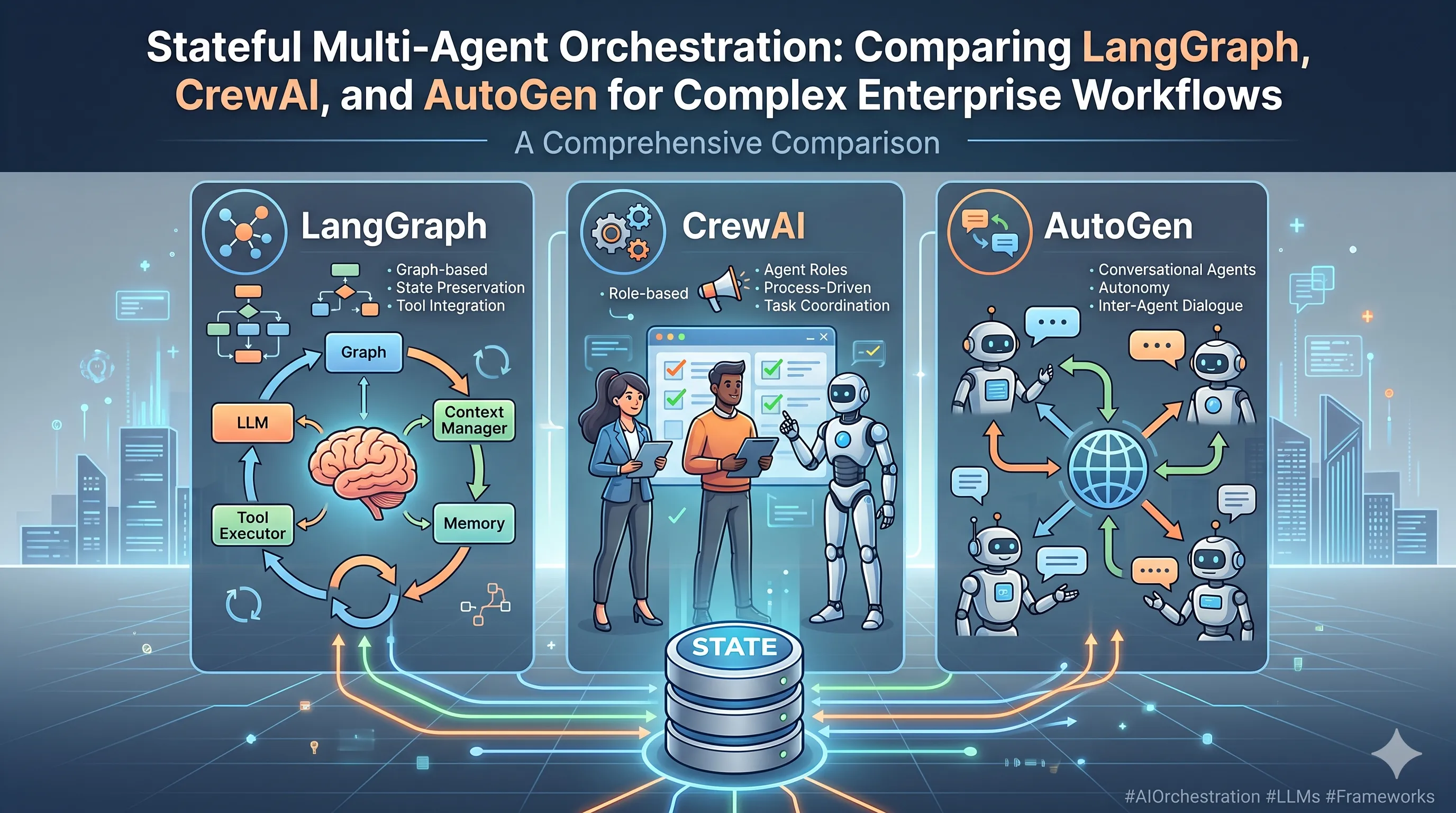
Short version: Enterprise AI is evolving from single prompts to stateful, multi-agent systems. LangGraph offers maximum control and auditability for strict environments. CrewAI excels in role-based collaboration with cognitive memory. AutoGen (AG2) provides highly scalable, async-first conversational problem-solving. Choose based on your need for determinism versus emergent interaction.
The architectural evolution of enterprise artificial intelligence is moving from stateless, single-turn prompts to stateful, multi-agent orchestrations capable of executing long-running, collaborative workflows. As modern enterprises automate increasingly intricate processes, developers require autonomous systems that handle isolated failures, leverage specialized prompts, execute independent tasks in parallel, and scale modularly. Specialized agencies like FNA Technology design and ship these intelligent platforms to keep ambitious global teams ahead in the digital era.
However, as the multi-agent framework ecosystem has fragmented, selecting the appropriate orchestrator has become a critical engineering decision; selecting an suboptimal framework can lead to weeks of refactoring when workflows are pushed to production scale. To guide enterprise architects, this analysis evaluates the three dominant open-source frameworks: LangGraph, CrewAI, and AutoGen (which has transitioned in the community to the AG2 fork).
LangGraph: The Deterministic State-Machine Paradigm
LangGraph, developed by the LangChain team, takes a graph-based approach to agent orchestration. Instead of modeling agents as loosely coupled conversationalists, LangGraph structures workflows as directed graphs where nodes represent execution functions (such as an LLM call, a tool execution, or custom business logic) and edges define the control flow and routing between those nodes. The foundation of LangGraph's architecture is its explicit, centralized, and typed state object, which is passed systematically from one node to the next.
The state transition within a LangGraph execution step is represented mathematically as:
St+1 = Reduce(St, fn(St))
where St is the explicit state dictionary at execution step t, fn is the active node function processing the state, and Reduce represents the state updater operation that merges the node's outputs back into the shared state schema.
A primary advantage of LangGraph is its deterministic control. In highly regulated sectors such as finance, healthcare, and enterprise compliance, step-by-step auditability and predictable execution paths are non-negotiable. LangGraph ensures that agents execute within strict boundaries, branching conditionally only when state variables satisfy explicit logic parameters.
Furthermore, LangGraph features native state persistence and checkpointing. Every state transition is recorded in a durable checkpoint store (such as SQLite, Postgres, or custom enterprise databases). This design enables robust fault tolerance; if an external API call fails, a database connection drops, or a server restarts mid-transaction, the workflow can resume from the exact last-saved checkpoint rather than restarting the entire sequence. This persistence layer also enables "time-travel" debugging, allowing developers to inspect past execution states, query historical pathways for compliance audits, and replay transactions from arbitrary checkpoints.
# State persistence and routing inside a LangGraph node
from typing import TypedDict, Optional, Literal
from langgraph.types import Command, interrupt

class WorkflowState(TypedDict):
    query: str
    generation: str
    approval_status: Optional[Literal["approved", "rejected"]]

def human_verification_node(state: WorkflowState) -> Command[Literal["approve", "reject"]]:
    # Interrupt halts the thread and persists the graph state to disk
    decision = interrupt({
        "action": "verify_output",
        "payload": state["generation"]
    })

    if decision == "approved":
        return Command(goto="approve_node", update={"approval_status": "approved"})
    else:
        return Command(goto="regenerate_node", update={"approval_status": "rejected"})
The Human-in-the-Loop (HITL) middleware in LangGraph is highly robust. Rather than treating human intervention as a peripheral wrapper, LangGraph supports both static interrupts (pausing execution before or after specific nodes) and dynamic interrupts (pausing from within a node based on active state parameters).
This allows sensitive operations—such as executing arbitrary SQL queries or writing files—to halt safely while awaiting human review. The human reviewer can approve the action as-is, reject it with specific feedback to guide automated regeneration, edit the parameters before execution, or act as a placeholder tool to supply missing information.
However, LangGraph introduces a steep learning curve. Developing complex orchestrations requires a deep understanding of graph design, node state-schemas, and conditional routing logic. It is also tightly coupled to the LangChain ecosystem, which can introduce library overhead and abstraction layers that some engineering teams may prefer to avoid.
CrewAI: Role-Based Collaboration and Cognitive Memory
CrewAI organizes multi-agent systems by mirroring the structures of human teams. Instead of conceptualizing nodes and edges, developers define distinct agents with specific roles, backstories, target goals, and specialized toolsets. These agents are then grouped into a "Crew" and assigned sequential or hierarchical tasks. This role-based abstraction makes CrewAI highly intuitive for automating real-world business workflows, such as market research, content creation pipelines, and customer support, allowing non-engineers to easily understand and construct agent behaviors.
The key differentiator of CrewAI is its advanced cognitive memory system. Rather than treating memory as a simple storage and retrieval problem, CrewAI models memory as an active cognitive process comprised of five operations: encode, consolidate, recall, extract, and forget.
Short-term memory is managed using ChromaDB with Retrieval-Augmented Generation (RAG) to maintain the context of the active session. Long-term memory is backed by SQLite to accumulate valuable insights and patterns across multiple execution cycles. Entity memory processes and organizes specific facts about people, places, and organizations.
When a crew executes tasks, an encoding pipeline analyzes the outputs to generate atomic memory structures, while a consolidation layer resolves semantic conflicts—such as when a new observation contradicts a previously stored fact—ensuring the database remains coherent over time.
# Configuring a role-based agent with integrated cognitive memory
from crewai import Agent, Task, Crew, Process
from crewai.memory import ShortTermMemory, LongTermMemory

market_analyst = Agent(
    role="Principal Intelligence Analyst",
    goal="Extract and synthesize emerging trends in decentralized financial systems",
    backstory="An expert financial analyst specializing in quantitative data patterns",
    memory=True,
    verbose=True
)
CrewAI Flows provides a hybrid orchestration layer that supports both unstructured state management (where variables are modified dynamically on the fly) and structured state management (utilizing Pydantic models to enforce strict schema validation and typing).
The state is persisted to a local SQLite database by default, enabling automated recovery from system crashes or unplanned restarts. For distributed production systems where local embedded file structures are insufficient, the community actively maintains integrations for Valkey—the open-source successor to Redis—as a high-throughput, low-latency key-value store and vector search engine using the valkey-glide client.
While CrewAI is excellent for rapid prototyping and human-centric workflows, it can become challenging when handling highly complex, cyclical logic or fine-grained execution control. The framework-specific abstractions can limit architectural flexibility, and the agents remain largely tied to the crew lifecycle rather than operating as independent, long-running processes.
AutoGen and AG2: Conversational Consensus and Async-First Scaling
Initially developed by Microsoft Research, AutoGen pioneered conversation-driven multi-agent collaboration. By mid-2025, Microsoft pivoted its focus toward the Microsoft Agent Framework and shifted the v0.2 API to maintenance mode. In response, the open-source community created AG2, a community-governed fork designed to provide long-term stability, maintain API compatibility, and integrate modern protocols.
AG2 models multi-agent orchestration as a dynamic, natural language dialogue. Agents are defined as conversational entities that collaborate through multi-party patterns, group chats, or structured sequential interactions. This conversation-centric model is highly effective for open-ended, iterative processes—such as collaborative software engineering, multi-perspective debates, and group consensus building—where the optimal solution emerges through discussion.
# Managing state in conversational agent groups using AG2
from autogen.agentchat.group import ContextVariables

# Shared context variables that persist across agent transitions
shared_context = ContextVariables(data={
    "active_session_id": "session-8921",
    "transaction_count": 0,
    "validation_history": []
})

# Accessing and updating the context variables within a specialized tool
def process_transaction_tool(amount: float, context_variables: ContextVariables) -> str:
    count = context_variables.get("transaction_count", 0)
    context_variables.set("transaction_count", count + 1)
    return f"Processed transaction of {amount}. Total transactions: {count + 1}"
AG2's architectural design features an async-first engine. The entire framework loop, including model requests, tool execution, and downstream agent handoffs, is built on asynchronous primitives. This design allows a single process to manage hundreds of concurrent agent conversations and streaming connections without blocking the main event thread.
Additionally, AG2 decouples its state management. While original versions kept conversation logs in local memory, AG2 externalizes execution history, session states, and message streams behind standardized protocols. These interfaces can be backed by distributed databases like Redis, allowing agents to remain stateless. Consequently, scaling an AG2 deployment horizontally across containerized clusters becomes straightforward, as separate web servers and background workers can share the same live conversation state.
For shared memory across group chats, AG2 provides ContextVariables. These variables act as a persistent key-value store accessible to all participating agents and executing tools. They are also integrated into system prompts, allowing agents' system messages to update dynamically as variables change.
Furthermore, AG2 integrates with FalkorDB to provide GraphRAG capabilities. This allows agents to query structured knowledge graphs, grounding their conversations in precise semantic relationships and reducing hallucinations during complex queries.
A key limitation of AG2 is its potential for high token consumption. Because the orchestration relies on continuous conversation, multi-turn dialogues can grow long, increasing execution costs. Additionally, the community's transition from Microsoft AutoGen to AG2 has created some fragmentation in tutorials, import paths, and documentation, which can slow down initial development.
Multi-Agent Framework Comparison
The table below provides a detailed comparison of the architectural patterns and production capabilities of LangGraph, CrewAI, and AutoGen/AG2.
| Orchestration Dimension | LangGraph | CrewAI | AutoGen / AG2 |
|---|---|---|---|
| Foundational Paradigm | Directed Cyclic Graphs (State Machines) | Role-Based Crews & Tasks | Conversational Group Chats & Hand-offs |
| State Persistence | Built-in SQLite/Postgres checkpointers | SQLiteFlowPersistence, Valkey | Externalized History (Redis, DB backends) |
| Human-in-the-Loop | First-class static/dynamic interrupts | Native @human_feedback(learn=True) | Real-time bidirectional event streams |
| Memory Architecture | State-based memory with time-travel | 5-stage cognitive memory stack | Context Variables & GraphRAG (FalkorDB) |
| Determinism & Control | Maximum; explicit transition edges | Moderate; driven by task assignments | Low; highly emergent conversations |
| Learning Curve | Medium to High | Low; intuitive role-based DSL | Medium; requires conversational routing |
| Production Readiness | Highest; robust tracing & streaming | Medium; fast setup, growing cloud | High; highly scalable async runtime |
| Framework Costs | Free; LangSmith observability is paid | Free; paid tiers for CrewAI Cloud | Fully open-source and free |
Strategic Framework Selection Matrix
Applying a structured decision matrix ensures that multi-agent architectures align with the engineering and compliance requirements of the enterprise.
| Framework | If the target application requires... | Why select it? |
|---|---|---|
| LangGraph |
|
|
| CrewAI |
|
|
| AutoGen / AG2 |
|
|