Can You Track Brand Mentions in AI Search? Yes — Here's How
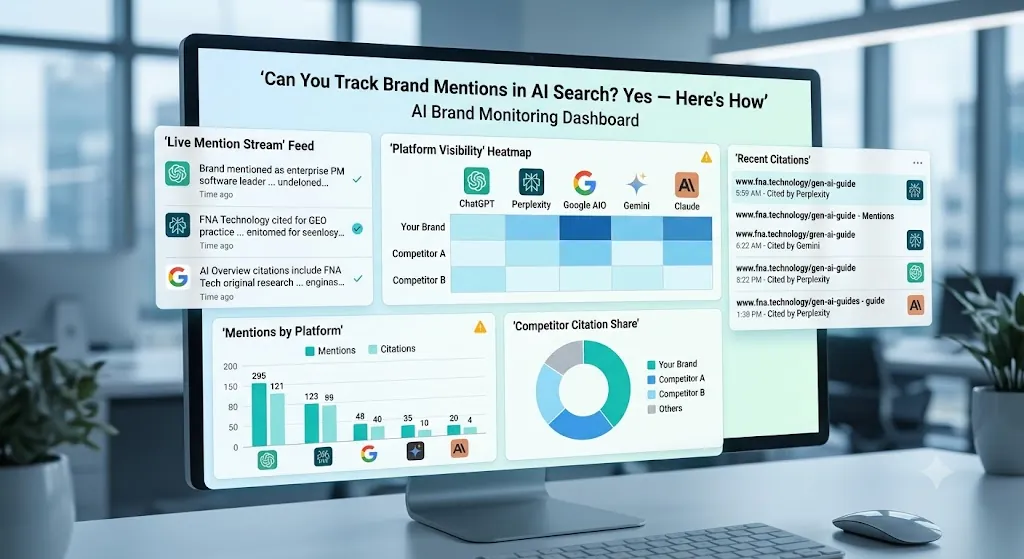
Short version: You can track brand mentions across ChatGPT, Perplexity, and Google AI Overviews by monitoring prompts, citations, and competitors. A strong workflow combines AI visibility tools, manual validation, and structured reporting over traditional keyword rankings.
Businesses have spent years measuring visibility through rankings, impressions, clicks, and backlinks.
AI search introduces a different challenge.
When someone asks ChatGPT for the best project management software, requests marketing recommendations from Perplexity, or receives an AI Overview from Google, there isn't always a traditional search result to click. Instead, AI systems generate an answer—and within that answer, they decide which brands deserve to be mentioned.
For marketing teams, that raises an entirely new question:
Is it possible to track brand mentions in AI search?
The short answer is yes.
The longer answer is that AI search requires a different measurement framework than traditional SEO.
Rather than asking:
- What position do we rank for?
- How many clicks did we receive?
- How many backlinks did we earn?
You'll begin asking questions like:
- Does ChatGPT mention our brand?
- Which competitors appear more frequently?
- Which pages are AI systems citing?
- Which prompts trigger our brand?
- Is our visibility improving month over month?
These metrics collectively describe your AI search visibility.
This guide explains how organizations can measure that visibility across ChatGPT, Google AI Overviews, Perplexity, Gemini, and emerging AI search platforms. You'll also learn the monitoring workflow our GEO team uses to identify opportunities, benchmark competitors, and improve citation performance over time.
Why tracking AI brand mentions matters
Traditional SEO tools tell you where your pages rank.
They don't tell you whether AI assistants recommend your company.
That's becoming an increasingly important distinction.
Imagine a software buyer asking ChatGPT:
"What are the best AI development companies for enterprise applications?"
The assistant responds with five companies.
If your business isn't one of them, you've effectively disappeared from that buying journey—even if you rank on the first page of Google.
The same applies to questions like:
- Best cybersecurity platforms
- Top AI chatbot companies
- CRM software recommendations
- Enterprise automation vendors
- Digital transformation consulting firms
Increasingly, users receive recommendations directly from AI systems before they ever visit a website.
That means visibility now extends beyond search rankings.
It includes being cited inside AI-generated answers.
Traditional SEO metrics vs AI visibility metrics
| Traditional SEO | AI Search Visibility |
|---|---|
| Keyword rankings | Brand citations |
| Organic traffic | Prompt coverage |
| Click-through rate | Citation frequency |
| Search impressions | AI answer inclusion |
| Backlinks | Entity recognition |
| SERP position | Competitor citation share |
Both sets of metrics remain valuable.
However, they measure different stages of the user's discovery journey.
AI search creates a new measurement challenge
Unlike Google Search Console or traditional analytics platforms, AI assistants don't provide dashboards showing:
- Number of ChatGPT mentions
- Monthly Perplexity citations
- Gemini recommendation history
- AI Overview visibility score
Instead, organizations must combine multiple techniques to understand how AI systems perceive their brand.
Fortunately, that's becoming increasingly practical through dedicated AI visibility platforms, prompt monitoring workflows, and structured competitor analysis.
Can you actually track brand mentions in AI search?
Short answer: Yes—but not in the same way you track keyword rankings.
AI search doesn't expose an official analytics dashboard showing every time your company is mentioned.
Instead, organizations monitor visibility by repeatedly testing important prompts and recording:
- Whether their brand appears
- Which competitors are mentioned
- Which pages receive citations
- How frequently they're recommended
- Which AI platform generated the mention
- Whether citation patterns change over time
Think of it less like rank tracking and more like citation tracking.
Instead of asking:
"What position am I?"
You're asking:
"Am I one of the trusted sources AI systems choose to recommend?"
That subtle difference changes how AI visibility should be measured.
AI mentions are influenced by multiple signals
Whether your brand appears in AI-generated responses depends on several factors, including:
- Topical authority
- Original research
- Technical crawlability
- Entity recognition
- Authoritative mentions
- Structured content
- First-party data
- Trusted citations
Because these signals evolve continuously, AI visibility should be monitored regularly rather than checked once.
What you'll learn next
In the next sections, we'll cover:
- How ChatGPT mentions can be monitored
- How Google AI Overviews expose citation opportunities
- How Perplexity references authoritative sources
- The best AI visibility tracking tools
- FNA Technology's AI search monitoring workflow
- KPIs every GEO team should track
How to track brand mentions across ChatGPT, Google AI Overviews, and Perplexity
Direct answer:
You can track brand mentions in AI search by monitoring important prompts across multiple AI platforms, recording which brands are recommended, identifying cited sources, measuring citation frequency, and comparing your visibility against competitors over time. This approach provides a much clearer picture than traditional keyword rankings alone.
Unlike Google Search Console, AI platforms don't provide a built-in analytics dashboard showing every time your brand appears.
Instead, successful GEO teams combine manual testing with specialized AI visibility platforms to build a repeatable monitoring system.
1. Tracking brand mentions in ChatGPT
According to OpenAI's documentation, ChatGPT has become one of the most widely used AI assistants for product research, vendor evaluation, software recommendations, and educational queries.
Businesses increasingly want answers to questions like:
- Does ChatGPT recommend our company?
- Which competitors appear more often?
- Which pages does ChatGPT reference?
- Are we gaining visibility over time?
Although OpenAI doesn't currently provide an analytics dashboard for brand mentions, organizations can still monitor visibility consistently.
Create a prompt library
Instead of searching random questions every week, maintain a standardized prompt library.
For example:
Awareness prompts
- What is Generative Engine Optimization?
- How does AI search work?
- What is AI search visibility?
Commercial prompts
- Best AI development companies
- Best AI SEO agencies
- Top GEO companies
- AI visibility platforms
Comparison prompts
- Company A vs Company B
- SEO vs GEO
- ChatGPT vs Perplexity
- AI search vs Google Search
Transactional prompts
- Which company should I hire?
- Best software for...
- Best consulting firms for...
Running the same prompt library every month makes trends much easier to identify.
Record every response
For each prompt, capture:
| Metric | Example |
|---|---|
| Prompt | Best AI development companies |
| Was your brand mentioned? | Yes |
| Position in response | Third recommendation |
| Competitors mentioned | Company A, Company B |
| Sources cited | Your blog, Gartner, Microsoft |
| Date tested | July 2026 |
This creates historical data that can be compared over time.
Monitor citation quality—not just mentions
Not every mention has equal value.
For example:
Company X is briefly listed among ten providers.
compared with
FNA Technology is recommended because of its experience building enterprise AI platforms and custom LLM solutions.
The second mention demonstrates stronger authority.
Evaluate:
- Depth of recommendation
- Supporting explanation
- Citation quality
- Context of the recommendation
2. Tracking Google AI Overviews
Google AI Overviews work differently from ChatGPT.
As outlined in Google Search Central's AI Overviews documentation, Google frequently displays cited sources directly within AI-generated summaries.
That creates an opportunity to measure which pages receive citations.
Identify keywords triggering AI Overviews
Begin with your most valuable commercial and informational keywords.
Examples include:
- AI chatbot development company
- Enterprise AI consulting
- AI automation services
- Generative AI agency
- AI software development
Record whether an AI Overview appears.
Then identify:
- Which brands are mentioned
- Which websites receive citations
- Which pages Google references
- Whether your content appears consistently
Measure citation share
A simple spreadsheet can include:
| Keyword | AI Overview? | Your Brand | Competitor A | Competitor B |
|---|---|---|---|---|
| AI chatbot development | ✅ | ✅ | ✅ | ❌ |
| AI consulting company | ✅ | ❌ | ✅ | ✅ |
| AI workflow automation | ❌ | — | — | — |
After monitoring dozens—or even hundreds—of keywords, you'll begin identifying patterns.
Review cited pages
Pay attention to the pages Google references repeatedly.
Ask questions such as:
- Are they original research reports?
- Do they publish first-party data?
- Do they include FAQs?
- Are they comprehensive guides?
- Are they comparison pages?
Those observations often reveal why competitors earn AI citations.
3. Tracking Perplexity brand mentions
Perplexity differs from many AI assistants because it places strong emphasis on source citations, a core feature highlighted in Perplexity's official resources.
Every answer provides an opportunity to understand which websites are considered authoritative.
Monitor recommendation prompts
Examples include:
- Best AI development company
- Best CRM software
- Best cybersecurity platform
- Best accounting software
- Best GEO agency
For each prompt, record:
- Recommended companies
- Number of citations
- Source diversity
- Supporting articles
- Explanation quality
Because Perplexity openly displays references, it's often one of the easiest AI platforms for citation analysis.
Compare competitors
Create a comparison table.
| Company | Mentioned | Number of Citations | Recommendation Quality |
|---|---|---|---|
| Your Brand | Yes | 5 | Detailed explanation |
| Competitor A | Yes | 7 | Detailed explanation |
| Competitor B | No | 0 | Not mentioned |
Over several months, this becomes a valuable benchmark for GEO performance.
Manual monitoring vs automated AI visibility tracking
Organizations usually begin with manual monitoring.
As prompt libraries grow, automation becomes essential.
| Manual Monitoring | Automated Monitoring |
|---|---|
| Lower cost | Scales to thousands of prompts |
| Good for validation | Continuous monitoring |
| Flexible analysis | Historical reporting |
| Easy to start | Better for enterprise teams |
| Time intensive | Saves significant time |
Many companies use both approaches together.
Manual reviews verify the quality of AI-generated responses, while automated platforms handle large-scale tracking and trend analysis.
What comes next?
Once you've established a repeatable monitoring process, the next step is choosing the right tools.
Some platforms focus on AI citation tracking, while others specialize in prompt monitoring, competitive benchmarking, or overall AI search visibility.
Best tools to track brand mentions in AI search
Direct answer:
There isn't a single tool that tracks every AI mention across ChatGPT, Google AI Overviews, Perplexity, Gemini, and Claude. Most organizations use a combination of AI visibility platforms, SEO tools, prompt monitoring, and custom dashboards to understand where their brand appears and how that visibility changes over time.
Choosing the right tools depends on what you want to measure.
Some focus on AI citations.
Others monitor prompts.
Some compare competitors.
The most mature GEO teams combine multiple data sources into a single reporting workflow.
What should an AI monitoring tool measure?
Before evaluating vendors, define the metrics that actually matter.
A useful AI visibility platform should help answer questions like:
- How often is our brand mentioned?
- Which competitors appear more frequently?
- Which prompts trigger our brand?
- Which pages receive citations?
- Which AI platforms recommend us?
- Is our visibility improving over time?
If a platform only reports keyword rankings, it isn't measuring AI visibility.
Key capabilities to look for
| Capability | Why it matters |
|---|---|
| AI prompt monitoring | Measures visibility across predefined prompts |
| Brand mention tracking | Detects whether your company appears in AI responses |
| Citation analysis | Shows which URLs AI systems reference |
| Competitor benchmarking | Compares your visibility with competing brands |
| Historical reporting | Tracks changes month over month |
| AI Overview monitoring | Measures visibility inside Google's AI-generated answers |
| Exportable reports | Helps share insights across marketing teams |
No platform is perfect.
The goal is choosing one that aligns with your reporting requirements.
Popular AI visibility platforms
The AI search monitoring market is evolving rapidly.
Several platforms now help businesses understand how they're represented across AI search engines.
Profound
Profound focuses on enterprise AI visibility.
It helps organizations monitor:
- Brand mentions
- AI-generated recommendations
- Competitor visibility
- Citation frequency
- Prompt coverage
Large enterprise teams often use it to measure how frequently their brands appear across multiple AI assistants.
Peec AI
Peec AI emphasizes AI search analytics and visibility reporting.
Typical capabilities include:
- AI prompt tracking
- Competitive benchmarking
- Historical visibility trends
- Brand monitoring
It's designed to help marketing teams understand how AI systems describe their business over time.
Scrunch AI
Scrunch AI focuses on helping brands understand and improve their presence within AI-generated search experiences.
Its reporting typically includes:
- AI citation analysis
- Brand visibility metrics
- Prompt performance
- Competitive insights
Organizations often use these insights to prioritize GEO initiatives.
Goodie AI
Goodie AI helps monitor how frequently brands appear in AI-generated answers and identifies opportunities to improve visibility through content optimization and stronger entity signals.
Traditional SEO tools still matter
Platforms such as:
- Ahrefs
- Semrush
- Google Search Console
- Google Analytics
remain essential.
However, they measure traditional search performance rather than AI citation frequency.
They should complement—not replace—AI visibility reporting.
Build an AI search monitoring dashboard
Most organizations don't need dozens of disconnected reports.
Instead, create a single dashboard combining AI visibility and traditional SEO metrics.
An example dashboard might look like this.
| KPI | Current Month | Previous Month |
|---|---|---|
| AI prompts monitored | 250 | 220 |
| Brand mentions | 118 | 95 |
| Citation frequency | 47% | 39% |
| Google AI Overview appearances | 42 | 31 |
| Competitor citations | 165 | 173 |
| New authoritative mentions | 14 | 8 |
This type of dashboard makes monthly reporting significantly easier.
Segment prompts by intent
Not every AI prompt has the same business value.
Organize prompts into categories.
| Prompt Type | Example |
|---|---|
| Awareness | What is Generative Engine Optimization? |
| Research | Best AI visibility tools |
| Commercial | Best AI development companies |
| Comparison | Company A vs Company B |
| Transactional | Which AI agency should I hire? |
This segmentation helps identify where visibility is strongest—and where additional content is needed.
Monitor competitors alongside your own brand
One of the biggest advantages of AI monitoring is understanding who consistently appears in AI-generated recommendations.
For every tracked prompt, record:
- Which companies were recommended?
- In what order?
- Which sources were cited?
- How detailed were the recommendations?
- Which competitor appears most often?
Over time you'll discover patterns that keyword ranking tools can't reveal.
For example, a competitor might receive fewer organic visits but dominate AI-generated recommendations because they publish stronger research or have better entity authority.
Combine manual reviews with automation
Automation saves time.
Manual reviews provide context.
The strongest GEO teams combine both.
| Manual Review | Automated Monitoring |
|---|---|
| Evaluates response quality | Tracks thousands of prompts |
| Identifies recommendation context | Detects visibility trends |
| Reviews citation accuracy | Generates recurring reports |
| Finds new prompt ideas | Monitors competitors continuously |
Neither approach replaces the other.
Together, they provide a much more complete picture of AI search performance.
Common mistakes when choosing AI monitoring tools
Organizations frequently make one of these mistakes:
- Measuring keyword rankings instead of AI citations
- Tracking only one AI platform
- Ignoring competitor recommendations
- Focusing only on brand mentions without reviewing citation quality
- Monitoring too few prompts
- Treating AI visibility as a one-time audit instead of an ongoing process
AI search changes rapidly.
Your monitoring strategy should evolve alongside it.
What's next?
Monitoring tools help collect the data.
The next step is building a repeatable workflow that turns those insights into action.
We'll walk through the exact GEO monitoring process our team follows—from selecting prompts and benchmarking competitors to identifying optimization opportunities and reporting AI visibility improvements month after month.
FNA Technology's AI search monitoring workflow
Direct answer:
At FNA Technology, AI search monitoring isn't treated as a monthly ranking report. Instead, we follow a continuous GEO workflow that tracks high-value prompts, measures brand citations across multiple AI platforms, benchmarks competitors, identifies content gaps, and prioritizes improvements that increase long-term AI visibility.
The objective isn't simply collecting data.
The objective is understanding why AI systems recommend certain brands and using those insights to improve future visibility.
Step 1: Identify your highest-value prompts
Every monitoring program starts with a carefully curated prompt library.
Rather than testing thousands of random questions, focus on prompts that directly influence your business.
For most organizations, these fall into five categories.
| Prompt Category | Example |
|---|---|
| Educational | What is Generative Engine Optimization? |
| Commercial | Best AI development companies |
| Comparison | Company A vs Company B |
| Buying Intent | Which AI agency should I hire? |
| Industry Specific | Best AI solutions for healthcare |
Prioritize prompts that real customers are likely to ask AI assistants before making purchasing decisions.
Step 2: Test across multiple AI platforms
Every AI search engine retrieves information differently.
A brand that appears prominently in ChatGPT may not receive the same visibility in Perplexity or Google AI Overviews.
Our monitoring process evaluates prompts across multiple platforms, including:
- ChatGPT
- Google AI Overviews
- Perplexity
- Gemini
- Claude (where applicable)
This provides a broader understanding of AI search visibility instead of relying on a single platform.
Step 3: Record every citation
For every prompt, we capture structured information rather than relying on screenshots.
Typical fields include:
| Metric | Description |
|---|---|
| Prompt | The exact question asked |
| AI Platform | ChatGPT, Perplexity, Google AI Overview, etc. |
| Brand Mentioned | Yes or No |
| Position | First, second, third recommendation |
| Pages Cited | URLs referenced by the AI system |
| Competitors Mentioned | Other recommended brands |
| Response Date | Monitoring date |
Over time, this creates a historical dataset that makes trends much easier to identify.
Step 4: Benchmark competitors
Tracking your own visibility isn't enough.
Competitive benchmarking often reveals the biggest optimization opportunities.
For each prompt, ask:
- Which competitors appeared?
- How frequently were they recommended?
- Which content was cited?
- What type of pages earned citations?
- Did they publish original research?
- Were they mentioned because of stronger authority?
Understanding why competitors are recommended is often more valuable than simply knowing that they were recommended.
Step 5: Identify content gaps
Once enough prompts have been analyzed, recurring patterns begin to emerge.
For example:
- Competitors dominate comparison queries.
- Nobody owns a specific educational topic.
- AI consistently cites industry reports instead of blog posts.
- Certain commercial keywords rarely mention your brand.
These observations help prioritize future content production.
Instead of publishing articles randomly, your GEO strategy becomes driven by measurable visibility gaps.
Step 6: Prioritize improvements
Not every issue deserves immediate attention.
We generally categorize improvements by expected business impact.
| Priority | Typical Actions |
|---|---|
| High | Publish missing commercial pages, improve authority signals, strengthen internal linking |
| Medium | Expand FAQs, improve structured data, refresh statistics |
| Low | Minor wording improvements, formatting updates, image enhancements |
This prevents marketing teams from spending weeks on changes that have little influence on AI visibility.
KPIs every GEO team should track
Traditional SEO dashboards focus on rankings, impressions, and clicks.
AI search requires additional performance indicators.
A practical GEO dashboard should include metrics that reflect both visibility and authority.
AI visibility KPIs
| KPI | Why it matters |
|---|---|
| Brand mention rate | Measures how often your company appears in AI responses |
| Prompt coverage | Percentage of tracked prompts mentioning your brand |
| Citation frequency | Tracks how often your pages are cited |
| Citation share | Compares your visibility against competitors |
| AI Overview appearances | Measures visibility within Google's AI-generated summaries |
| Entity recognition | Indicates how consistently AI systems recognize your brand |
Together, these metrics provide a much more complete picture than rankings alone.
Content performance KPIs
It's also important to understand which content contributes to AI visibility.
Track metrics such as:
- Most-cited articles
- Most-cited landing pages
- Highest-performing research reports
- Frequently referenced comparison guides
- Pages generating the strongest AI recommendations
These insights help determine where future investment should be directed.
Authority KPIs
AI systems tend to recommend brands that demonstrate credibility across multiple sources.
Useful authority metrics include:
- New media mentions
- Industry citations
- Backlinks from trusted publications
- Speaking engagements
- Original research published
- Expert author contributions
Although these metrics aren't unique to AI search, they strongly influence long-term visibility.
Common mistakes when tracking AI brand mentions
Organizations often collect large amounts of AI search data but struggle to extract meaningful insights.
Here are some of the most common mistakes.
Monitoring only ChatGPT
ChatGPT is influential, but it isn't the entire AI search ecosystem.
Users also rely on:
- Google AI Overviews
- Perplexity
- Gemini
- Claude
- Microsoft Copilot
Monitoring multiple platforms provides a more balanced view of your visibility.
Tracking mentions without context
A simple mention doesn't tell the whole story.
Instead, evaluate:
- Was your brand recommended positively?
- Was it the primary recommendation?
- Which competitors appeared alongside it?
- Which supporting sources were cited?
The context behind a recommendation is often more valuable than the mention itself.
Ignoring competitor trends
Many organizations focus exclusively on their own performance.
Competitive monitoring often uncovers:
- Emerging industry leaders
- New content formats
- Frequently cited research
- High-performing comparison pages
- Authority-building opportunities
These insights can shape future GEO strategies.
Treating AI monitoring as a one-time project
AI search changes continuously.
New models are released.
Fresh content is published.
Competitor authority evolves.
A visibility audit completed today may look very different six months from now.
Consistent monitoring is essential for identifying long-term trends.
What's next?
Tracking brand mentions is only the first step.
The organizations that consistently appear in AI-generated answers use monitoring insights to improve content quality, strengthen entity authority, publish original research, and expand topical coverage.
In the final section, we'll summarize the key takeaways, answer the most common questions about AI brand monitoring, and explain how businesses can build a sustainable AI search visibility strategy.
Conclusion
AI search has fundamentally changed how people discover brands.
Instead of browsing through ten blue links, users increasingly ask ChatGPT, Google AI Overviews, Perplexity, Gemini, and other AI assistants to recommend products, companies, agencies, and software.
If your brand isn't part of those conversations, you're invisible during one of the most important stages of the buying journey.
The good news is that AI visibility isn't a black box.
While AI platforms don't yet offer native analytics dashboards for brand mentions, organizations can reliably measure their presence by tracking prompts, monitoring citations, benchmarking competitors, and analyzing recommendation patterns over time.
The most successful GEO teams don't rely on a single metric.
They combine AI visibility data with traditional SEO metrics to understand:
- Which prompts recommend their brand
- Which competitors dominate AI-generated answers
- Which pages receive citations
- Which content formats perform best
- Where authority gaps exist
- How AI visibility changes month after month
Rather than asking:
"Where do we rank?"
Forward-thinking organizations are beginning to ask:
"Are AI systems choosing us as a trusted source?"
That shift represents the future of search measurement.
Companies that monitor AI visibility today will be better positioned to improve their content, strengthen their entity authority, and earn more recommendations as AI search continues to evolve.
Key takeaways
If you're building a GEO strategy, remember these principles:
- AI search visibility can be measured, even without native analytics dashboards.
- Brand mentions should be tracked across multiple AI platforms rather than one assistant.
- Citation quality is often more valuable than the number of mentions.
- Prompt coverage provides a better long-term KPI than individual rankings.
- Competitor benchmarking helps identify new content opportunities.
- AI visibility should complement—not replace—traditional SEO reporting.
- Consistent monitoring enables continuous optimization instead of one-time audits.
Organizations that measure AI search visibility consistently are better equipped to improve their presence across ChatGPT, Google AI Overviews, Perplexity, Gemini, and future AI search experiences.
Next steps: Build a repeatable AI visibility strategy
Tracking brand mentions is only the first step.
The real competitive advantage comes from using those insights to improve your AI search performance.
A practical workflow looks like this:
- Define a library of high-value prompts.
- Monitor those prompts across multiple AI platforms.
- Record citations and competitor recommendations.
- Identify visibility gaps.
- Publish or improve content addressing those gaps.
- Strengthen entity authority through original research and external mentions.
- Review performance every month and refine your strategy.
Over time, this creates a feedback loop where AI monitoring directly informs your content roadmap and GEO initiatives.
Need help improving your AI search visibility?
Whether you're just starting with Generative Engine Optimization or already tracking AI search performance, having a structured monitoring process makes it easier to identify opportunities before your competitors do.
Our team helps organizations:
- Measure AI search visibility
- Benchmark competitors
- Improve AI citation frequency
- Build authoritative content strategies
- Strengthen entity authority
- Optimize websites for AI retrieval
Frequently Asked Questions
Related Resources
Continue learning about Generative Engine Optimization with these guides:

Written by
Arun Pandit
CEO & Founder
CEO & Founder of FNA Technology. Specializing in AI, automation, and scalable software solutions — helping businesses leverage cutting-edge technology to drive growth and innovation.
Work with us