WhatsApp Chatbot for GCC Businesses: The Complete 2026 Guide
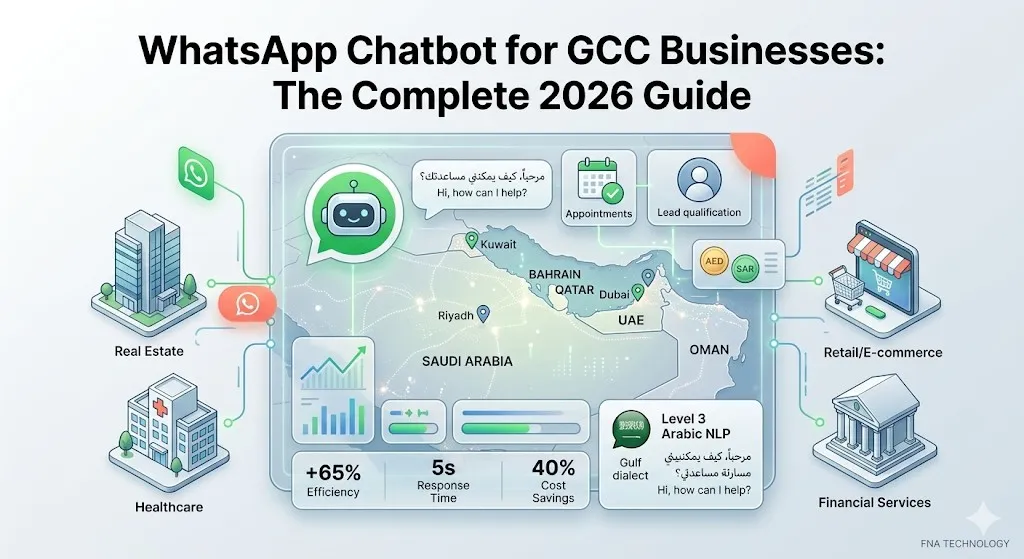
The short version: WhatsApp reaches over 90% of the GCC population. Businesses that automate their WhatsApp channel with a properly built chatbot reduce first-response time to under 5 seconds, qualify leads 24/7, and cut support volume by 40–60%. This guide covers everything you need to know to get there.
WhatsApp is not just a messaging app in the GCC — it is the primary channel for customer communication, business enquiries, appointment bookings, and support. Understanding how to build a WhatsApp chatbot that works for the GCC market specifically is different from following a generic global guide.
Most businesses arrive at WhatsApp automation after realising that manual responses cannot keep pace with volume. Customers message on WhatsApp the same way they message friends — they expect a reply in minutes, not hours. A well-built WhatsApp chatbot handles that volume at any hour, qualifies leads before they go cold, and resolves routine queries without involving your team at all.
- WhatsApp messages have an open rate above 95% in the GCC, compared to 20–25% for email
- 70%+ of UAE customers prefer to contact businesses via WhatsApp over phone or website chat
- Response time expectations on WhatsApp are under 5 minutes — a threshold most businesses cannot meet with human agents alone during peak hours
- Properly built WhatsApp chatbots in the GCC typically reach 60–75% automation within 90 days of deployment
This guide covers how WhatsApp chatbots work in the GCC market, what they cost in AED, which use cases produce real returns, and how Arabic language support actually functions in production.
Why WhatsApp is the #1 Business Channel in GCC
WhatsApp penetration across the GCC exceeds 90% of the active internet-using population. In the UAE, it is the default communication channel for both personal and business use — customers routinely message businesses on WhatsApp the same way they message friends. This is not the case in most Western markets, where WhatsApp is one channel among many.
For GCC businesses, WhatsApp is not a supplementary channel. It is where your customers already are, and where they expect immediate responses. A business that takes two hours to respond on WhatsApp loses the lead to a competitor that responds in two minutes. At scale, that gap is not closable with human teams alone.
The businesses seeing the strongest returns from WhatsApp automation are the ones that treat it seriously — building proper conversation flows, integrating with their backend systems, and investing in Arabic language quality from the start rather than bolting it on later.
WhatsApp Chatbot vs. WhatsApp Business: What's the Difference?
This distinction matters before spending any budget.
WhatsApp Business (free app)
- Designed for very small businesses — one device, manual responses
- Can set automated away messages and quick replies
- Cannot run a real chatbot — no API access, no CRM integration, no multi-agent support
- Works fine for businesses receiving under 20 messages per day
WhatsApp Business API
- Designed for medium-to-large businesses with message volume
- Enables full chatbot automation, AI-powered responses, and conversation routing
- Connects to your CRM, booking system, or product catalogue
- Supports multiple agents handling conversations simultaneously
- Requires an approved business account and an API integration partner
- Has per-conversation pricing from Meta (covered in the cost section below)
| Feature | WhatsApp Business App | WhatsApp Business API |
|---|---|---|
| Chatbot automation | No | Yes |
| Multi-agent support | No | Yes |
| CRM integration | No | Yes |
| Arabic NLP | No | Yes (if built correctly) |
| Cost | Free | API fees + build cost |
| Approval required | No | Yes (3–7 days) |
If you want to automate customer conversations on WhatsApp, you need the API. The free app is not a path to automation.
Step-by-Step: Setting Up a WhatsApp Chatbot for Your Business
Setting up a WhatsApp chatbot for a GCC business follows a consistent sequence. The steps are straightforward; the quality of execution at each step is what separates bots that hold up in production from ones that frustrate customers and get abandoned.
Get WhatsApp Business API access. Apply through Meta's Business Manager with a verified account, a phone number not already registered to WhatsApp, and a business display name that matches your registered entity. Approval takes 3–7 business days. Working with an API partner speeds this up as partners have established approval relationships.
Define your use cases before building anything. The most effective GCC deployments focus on two to three high-volume use cases — lead capture and qualification, appointment booking and reminders, FAQ and product enquiries, or document collection. Trying to automate everything at once produces a bot that handles nothing well. Start focused, measure results, then expand.
Design conversation flows that account for GCC context. Map each use case as a conversation flow — what the customer says, what the bot responds, what happens at each branch point, and when to escalate to a human agent. For GCC businesses this must account for Arabic-first interactions, Gulf dialect variations, code-switching between Arabic and English mid-conversation, and cultural communication norms that differ from Western chatbot templates.
Build and integrate. This is where the technical work happens: NLP model and conversation logic, WhatsApp Business API integration, CRM or booking system connection, escalation and human handoff configuration, and analytics setup. The integration layer is what makes the chatbot genuinely useful rather than a sophisticated FAQ page.
Test with real Arabic queries. Test the bot against real customer messages, not scripted test cases. GCC customers send short, colloquial messages that differ significantly from formal Arabic or English. A bot that passes scripted tests frequently fails on real production queries. Native Arabic speakers should test every flow before go-live.
Launch and optimise. Go live, monitor conversation data closely for the first 30 days, and iterate. The first month always surfaces gaps between training data and actual customer language. Build the optimisation cycle into your project plan from the start.
The most common failure in WhatsApp chatbot projects is not the AI. It is that the bot was designed around ideal test scripts, not how GCC customers actually communicate on WhatsApp. We have never fixed that problem by upgrading the model.
WhatsApp Chatbot Use Cases for GCC Industries
Customer enquiry handling is the highest-volume use case across all GCC sectors. A properly built WhatsApp chatbot handles the same 15 questions your team answers every day — without involving your team. The support function stops being a bottleneck and starts being a competitive advantage.
Real estate is the highest-adoption industry for WhatsApp chatbots in the GCC. Developers and agencies handle hundreds of property enquiries daily — bots qualify buyers by budget, location preference, and property type, then book viewing appointments automatically. Response time for property enquiries drops from hours to seconds. In a market where the first agent to respond often wins the lead, that speed advantage is material.
Healthcare clinics and hospitals across the UAE use WhatsApp chatbots for appointment booking, reminders, and basic triage. Patients prefer WhatsApp over phone calls for scheduling. Automated reminders reduce no-show rates significantly. Arabic language support is not optional in this sector — many patients communicate exclusively in Arabic, and a bot that cannot handle that properly is worse than no bot.
Retail and e-commerce businesses use WhatsApp chatbots for order status updates, product queries, returns initiation, and promotional broadcasts to opted-in customers. During peak periods — Ramadan, National Day sales — chatbots handle volume spikes that would overwhelm human teams. A retailer we supported handled three times normal enquiry volume during a Ramadan campaign without adding headcount.
Financial services firms use WhatsApp chatbots for lead qualification, document collection, and customer onboarding. Compliance design — explicit opt-in, data handling, audit trails — must be built in from the start, not retrofitted. The firms that get this right treat compliance as a feature, not a constraint.
Government and semi-government entities are a growing sector in the UAE. WhatsApp appointment booking, document status updates, and service information in Arabic and English. Arabic-first is mandatory here, which rules out most generic platforms.
How Much Does a WhatsApp Chatbot Cost in UAE?
WhatsApp chatbot costs in the UAE have two components: the build cost and the ongoing API conversation fees from Meta.
Build Cost
| Bot Type | Description | Approximate Cost (AED) |
|---|---|---|
| Basic WhatsApp Bot | Single use case (FAQ or lead capture), English only | 12,000–18,000 |
| Standard WhatsApp Bot | 2–3 use cases, Arabic + English, basic CRM connection | 20,000–35,000 |
| Enterprise WhatsApp Bot | Full Arabic NLP, multi-use-case, deep CRM + backend integration | 40,000–80,000+ |
| SaaS Platform (monthly) | Yellow.ai, Freshchat, etc. — limited Arabic, no custom integration | 370–3,680/month |
WhatsApp API Conversation Fees (Meta Pricing)
Meta charges per conversation, not per message. A conversation is a 24-hour window of messages.
| Conversation Type | Approximate Cost (AED) |
|---|---|
| Marketing (business-initiated promotional) | ~0.55 per conversation |
| Utility (order updates, appointment reminders) | ~0.18 per conversation |
| Service (customer-initiated support) | ~0.14 per conversation |
For a business handling 1,000 customer conversations per month, API fees are roughly AED 140–550 depending on conversation mix — a small cost relative to the labour hours saved.
Total Cost of Ownership
A standard bilingual WhatsApp chatbot at AED 25,000 build cost, handling 2,000 conversations per month at an average of AED 0.20 per conversation (AED 400/month), typically pays back within 6–12 months for any business where a human agent costs more than AED 2,500 per month to handle that volume. Get a written breakdown of what is included after go-live before signing anything — post-launch maintenance and retraining are recurring costs that credible partners will confirm upfront.
Arabic Language WhatsApp Bots: What to Expect
Arabic language support is where most generic WhatsApp chatbot platforms fail GCC businesses. There are three levels, and they are not equivalent.
RTL text rendering only. The bot displays Arabic script correctly (right-to-left). But the NLP — the understanding of what the customer means — is still English-based. The bot cannot reliably interpret Arabic intent. Most SaaS platforms are at this level and claim "Arabic support."
Modern Standard Arabic (MSA) NLP. The bot understands formal Arabic text. Better for written, formal queries. Still struggles with Gulf dialect expressions that GCC customers actually use in casual business messaging on WhatsApp.
Gulf dialect and Arabic-English code-switching. The bot understands Khaleeji dialect, recognises colloquial expressions, and handles messages that mix Arabic and English naturally — which is extremely common in UAE and GCC business communication. This is what a properly built custom Arabic chatbot delivers.
If your customers primarily communicate in Arabic, the third level is what you need. The gap in customer satisfaction between Level 1 and Level 3 is significant and visible in CSAT scores within the first month of operation. I have reviewed deployments where businesses assumed their platform's Arabic support was sufficient, only to find the bot failing on the most common queries their customers actually sent.
Want to see what production-grade Arabic support looks like? Test our live Arabic + English WhatsApp chatbot — no sign-up required.
Compliance: UAE TRA and WhatsApp Business Policies
GCC businesses using WhatsApp Business API must comply with two overlapping frameworks, plus UAE data protection law. Build compliance in from the design phase. Retrofitting is expensive and frequently requires rebuilding conversation flows.
The UAE Telecom Regulatory Authority (TRA) regulates business messaging in the UAE. Businesses must obtain explicit opt-in consent before sending messages to customers, customers must be able to opt out at any time with a clear mechanism, and unsolicited promotional messages are prohibited and can result in account suspension.
Meta's WhatsApp Business Policy adds further requirements: no messaging customers who have not opted in, message templates for business-initiated conversations must be pre-approved by Meta, and accounts violating policies can be banned without appeal. The industries with prohibited use cases include certain financial products, gambling, and adult content.
The UAE Personal Data Protection Law (PDPL), effective September 2023, governs how customer conversation data is collected, stored, and processed. For WhatsApp chatbots this means documenting what data the chatbot collects and why, ensuring data is stored securely with defined retention periods, and having a process for customers to request data deletion.
Measuring Success: KPIs for Your WhatsApp Bot
Set these KPIs before launch so you have a baseline to measure against. A well-built WhatsApp chatbot for GCC businesses typically reaches 60–75% automation within three months of deployment, after real-world adjustments to conversation flows and NLP training. Expect the first four weeks to surface gaps between your training data and how customers actually communicate. That is normal. What matters is whether your partner has a process for closing those gaps systematically.
| KPI | What It Measures | Target Benchmark |
|---|---|---|
| Automation rate | % of conversations fully resolved by the bot without human intervention | 60–75% by month 3 |
| First response time | Time between customer message and bot reply | Under 5 seconds |
| Containment rate | Conversations handled end-to-end without escalation | Above 55% for well-scoped use cases |
| Lead qualification rate | % of enquiries that become qualified leads | 15–30% (industry dependent) |
| Opt-out rate | % of customers who opt out after first contact | Under 3% — higher indicates messaging is off-target |
| CSAT (bot sessions) | Customer satisfaction score for bot-handled conversations | Within 15% of your human-agent benchmark |
Review these monthly for the first quarter. Most bots improve significantly between weeks 4 and 12 as conversation flows are refined against real data. Bots that are not monitored and actively updated degrade — product changes, new service lines, and shifts in customer language affect accuracy and resolution rates over time. Build post-launch iteration into your contract.
Build Your GCC WhatsApp Chatbot
AI Chatbot Development
Custom chatbots for the GCC market on WhatsApp and web — Arabic NLP, WhatsApp Business API, lead qualification and support automation.
Arabic AI Chatbot
Bilingual Arabic + English chatbots with Gulf dialect NLP. Built for real GCC customer conversations, not translated templates.
Frequently Asked Questions
Get Your WhatsApp Bot Built by GCC Experts
Building a WhatsApp chatbot that works for GCC customers — Arabic language, WhatsApp-first, compliant with UAE TRA guidelines — requires more than configuring a global SaaS template. Our Arabic chatbot team works with businesses across the GCC to scope and build bots that hold up in production. Contact us to discuss your use case, or try our live WhatsApp chatbot demo to see exactly what a production-grade GCC chatbot looks like before committing to anything.

Written by
Arun Pandit
CEO & Founder
CEO & Founder of FNA Technology. Specializing in AI, automation, and scalable software solutions — helping businesses leverage cutting-edge technology to drive growth and innovation.
Work with us