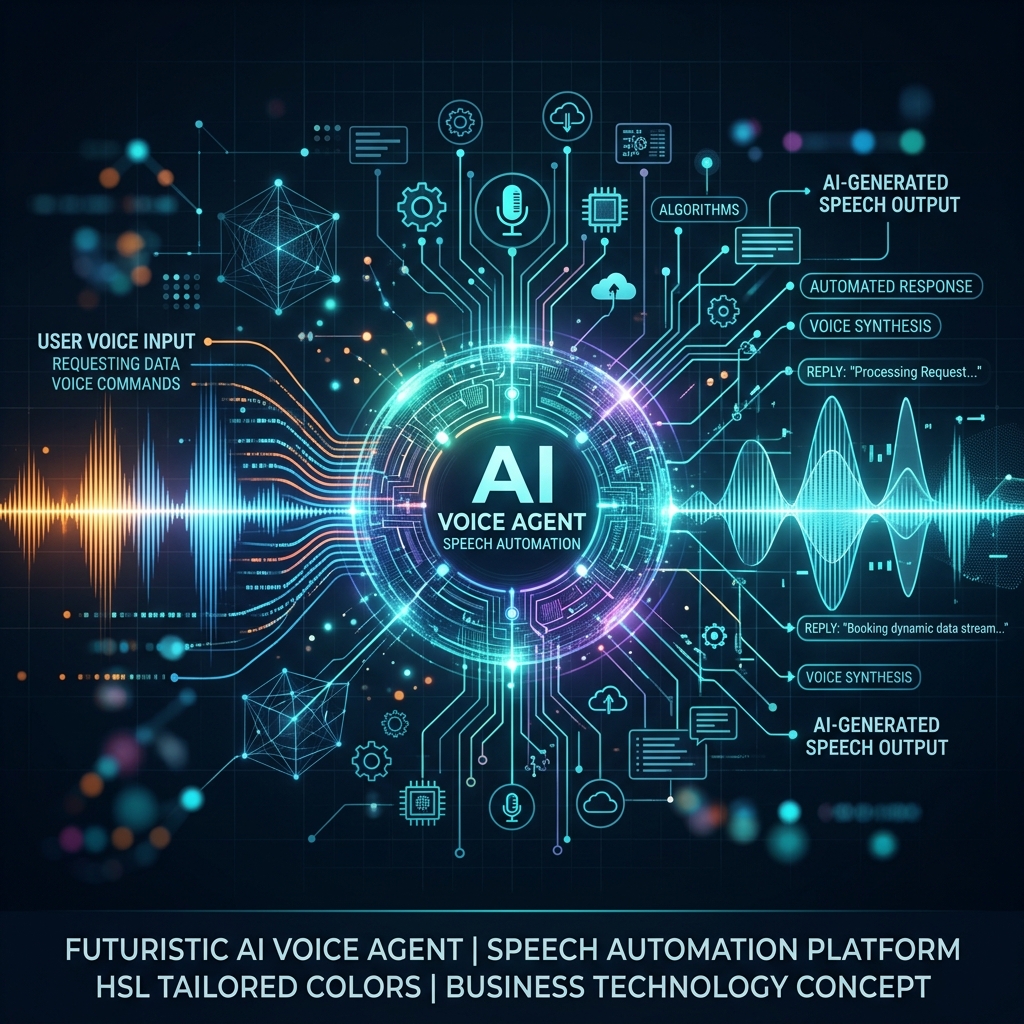
Short version: An AI voice agent answers phone calls in natural speech, works out what the caller wants, and acts on it: it books an appointment, checks an order, or routes to a person. It chains speech recognition, a language model, and synthesized speech over a phone line.
Phones still convert. A customer who calls usually wants something now, and a missed or queued call is a lost job. An AI voice agent picks up every time, talks like a person, and does the task end to end. This guide covers how a voice agent actually works, the parts a production build needs that demos quietly skip, how to build one, and what it costs in 2026.
We build custom AI voice agents and bilingual (Arabic and English) phone assistants for a living, so the engineering notes below come from shipped calls, not a spec sheet. Where a number is ours, we say so.
What is an AI voice agent?
An AI voice agent is software that answers or makes phone calls, holds a spoken conversation in natural language, and completes a task. It listens to the caller, works out what they want, and takes an action: books a slot, looks up an account, answers a question, or transfers the call to a human when the request needs one.
The difference from the old phone tree is the point. An IVR menu makes the caller press 1 for sales and 2 for support, and it breaks the moment the caller talks instead of presses. A voice agent listens to free speech. Say "I need to move my Thursday appointment to next week" and it treats that as a reschedule, not an unmatched key.
How do AI voice agents work?
A voice agent is a loop of three jobs running over a live phone call, fast enough that the caller never feels the machine in between.
- Speech-to-text (STT). The caller's audio is transcribed to text in real time as they speak.
- The language model (the brain). The text goes to a language model that decides what the caller means and what to do: answer, ask a follow-up, call your booking system, or escalate. This is where your business rules and the connections to your systems live.
- Text-to-speech (TTS). The model's reply is spoken back in a natural voice, streamed so the caller hears it begin almost immediately.
That STT to model to TTS loop runs once per turn, every time the caller speaks. The whole thing sits on top of a phone line through a telephony provider, so the agent can be reached on a normal number. The engineering challenge is not any single step. It is doing all three in the rhythm of a real conversation, which is where most demos that sound great fall apart on a live call.
What does a production AI voice agent really need?
This is the section most "how to build a voice bot" content skips, because it is where the work actually is. A weekend prototype can chain three APIs. A voice agent you put on your main phone line has to survive real callers. Five things separate the two.
Low latency. In a phone conversation, a reply that lands more than roughly a second after the caller stops talking feels broken. People start repeating themselves or talking over the agent. Hitting that means streaming the speech-to-text, the model, and the text-to-speech instead of waiting for each to finish, and choosing models fast enough to keep the round trip tight. Latency is the single thing that most often decides whether a voice agent feels real or feels like a bad robot.
Interruption handling (barge-in). Real people interrupt. They cut in with "no, the other branch" while the agent is still talking. A usable agent stops speaking the instant the caller starts, listens, and picks up the new intent. An agent that talks over the caller, or ignores the interruption and finishes its scripted line, fails the call. This is hard, and its absence is the clearest tell of a cheap build.
Telephony that holds up. The agent has to live on an actual phone number through a carrier or telephony provider, handle calls that drop, manage hold and transfer, and deal with the messiness of real audio: background noise, bad lines, people on speakerphone in a car. Web-demo audio is clean. Phone audio is not, and the agent has to work on phone audio.
A clean human fallback. A voice agent that cannot recognise its own limits is dangerous on a real line. It needs to know when it is stuck, when the caller is upset, or when the request is outside its job, and warm-transfer to a person with the context of the call already passed along, not dump the caller back to a cold queue. Designing the handoff is as important as designing the conversation. The agent's job is to handle the routine calls well and get out of the way fast on the ones it should not touch.
Guardrails and grounding. The agent must answer from your real data (your calendar, your prices, your policies) and not invent an answer when it does not know. On a phone call there is no link to click and check, so a confident wrong answer does real damage. Production builds constrain the model to verified facts and have it say "let me get someone who can confirm that" rather than guess.
How do you build an AI voice agent? (7 steps)
Here is the build as we run it, whether the result is a single-purpose receptionist or a full bilingual phone assistant.
- Define the job and the calls it should not take. Write down exactly what the agent handles: book, reschedule, answer the top questions, take a message. Just as important, write down what it must hand to a human. The scope is the product; everything else is downstream of it.
- Map the real conversations. Use actual call recordings or transcripts if you have them. Capture how people really ask, including the messy phrasings, the interruptions, and the questions that should trigger a transfer. A voice agent designed off a tidy script breaks on real callers.
- Wire up the voice loop. Connect speech-to-text, the language model, and text-to-speech, streaming each so the round trip stays under that one-second feel. Pick a voice that fits your brand and, if you serve more than one language, that handles each one naturally.
- Connect it to your systems. A voice agent that cannot read your calendar or write to your CRM is an answering machine. This is the step that makes it useful. Wire it to your booking system, CRM, or order system so it does the task, not just talks about it.
- Build interruption handling and human handoff. Make the agent stop on barge-in, and define every escalation path: when it transfers, to whom, and what context goes with the call. Test these deliberately, because they are what protect the customer relationship.
- Set up the phone number and telephony. Provision the number through a telephony provider, handle inbound (and outbound, if needed), and test on real lines with real noise, not just clean studio audio.
- Test on hard calls, then launch and tune. Run the agent against angry callers, mumbled requests, accents, background noise, and the calls it should refuse. Listen to the first weeks of live calls and tune from there. Launch is the start of the work, not the end of it.
Across our projects, a focused voice agent like this goes live in about two weeks and handles roughly 80% of incoming calls on its own, with the rest warm-transferred to a person. Those figures are from our own delivery, not an industry average; yours depend on how varied your calls are.
Where do businesses use AI voice agents?
The pattern is the same everywhere: high call volume, repetitive requests, and a cost to every missed or queued call. The agent takes the routine calls so people handle the ones that need a person.
| Industry | What the voice agent does |
|---|---|
| Clinics and dental | Books, reschedules, and confirms appointments; answers hours and location; transfers clinical questions to staff |
| Home services | Captures job requests after hours, qualifies the lead, and books the visit so no call goes unanswered |
| Restaurants and hospitality | Takes reservations and waitlist requests, answers menu and timing questions, frees the front desk during the rush |
| Real estate | Qualifies inbound buyers and renters, answers listing questions, and books viewings into the agent's calendar |
| Retail and e-commerce | Handles order status, returns, and store-hour calls; routes complex cases to a person |
| Logistics and field service | Confirms deliveries, reschedules, and answers tracking calls without tying up a dispatcher |
In each case the test is the same: does the agent remove routine call work and book the thing, in the caller's language, at the hour they actually call. An agent that only says "please hold for the next available representative" fails that test.
How much does an AI voice agent cost?
Cost has two parts: the running cost of the calls and the build itself.
The running cost. A voice agent pays per minute of conversation across the pieces it uses: speech-to-text, the language model's tokens, text-to-speech, and the telephony minutes. The total is usually a small amount per minute of call, set by the models and the call volume. Higher quality voices and faster models cost more per minute, which is a real trade-off against how human the agent should sound.
The build. A simple single-task agent on a self-serve platform is a lower monthly cost with limited integration. A custom build that connects to your systems, handles two languages, and gets interruption and handoff right is a one-time project cost that scales with the integrations and languages involved. The trade is the familiar one: rent something generic, or own something that fits your calls.
Template platform vs custom build: which do you need?
Most guides sell one side of this. Here is how we tell businesses to decide.
| Factor | Template / self-serve agent | Custom-built voice agent |
|---|---|---|
| Best for | One simple task, one language, light volume | Real automation, integrations, high or critical call volume |
| Time to live | Hours to days | About two weeks (our typical build) |
| Integrations | The platform's built-in connectors only | Any system with an API (CRM, booking, ERP) |
| Languages | Usually one, English-first | Bilingual or more, including Arabic |
| Interruption handling | Often basic or absent | Built and tuned for real calls |
| Human handoff | Cold transfer, if any | Warm transfer with call context passed along |
| Ongoing cost | Monthly subscription plus usage | Usage plus a one-time build and support |
| You own | A configuration | The agent and its logic |
The plain rule: if you need to answer the same few questions or book one kind of slot in one language, a self-serve agent is the right, cheap answer. If the phone is a main way customers reach you, the calls vary, or you need two languages and a clean handoff, a template will frustrate callers within a month. We have rebuilt voice agents for businesses that outgrew a template; starting custom would have cost less than the rebuild.
What does a real AI voice agent look like in practice?
We build bilingual voice agents that take calls in Arabic and English, understand what the caller wants, act on it through the business's own booking or CRM system, and transfer to a person when a call needs one. The point of those builds is never the novelty of a talking bot. It is that a customer who calls at an awkward hour gets a real answer in their own language and gets the appointment booked, without a person tied to the phone for every routine call.
That is the bar we hold a build to: does it handle the routine call well, in the caller's language, and get out of the way cleanly on the calls it should not take.
Build Your AI Voice Agent & Chatbot
AI Chatbot & Voice Agent Development
Custom, production-grade AI voice agents and chatbots in Arabic and English, integrated with your phone lines, booking systems, and CRM.
Arabic AI Chatbots & Phone Assistants
Custom AI assistants built for the GCC market — native Gulf Arabic NLP, bilingual phone integrations, and automated lead qualification.
Frequently Asked Questions
Ready to build your AI voice agent?
If you know what your callers ask and which systems you run, we can scope a bilingual AI voice agent or phone assistant that handles the repetitive work and routes complex requests. Most custom builds are live in about two weeks. Contact the FNA Technology team to start with a discovery call, or explore our AI chatbot development service to see how we build conversational assistants for production.