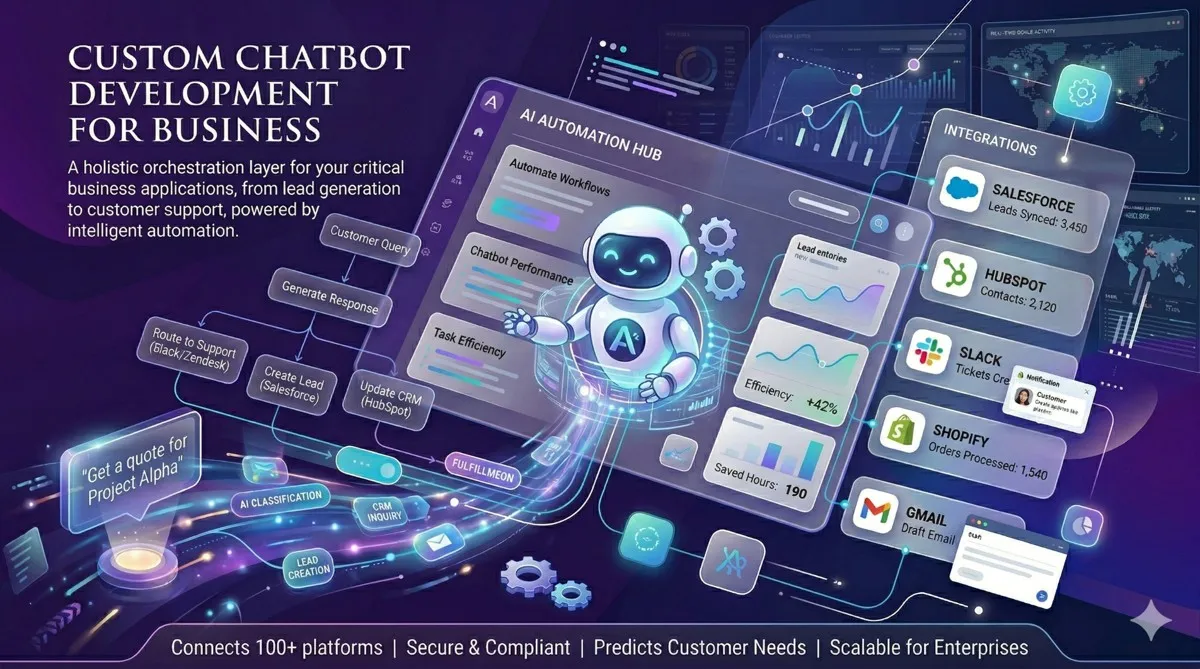
The short version: Custom chatbot development builds AI conversation systems around your specific workflows and data — not generic templates. The most common failure point is conversation design built on test scripts instead of real customer messages. Expect 6–18 weeks to deploy and 65–80% automation rates by month three in well-scoped projects.
Custom chatbot development builds AI conversation systems around your specific workflows, customer queries, and backend systems — not a generic template with your logo on it. The difference shows up in production, not in demos.
Most businesses arrive at custom development after a simpler approach failed. A generic chatbot that handles FAQs from a competitor's template. A widget that gives canned replies. A tool that looked good in a sandbox and confused real customers on day one. Custom chatbot development starts from a different place: your actual customer messages, your data, your systems. The result is a chatbot that handles specific workflows reliably rather than everything poorly.
- Custom-built chatbots resolve 70–90% of routine queries in well-scoped deployments — generic bots average 30–50%
- Businesses typically see a 40–60% reduction in first-contact support volume within 90 days of a properly built chatbot going live
- Integration with your CRM, knowledge base, or booking system is what separates a useful chatbot from a frustrating one
- The global chatbot market is forecast to reach $27.3 billion by 2030 (Grand View Research, 2024)
| Capability | Off-the-shelf chatbot | Custom chatbot development |
|---|---|---|
| Query handling | Generic FAQ patterns | Trained on your actual customer messages |
| Backend integration | Limited connectors, often read-only | Full CRM, OMS, and knowledge base write access |
| Escalation logic | Simple keyword triggers | Context-aware handover with full conversation history |
| Ongoing training | Vendor-managed model updates | Retraining on your production query data |
| Automation rate | 30–50% for generic queries | 65–80% for well-scoped use cases by month 3 |
| Typical cost | $50–500/month SaaS | $15k–150k+ build, then ongoing maintenance |
What is custom chatbot development for business?
Custom chatbot development means building a conversation system designed around your specific workflows, customer queries, and backend systems. Configuring a SaaS chatbot with your logo is not custom development. Neither is plugging in a pre-trained model and hoping it handles your edge cases.
The distinction matters in production. Generic chatbot tools perform reasonably on generic queries. The problems start when a customer asks about their specific order, why their renewal quote changed, or whether an appointment covers what they actually need. Those questions require access to your data. Professional AI chatbot development services build the integrations and conversation logic that make real answers possible — not pre-written scripts that fall apart at the first unexpected message.
Most businesses that come to us have already trialled an off-the-shelf product. The gap between the demo and production was wider than they expected.
Custom chatbot use cases that produce real returns
Customer support is the most common entry point for custom chatbot development for business. A well-built chatbot handles tier-1 queries (account questions, order status, policy FAQs) without human involvement, passing complex cases to agents with the full conversation context already captured. The support team stops answering the same 12 questions each day and focuses on cases that genuinely need them.
Lead qualification produces some of the fastest returns. A chatbot that asks the right questions (budget, timeline, specific requirement) before routing to sales means your team spends time on qualified opportunities rather than exploratory calls that go nowhere. In lead-heavy B2B services businesses, we have seen unqualified call volume drop by more than half within the first quarter after deployment.
The less obvious win is internal tooling. Organisations with large knowledge bases, complex internal processes, or high staff turnover use custom chatbots to answer internal queries: HR policy questions, IT support requests, compliance documentation. The reduction in internal email volume alone justifies the build for some businesses.
Across industries, the pattern holds. E-commerce businesses use custom chatbot development for product recommendations, returns initiation, and post-purchase support. A healthcare practice we supported reduced appointment admin time by 35% within two months of deploying a triage and scheduling chatbot. Financial services firms use chatbots for customer onboarding and document collection, with compliance design built in from the start. For businesses where WhatsApp is already a primary customer channel, our AI chatbot development service covers that channel as part of a broader chatbot strategy.
If your use case is answering three FAQs on a contact page, custom chatbot development is not the right call. The returns come from volume and workflow complexity.
What custom chatbot development services should include
A properly scoped engagement covers more than building a chat interface. The most consequential decisions happen in the design phase, before any code is written. Businesses that skip discovery and go straight to build almost always come back to redesign within six months.
A serious chatbot project runs through six stages. Vendors who skip stages 1 and 2 are where bad projects come from:
- Use case discovery and real message analysis — review 3–6 months of actual customer messages (support tickets, chat logs, emails) to identify true query patterns and edge cases. This takes 1–2 weeks and determines whether the project is viable.
- Conversation flow mapping — design conversation trees based on discovered patterns, not assumed ones. Define escalation triggers and handover protocols before writing a line of code.
- NLP model selection and domain training — choose between fine-tuning an existing LLM (GPT-4o, Claude, Gemini) or intent classification on a smaller model. The choice depends on query complexity and latency requirements.
- Backend integration development — connect the bot to your CRM, booking system, product catalogue, or knowledge base via API. This is usually the longest stage for complex stacks.
- Testing against real production data — run the bot against historical messages it hasn't seen. A bot that handles 85% of your test set but struggles with the real query distribution is not ready.
- Post-launch monitoring and retraining — the first 30 days will surface failure patterns the test set didn't catch. Budget for this explicitly.
The most common failure in chatbot projects is not the AI. It is that the bot was designed around test scripts, not real customer messages. We have never fixed that problem by upgrading the model.
Factors that affect custom chatbot development cost
Custom chatbot development costs vary based on conversation scope, integration complexity, channel requirements, and the experience of your development partner. Understanding what drives cost helps you scope a project correctly and avoid low-ball proposals that leave out the parts that make the chatbot actually work.
Request a scoped proposal, not a fixed quote. A credible chatbot development service will map your use cases and technical requirements before pricing. Not price before understanding what you need.
| Cost Factor | Why It Matters | Complexity Impact |
|---|---|---|
| Conversation scope | Number of intents, query types, and edge cases the chatbot must handle. More depth requires more design and training effort. | High |
| Backend integrations | Connecting to CRMs, databases, booking systems, or product catalogues adds significant development and ongoing maintenance | High |
| NLP sophistication | Basic intent matching requires far less engineering than full natural language understanding with entity extraction and context retention | High |
| Number of channels | Building for website only is simpler than deploying across website, WhatsApp, mobile app, and internal tools simultaneously | Medium |
| Compliance requirements | Regulated industries (healthcare, financial services, legal) require additional design, testing, and documentation | Medium |
| Ongoing support | Post-launch retraining, conversation updates, and integration maintenance are recurring costs that must be confirmed upfront | Ongoing |
The right chatbot development service will walk you through post-launch obligations before you sign. If they cannot answer what is included after go-live, that tells you what you need to know about how they work.
How to choose the right AI chatbot development company
Ask to interact with a live chatbot they have built and deployed. Not a prototype. Not a sandbox environment. A production system serving real users right now. If an AI chatbot development company cannot point you to one, they have not shipped at scale.
Ask how they handle the gap between training data and production queries. Every chatbot underperforms in the first weeks because real customer language differs from scripted test cases. A credible partner has a process for closing that gap through monitoring and retraining. One that does not will charge you again to fix it.
Check their integration experience specifically. The conversation layer of a chatbot is the visible part. The value is in what the chatbot can actually do. That depends entirely on how well it connects to your systems. Ask for examples of integrations they have built for similar platforms.
Confirm their data handling approach. Custom chatbots process customer conversations that contain personal data. Your development partner needs a clear data processing agreement, a documented retention policy, and an understanding of your regulatory context.
I have reviewed deployments from agencies whose demos were technically impressive and whose production systems were not. The difference was almost always in how much time they spent on conversation design and real-world testing before go-live.
Is custom chatbot development right for your business?
It works well if you:
- Handle high volumes of repetitive customer queries that follow predictable patterns
- Have teams where response delays are losing leads, generating complaints, or consuming disproportionate staff time
- Already use backend systems (CRM, booking platforms, databases) that the chatbot can connect to and act on
- Are willing to monitor performance and iterate on the chatbot after launch. It is not a set-and-forget product
It may not be the right fit if you:
- Have low query volume where the development investment will not pay back within a reasonable timeframe
- Need specialist expertise or genuine unpredictability in every customer conversation
- Want to replace human relationships entirely — customers recognise automation, and poorly implemented chatbots damage trust faster than slow human response
- Have no backend systems to integrate with — a chatbot that can only answer static FAQs does not need to be custom-built
- Need a chatbot live in under four weeks without time for proper conversation design — rushed builds fail in production
How to measure custom chatbot performance
A well-built chatbot typically reaches 65–80% automation within three months, after real-world adjustments to conversation flows and NLP training. Expect the first four weeks to surface gaps between your training data and how customers actually communicate. That is normal. What matters is whether your development partner has a structured process for closing those gaps — not just a promise to "monitor and improve."
Bots that aren't monitored and actively updated degrade. Product changes, new service lines, and shifts in customer language affect accuracy and resolution rates over time. Post-launch iteration belongs in your contract, not as an optional line item.
| Metric | What it measures | Healthy benchmark |
|---|---|---|
| Automation rate | Conversations fully resolved without human involvement | 65–80% by month 3 |
| First response time | Time between customer message and chatbot reply | Under 5 seconds |
| Containment rate | Conversations handled end-to-end without escalation | Above 60% for well-scoped use cases |
| Escalation quality | Handovers include full context and correct routing | 95%+ of handovers include complete conversation history |
| CSAT on automated sessions | Customer satisfaction on bot-handled conversations | Within 10–15% of your human-agent benchmark |
If you are deciding between subscribing to an off-the-shelf platform or building custom, see our build vs buy AI chatbot decision framework. If your business is evaluating AI beyond conversational retrieval into autonomous action execution, our AI agent vs chatbot comparison and agentic AI for B2B support guides cover where each architecture delivers ROI.
Explore Our Chatbot Services
Frequently Asked Questions
Ready to build your custom chatbot?
Looking to move forward with custom chatbot development for your business? Our AI chatbot development team works with businesses across industries to scope and build chatbots that hold up in production. Contact us to discuss your use case and get a proposal built around what you actually need.