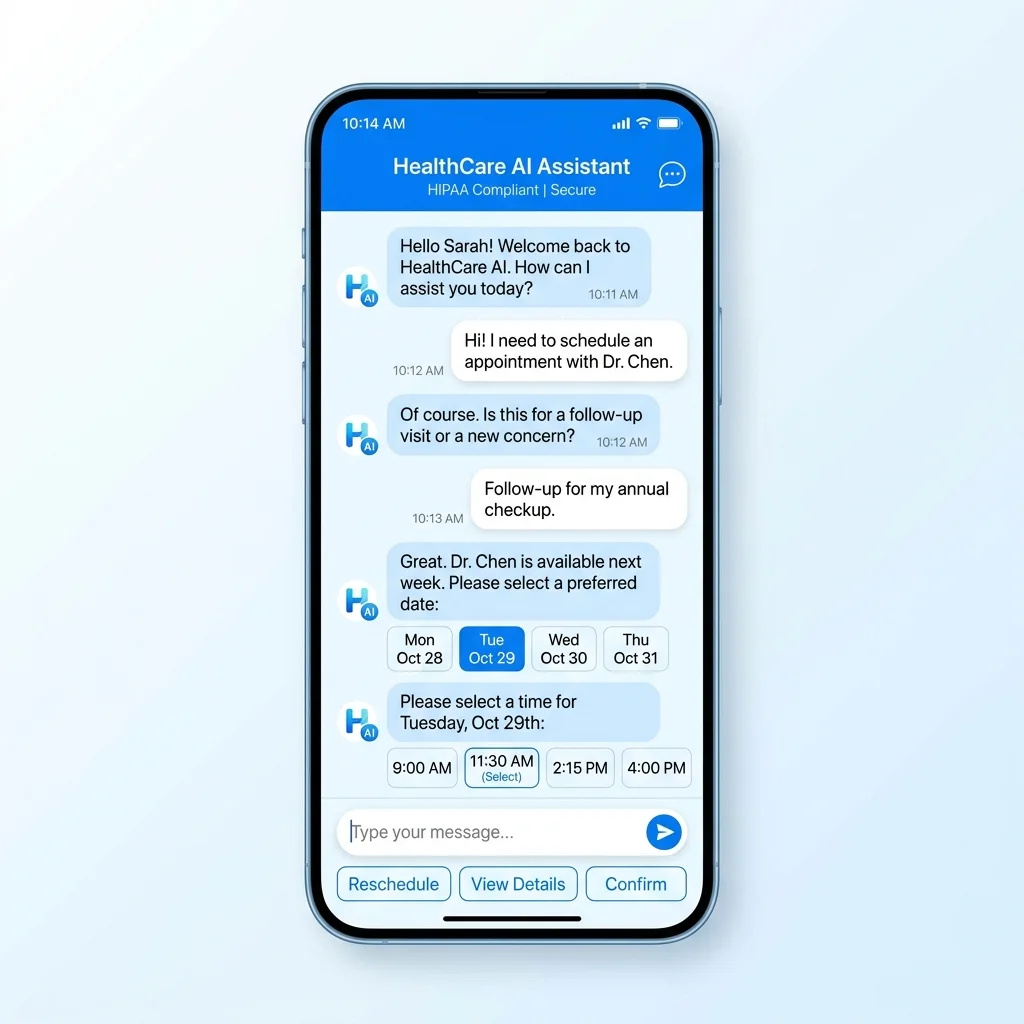
Short version: An AI chatbot for healthcare automates scheduling, triage, and administrative tasks, saving health systems up to 35% in staff time and cutting no-shows by 25–50%. When deployed with a signed BAA and end-to-end encryption, these systems maintain full HIPAA compliance.
An AI chatbot for healthcare is a conversational application that automates patient support, appointment scheduling, and triage while maintaining HIPAA compliance. By integrating directly with electronic health records (EHR), these agents handle high-volume administrative tasks to reduce front-desk workload and improve patient access.
Healthcare front desks are drowning. Patients still hear a busy tone or reach a voicemail box that nobody checks until Tuesday, while staff spend hours a day answering the same five questions about parking, insurance, and appointment times. Meanwhile, patients now expect the same instant, always-on service they get from their bank or airline.
Done correctly, it becomes a 24/7 digital front door (scheduling visits, answering FAQs, triaging symptoms, and sending reminders) without exposing a single byte of protected health information (PHI) to risk. Done carelessly, it can turn into a patient-safety incident or a six-figure HIPAA liability.
This guide covers where a healthcare AI chatbot earns its keep, documented ROI numbers from named health systems, exactly what "HIPAA-compliant" means in practice, the EHR integration reality, the real risks regulators are flagging in 2026, and a build-vs-buy framework.
What Is an AI Chatbot for Healthcare?
A healthcare AI chatbot is a conversational software agent, deployed on your website, patient portal, SMS, or WhatsApp, which uses natural language processing to understand patient questions and respond, book, or escalate accordingly. Unlike a generic customer-service bot, a properly built healthcare chatbot is designed around clinical risk levels where routine questions get automated answers, ambiguous symptoms get triaged, and anything urgent is routed straight to a human.
The market reflects how fast this shift is happening. Industry analysts project the global healthcare chatbot market to grow from roughly $1.17 billion in 2024 to more than $12 billion by 2034, driven largely by appointment scheduling, patient engagement, and clinical support automation. Separately, Juniper Research estimates chatbot automation of high-volume, low-judgment healthcare tasks (scheduling, reminders, record retrieval, and insurance queries) is already saving the healthcare industry $3.6 billion annually. That kind of measurable savings is why adoption has moved from pilot programs to standard operating procedure at major health systems.
Where Do Healthcare Chatbots Deliver the Most Value?
1. AI Appointment Scheduling for Healthcare
This is the single highest-ROI use case. A well-integrated scheduling bot lets patients book, reschedule, or cancel visits at 2 a.m. without waiting on hold. Connected to your practice management or EHR system, the bot checks real provider availability, confirms insurance eligibility, and sends automated SMS or email reminders to cut down no-shows.
The financial case is significant. No-shows currently cost the U.S. healthcare system an estimated $150 billion annually, with individual physician practices losing roughly $150,000 a year each to missed visits at a 15–30% no-show rate. Practices that deploy conversational AI for reminders and rebooking report no-show reductions of 25% to 38%, and one statistics roundup cites clinics using AI-driven scheduling seeing a 50.7% reduction in patient no-shows. Separately, industry benchmarking puts typical results at 35% fewer no-shows and roughly 30% less administrative staff time, with intake automation saving about 15 minutes per appointment.
2. Patient Triage and Symptom Routing
Triage chatbots ask structured questions about symptoms and use decision trees or clinical logic to route patients appropriately, including self-care advice, a scheduled visit, urgent care, or an immediate emergency escalation for red-flag symptoms. Platforms such as Buoy Health and HealthTap use this model to conduct preliminary consultations and connect patients to virtual doctors, and providers have reported this kind of routing helps reduce unnecessary emergency room visits.
A triage bot should never attempt to diagnose. Its job is classification and routing (not clinical judgment) and every response should be traceable to a verified clinical guideline rather than model improvisation.
3. Patient FAQ and Administrative Automation
Insurance questions, billing disputes, procedure prep instructions, visiting hours, and parking are repetitive queries that eat up enormous front-desk bandwidth. A well-scoped chatbot can deflect a large share of this volume automatically: one 2026 guide puts a properly scoped medical-practice chatbot at handling 30–50% of administrative call volume, freeing staff for complex, judgment-heavy interactions. Broader chatbot benchmarks report deflection rates as high as 85%+ of routine calls when the knowledge base is well maintained.
4. Prescription Refill Requests and Chronic Care Support
Chatbots can collect refill requests, verify identity, and route them to a pharmacist or physician for approval, while also sending medication adherence reminders and post-discharge follow-up check-ins, functioning like a digital care coordinator for chronic-disease management. This matters clinically as well as financially: a 2026 review of hybrid AI systems in post-discharge workflows found they reduced hospital readmissions by up to 25%, a figure that matters directly to reimbursement under value-based care models.
5. Patient Onboarding and Digital Intake
Digital intake forms delivered conversationally reduce paperwork friction and pre-populate records before the patient even arrives, cutting check-in time significantly compared to clipboard-and-pen intake, and feeding structured data straight into the EHR instead of requiring manual re-entry by staff.
Use Case vs. Risk Level
| Use Case | PHI Exposure | Implementation Complexity | Typical Time to Launch |
|---|---|---|---|
| General FAQs (hours, location, services) | None to low | Low | 1–2 weeks |
| Appointment scheduling & reminders | Moderate (needs OTP verification) | Moderate | 3–6 weeks |
| Prescription refill requests | Moderate–high | Moderate | 4–8 weeks |
| Symptom triage & routing | High | High | 8–16 weeks |
| Post-discharge check-ins | High | High (EHR-integrated) | 8–16 weeks |
Which Health Systems Have Successfully Deployed AI Chatbots?
The results are not theoretical. Several named deployments illustrate what is achievable:
- Northwell Health cut incoming call volume by 50% after deploying a scheduling chatbot, because patients who can self-serve routine tasks stop calling the front desk for them.
- Tampa General Hospital deployed a voice AI system in late 2025 and achieved a 58% reduction in patient wait times, handling appointment scheduling, prescription inquiries, and billing questions around the clock.
- Grewal Eye Institute used a WhatsApp-based scheduling chatbot to handle over 7,000 chats in 90 days, booking 1,646 appointments and generating $618,000 in pipeline revenue for a 675% ROI.
- Houston Methodist projects 25–50% cost savings across administrative workflows from chatbot-driven automation, redirecting staff time from repetitive data entry toward complex patient interactions.
Closer to home, FNA Technology built the Khedmah Chatbot, an AI-powered customer-support assistant for Oman's trusted digital services platform, handling real-time order and request tracking at scale. The same conversational-AI architecture (intent detection, secure data handling, and human handoff) is directly transferable to healthcare patient support, appointment management, and account queries.
Restructured Example: Structured Scheduling Workflows
To maintain HIPAA compliance and clinical accuracy, a structured conversational flow is superior to open-ended text input:
- Bot: "Would you like to book, reschedule, or check a symptom?" (Interactive quick-reply buttons)
- User clicks: "Book an appointment"
- Bot: "Are you a new or returning patient?"
- User clicks: "Returning"
- Bot: "Please verify your mobile number to receive a secure login PIN." This flow eliminates unstructured text fields where patients might share unnecessary PHI before identity verification is complete.
How Do You Integrate an AI Chatbot With an EHR System?
A chatbot that cannot see real provider availability or write back to the patient record functions only as an FAQ page. Real value comes from bi-directional integration with your practice management system or EHR. The integration path differs by platform. Epic's FHIR-based APIs generally make integration smoother than Cerner's HL7 interfaces, but either way you will typically need bi-directional sync for appointment updates and medication changes, plus real-time event triggers for lab results and scheduling changes. Practices evaluating vendors should also confirm compatibility with common scheduling platforms such as Athenahealth, NexHealth, or Zocdoc if those already anchor their workflow.
Budget accordingly: integration complexity, not conversation design, is usually what separates a two-week pilot from a four-month rollout.
How Do You Ensure a Healthcare Chatbot Is HIPAA-Compliant?
This is where most healthcare chatbot projects fail. HIPAA compliance is not a feature toggle; it is a set of contractual, technical, and procedural obligations that apply the moment your chatbot touches PHI.
The Core Technical and Legal Requirements
- A signed Business Associate Agreement (BAA). If your vendor will not sign a BAA, you cannot legally use their tool for anything touching patient names, appointment times, diagnoses, or insurance details.
- Encryption in transit and at rest, typically AES-256, for every message, transcript, and log.
- Role-based access control so only authorized staff can view PHI-containing conversations.
- Detailed audit logging of every access event, for breach investigation and regulatory review.
- Patient identity verification, commonly via one-time password (OTP) sent by SMS or email, before any PHI is shared in a chat session, with sessions expiring automatically after a short window of inactivity.
- Defined data retention and deletion policies, agreed with your vendor in writing, not left to default settings.
The Financial and Regulatory Stakes
The consequences of getting this wrong are severe. The U.S. Department of Health and Human Services can levy HIPAA penalties of up to $1.5 million per incident. Breach data highlights how large the exposure already is: in a single recent year, the HHS Office for Civil Rights logged 725 healthcare data breaches affecting 500 or more individuals, exposing 133 million patient records. Any chatbot that touches a name, appointment time, or symptom description is touching PHI, and the technical safeguards around it are non-negotiable.
Standard consumer AI tools are generally not HIPAA-compliant out of the box. Healthcare organizations need either a purpose-built healthcare chatbot vendor or a custom-developed solution with compliance engineered in from day one.
Beyond HIPAA: Disclosure Laws and Algorithmic Liability
Compliance in 2026 goes further than data privacy. A growing number of states now require explicit AI disclosure. Under laws such as Texas's Responsible AI Governance Act, providers must tell the patient they are interacting with an AI at the moment the interaction begins, in plain language, without burying the disclosure in a terms-of-service link. California has introduced similar transparency mandates. If your chatbot offers anything resembling symptom-checking, it should be explicitly framed as a wellness or informational tool, and the practice's medical director typically retains liability if the bot gives harmful guidance.
This is a real concern. Patient-safety organization ECRI named the misuse of AI chatbots in healthcare as the single most significant health technology hazard for 2026, warning that large language models have suggested incorrect diagnoses, recommended unnecessary testing, and produced other confidently-worded but inaccurate clinical guidance. The practical takeaway for healthcare organizations: general-purpose AI chatbots (ChatGPT, Gemini, Copilot, and similar tools) are not validated medical devices. Any patient-facing healthcare bot needs guardrails (verified knowledge sources, clear scope limits, mandatory human escalation paths, and visible AI disclosure) rather than an open-ended LLM answering clinical questions unsupervised.
Should You Build or Buy a Healthcare AI Chatbot?
Off-the-shelf healthcare chatbot platforms can get you live quickly. Pricing for no-code, HIPAA-inclusive platforms typically starts in the range of a few dozen dollars per month for small deployments, rising to $1,500–$3,000+ per month for mid-market platforms with deeper compliance tooling, and into five- and six-figure annual contracts for enterprise-grade systems with dedicated support. The tradeoff is flexibility: many off-the-shelf tools are priced and built for generic customer support and lack deep EHR integration or the ability to match your exact clinical workflows.
Building a fully compliant system from scratch is a significant undertaking. It requires a BAA with your cloud provider, a compliant data infrastructure stack, a retrieval-grounded (RAG) knowledge base built on your own verified documents rather than open-ended model guesses, ongoing security audits, and internal resources to maintain the system as underlying AI models evolve. For a hospital system with a dedicated engineering team, that investment pays off through tighter integration and full control of the roadmap. For an independent practice or a multi-location clinic group, a custom-built solution from an experienced partner is usually the more capital-efficient route.
FNA's 4-Tier Clinical Safety Guardrail System
To deploy conversational AI in clinical settings safely, FNA Technology utilizes a 4-Tier guardrail model that isolates clinical risk from general language model behavior:
| Tier | Guardrail Layer | Purpose | Technical Implementation |
|---|---|---|---|
| Tier 1 | Information Isolation | Prevent model from guessing administrative details | RAG (Retrieval-Augmented Generation) restricted entirely to first-party clinic documents. |
| Tier 2 | OTP & Auth Verification | Protect Patient Health Information (PHI) | Multi-factor OTP authentication via SMS/email before accessing appointment or billing databases. |
| Tier 3 | Structured Clinical Routing | Eliminate algorithmic diagnosis risks | Deterministic clinical decision trees (non-LLM) for triage questions, mapping directly to expert guidelines. |
| Tier 4 | Live-Agent Escape Route | Ensure clinical safety fail-safe | Instant fallback triggers that hand off the conversation to live clinic staff with full context transfer. |
FNA Healthcare AI Solutions
How Do Chatbots Improve the Patient Experience and Accessibility?
A healthcare chatbot is only as useful as the population it can actually serve. Two factors matter more than most vendors advertise:
- Multilingual support. Patient populations are rarely monolingual, and a bot that only handles English will silently exclude a meaningful share of the people you're trying to help. Language detection and native-language responses should be a baseline requirement, not an add-on.
- Channel choice for older patients. It's a common assumption that older patients avoid digital channels, but the data says otherwise: text-based communication adoption among patients 65+ reached 73% in 2026. The key is offering choice, offering AI-handled digital channels alongside a phone option, rather than forcing every patient into one interaction model.
What Metrics Measure the Success of a Healthcare Chatbot?
Do not just track conversation volume. The metrics that indicate a healthcare chatbot is working:
- Containment/completion rate: the percentage of conversations resolved without human escalation.
- No-show reduction: a measurable drop in missed appointments after automated reminders.
- First-response time and average handling time: near-instant response times compared to hours or days for voicemail-based systems.
- Cost per interaction: chatbot interaction cost versus a live agent call.
- Patient satisfaction (CSAT) on chatbot-handled interactions, where multiple case studies show CSAT scores increasing after deployment, because patients prefer instant, accurate answers over holding on the phone.
- Medication adherence rates, where applicable to chronic-care workflows.
- Escalation quality: how smoothly urgent cases hand off to live staff, with no repeated questions or dead ends.
Launch Your HIPAA-Compliant Healthcare Chatbot
Building a healthcare chatbot that balances patient accessibility with strict data privacy requires a dedicated compliance architecture. Contact FNA Technology to map the integrations, security standards, and conversational workflows required for your practice.