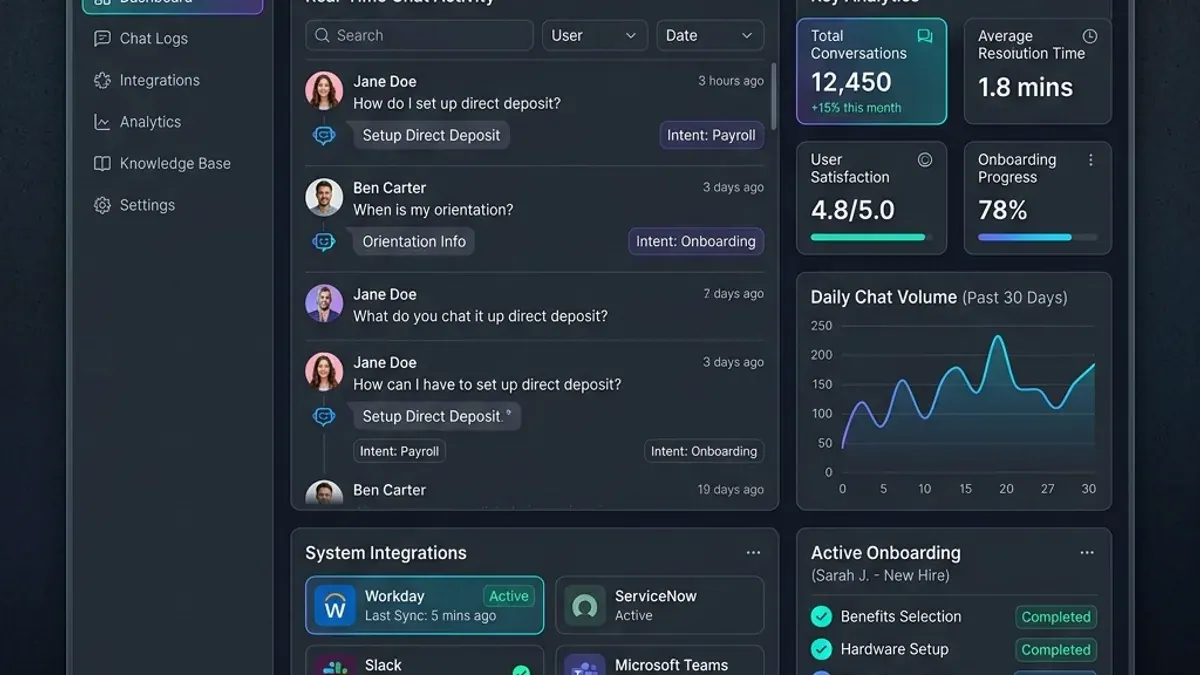
Short version: AI chatbots for HR are automating up to 80% of routine internal inquiries and reducing administrative workload by 60%. By shifting from basic Q&A bots to autonomous agents integrated with HRIS and IT systems, enterprises can accelerate onboarding, instantly resolve payroll questions, and drastically improve the daily employee experience.
Human resources departments within modern enterprise environments are currently operating at a critical operational inflection point. As organizations scale globally and remote workforces introduce complex logistical challenges, the administrative burden of managing employee queries, processing onboarding workflows, and resolving internal support tickets has grown exponentially. Data indicates that human resources professionals spend a vast majority of their operational hours answering repetitive questions regarding company policies, leave balances, payroll details, and access provisioning. To address these operational bottlenecks, enterprise leaders are increasingly turning to the AI chatbot for HR, an advanced conversational interface powered by generative artificial intelligence and agentic reasoning architectures designed to automate internal employee support completely.
The macroeconomic data surrounding this technological shift reveals staggering potential for organizational transformation. Estimates from McKinsey's 2023 report The economic potential of generative AI project that human resources administrative work could decline by 60% to 70% with the deployment of advanced generative AI models. Concurrently, according to research by the Society for Human Resource Management (SHRM), artificial intelligence adoption across HR tasks climbed from 26% in 2024 to 43% in 2025, with 46% of organizations expecting to use AI in their HR functions by 2026.
However, a significant dichotomy exists in the current state of implementation. While AI has saved employees in relevant roles an average of 1.5 hours per day, an overwhelming 88% of HR leaders in a SHRM study report their organizations have not yet realized significant business value from AI tools. This gap between technological potential and realized value stems largely from poor integration, a reliance on legacy conversational models, and a failure to implement workflow-oriented automation.
This detailed report explores the underlying architecture, core operational use cases, platform comparisons, and measurable return on investment (ROI) associated with deploying an employee support chatbot. By analyzing the transition from rigid decision-tree systems to modern autonomous AI agents, organizations can understand how to implement platforms that drive genuine operational efficiency, improve the employee experience, and transform the human resources function from a reactive cost center into a strategic organizational asset.
The Evolution of Conversational AI for HR: From Chatbots to Autonomous Agents
To fully grasp the capabilities of a modern AI HR helpdesk, it is essential to understand the architectural evolution of conversational artificial intelligence over the past decade. Early iterations of employee support chatbots relied heavily on rigid decision trees and predefined keyword matching. In these legacy systems, an employee searching for maternity leave policies would be forced down a narrow, pre-programmed conversational path. If the employee used an unrecognized synonym or asked a multi-part question, the system would fail, ultimately routing the frustrated user to a human agent and negating any potential efficiency gains.
By 2026, the underlying technology has shifted entirely toward generative AI and agentic reasoning architectures. Modern systems use Retrieval-Augmented Generation (RAG) and specialized Large Language Models (LLMs) to interpret the semantic intent behind an employee's query, evaluate the request against live organizational data, and execute a resolution autonomously.
The core differentiator in enterprise-grade platforms for employee support is autonomy. While a standard conversational AI bot simply retrieves context from a static document and synthesizes an answer, an AI agent for HR uses the ReAct (Reasoning and Acting) paradigm. This shift from passive information retrieval to active workflow execution represents the foundation of modern HR automation.
The table below delineates the architectural and functional differences between legacy conversational chatbots and modern autonomous AI agents.
| Capability Pillar | Legacy Conversational AI Bot | Modern Autonomous HR Agent |
|---|---|---|
| Primary Function | Synthesize answers and summarize static data. | Complete multi-step, cross-departmental workflows. |
| Tool Utilization | None, or basic search retrieval. | Reads and writes via internal and external APIs (e.g., Okta, Workday). |
| State Management | Simple conversation history. | Complex memory structures and directed cyclic task graphs. |
| Resolution Strategy | Directs employees to a knowledge base article. | Executes the action (e.g., submits the PTO request, resets the password). |
In the autonomous model, when an employee submits a request, the AI agent performs a multi-step cognitive loop. The system first evaluates the natural language input to determine the ultimate goal. It then selects the appropriate internal Application Programming Interface (API) tool to retrieve data, such as querying an HRIS for a PTO balance. Finally, the system reads the API response, communicates the balance to the employee, and executes a secondary action, such as submitting the time-off request and sending an automated notification to the direct manager for approval. This multi-hop reasoning allows the AI chatbot to function as a digital human resources representative capable of orchestrating complex backend systems securely.
High-Impact Use Cases for an Employee Support Chatbot
The operational value of an AI chatbot for HR is realized through the automation of high-volume, low-judgment tasks. Research highlights that talent acquisition and onboarding account for nearly 20% of the total value derived from AI in HR, with talent management contributing an additional 20%. The following use cases represent the most impactful deployments of automated HR workflows across enterprise environments.
Automated Employee Onboarding and Offboarding Workflows
The onboarding experience sets the trajectory for an employee's tenure, yet it is traditionally marred by extreme administrative friction. Studies indicate that 52% of employees report administrative tasks dominating their onboarding experience, signaling that the work that should happen before they arrive is instead bogging down their first weeks on the job. An automated employee onboarding chatbot transforms this process by orchestrating workflows across multiple systems from the moment a candidate accepts an offer.
On day one, a new hire interacting with an onboarding chatbot via communication platforms like Microsoft Teams or Slack receives a customized, role-specific checklist. The AI agent smoothly guides the employee through the organization's handbook, collects necessary payroll documentation securely, schedules orientation sessions, and proactively triggers IT provisioning workflows in identity systems to ensure software access is granted immediately. Furthermore, systems equipped with agentic capabilities monitor training deadlines, proactively reminding new hires to complete mandatory cybersecurity or compliance training. Organizations deploying reliable AI onboarding solutions report a 53% faster onboarding completion rate, a 75% reduction in administrative workload, and an impressive 82% improvement in new hire retention rates within the first year.
Conversely, offboarding requires meticulous attention to detail to mitigate security risks and ensure strict compliance. An automated offboarding workflow triggered by an HR chatbot orchestrates the entire departure sequence autonomously. Upon confirmation of an employee's termination date, the chatbot issues exit checklists, schedules exit interviews, coordinates the return of physical company assets, and triggers identity management APIs to revoke access to corporate software instantly. This eliminates the dangerous manual communication delays between HR, IT, and department managers, ensuring absolute security compliance.
AI HR Helpdesk: Leave, Attendance, and Payroll Management
Inquiries regarding paid time off (PTO) and payroll are consistently among the highest-volume requests fielded by HR departments. An AI agent for HR handles these interactions with precision, functioning as a highly efficient AI HR helpdesk. Employees can query the system in natural language, asking complex questions regarding unused vacation days or carry-over policies.
Because the chatbot integrates directly with human resources information systems, it pulls real-time balances instantly. It accepts leave requests, validates them against the specific constraints of the company policy, routes them to the appropriate manager for approval, and updates the backend system once the approval is logged. Regarding payroll, the chatbot securely handles inquiries regarding payslips, tax deductions, and reimbursement rules, offering 24/7 self-service without requiring HR personnel to manually review individual employee files. When highly sensitive payroll exceptions arise, the system executes a direct human handoff, passing the full conversation context to a live payroll specialist.
IT Service Requests and Cross-Departmental Support
In many enterprise environments, the boundary between HR and IT support is fluid, particularly concerning system access, password resets, and role changes. An employee support chatbot serves as a unified conversational front door, eliminating the need for employees to determine which department handles a specific issue before submitting a ticket.
When an employee experiences a lockout or requires access to a new software platform, the chatbot verifies the user's identity, cross-references their role-based access control (RBAC) permissions, and executes the password reset or access provisioning automatically through integrations with platforms like Azure AD. If a request requires manual IT intervention, the chatbot automatically creates a helpdesk ticket with the full conversation context attached. This capability alone is proven to resolve up to 80% of routine internal inquiries autonomously.
Leading HR Chatbot Platforms and Solutions for 2026
The market for conversational AI in HR is highly segmented, and buyers often mistakenly treat the term "HR chatbot" as a single, uniform category. This misconception leads to misalignment between organizational needs and software capabilities. Platforms generally fall into three distinct categories: recruiting chatbots designed for candidate-facing interactions, employee support chatbots tailored for internal FAQ and policy navigation, and agentic HR service platforms built for multi-hop workflow execution across enterprise systems.
Understanding the nuances of these best HR chatbots is critical for successful procurement and deployment. The table below outlines the premier platforms for employee support and their respective market positioning.
| Platform | Core Focus Area | Key AI Capabilities | Integration Depth | Target Segment |
|---|---|---|---|---|
| Moveworks | Enterprise IT & HR Support | Reasoning Engine, multi-hop workflow execution, inline citations. | Deep native integration with ServiceNow, Workday, and Microsoft Teams. | Large Enterprises |
| Leena AI | Enterprise Employee Experience | Proprietary WorkLM, advanced sentiment analytics, 100+ language support. | 1,000+ integrations focused heavily on HRIS and knowledge bases. | Global Corporations |
| Workativ | Mid-Market IT & HR Automation | Agentic RAG, pre-built workflow templates, intent-less design. | 100+ app integrations including BambooHR, Jira, Okta. | Mid-Market SMBs |
| Paradox (Olivia) | High-Volume Recruitment | SMS/chat candidate screening, automated interview scheduling. | Focuses on ATS integrations; lacks internal policy capabilities. | High-Volume Hiring |
| Phenom | Frontline & Candidate Experience | Conversational recruitment, career site matching, employee portal. | Integrates with Workday, SuccessFactors, and core ATS. | Enterprise Teams |
In-Depth Platform Analysis
Moveworks: Recognized universally as a leader in massive enterprise deployments, Moveworks differentiates itself through its proprietary Reasoning Engine. Unlike basic conversational interfaces, Moveworks executes permission-aware, multi-step workflows. For example, if an employee requests a specialized software license, the platform checks active directory groups, seeks managerial approval via Slack, provisions the software autonomously, and logs the action for compliance audits. According to Gartner's HR technology insights, sophisticated systems operating at this level are essential for achieving the 74% autonomous resolution rate that Moveworks boasts for common HR requests.
Leena AI: Designed specifically as a virtual HR assistant rather than a generalized IT tool, Leena AI excels at centralizing scattered human resources data. Using its proprietary WorkLM architecture, the platform generates direct conversational responses from parsed policy content, rather than simply matching keywords to static knowledge base articles. The platform is highly regarded for its multilingual capabilities, supporting over 100 languages, making it a premium choice for multinational deployments. Leena AI's analytics consistently demonstrate an average 65% reduction in HR ticket volume within 90 days of implementation.
Workativ: For organizations seeking enterprise-grade AI automation without prohibitive six-figure pricing structures, Workativ provides a highly compelling alternative. It features a no-code AI agent builder that allows HR teams to configure complex workflows (such as offboarding or leave management) and deploy them within days rather than months. By natively integrating with systems like BambooHR, Freshservice, and Okta, Workativ ensures that the chatbot takes real, verifiable action in backend systems rather than just serving conversational information.
FNA Technology (Custom Enterprise Development): While off-the-shelf SaaS platforms offer rapid deployment, highly regulated industries or organizations with bespoke legacy infrastructure frequently require custom architectural solutions. Exploring AI development services reveals that custom agent development involves building deterministic, ReAct-driven agents that integrate directly with an organization's proprietary APIs. By engineering the solution precisely around the organization's unique data architecture and security protocols, custom builds achieve unparalleled accuracy and compliance, operating completely independent of generic vendor templates.
Industry-Specific Implementations: Healthcare and Manufacturing
To validate the theoretical capabilities of conversational AI in HR, it is necessary to examine how these systems operate in complex, highly regulated production environments.
Manufacturing and Global Distribution: Coca-Cola's GenAI Transformation
Coca-Cola represents a premier example of using generative AI to completely transform HR and sales operations. Historically, the organization faced severe operational challenges due to HR policy information being scattered across disparate documents and regional business functions, which severely hampered employee productivity and delayed decision-making.
Partnering with technical providers and using Microsoft Azure OpenAI Service, Coca-Cola deployed a generative AI-powered conversational HR assistant. This initiative consolidated unstructured HR policy documents into a unified, natural language interface accessible globally. The results were definitive: the implementation of the AI chatbot enabled the HR department to save 60% of the time previously spent answering repetitive employee queries. Furthermore, employees' time to access critical policy information decreased by 50%, and overall support ticket generation was reduced by 34% within the first year. By resolving these operational bottlenecks, Coca-Cola was able to shift its HR department's focus away from administrative triage and toward strategic employee experience initiatives.
Healthcare Administration: Privacy, Triage, and HIPAA Compliance
In the healthcare sector, AI chatbots serve a dual purpose: supporting clinical staff internally and managing patient operations externally. When deploying AI chatbots for healthcare, compliance is the absolute highest priority. Internal AI agents handle scheduling, policy navigation, and compliance training tracking for medical staff. Simultaneously, specialized chatbots integrate directly with electronic health records (EHR) to automate patient triage, schedule appointments, and manage prescription refills.
These implementations have been shown to save health systems up to 35% in staff administrative time. However, achieving these efficiencies requires strict adherence to regulatory frameworks. A healthcare chatbot must be deployed with a signed Business Associate Agreement (BAA), use end-to-end AES-256 encryption for every message and transcript, and implement rigid role-based access controls to ensure that no protected health information (PHI) is ever exposed. Furthermore, modern algorithmic liability laws require organizations to explicitly disclose to users that they are interacting with an artificial intelligence system at the initiation of the conversation.
Measuring HR Chatbot ROI: Metrics That Matter
Securing organizational buy-in for an AI chatbot for HR requires moving beyond abstract technological promises and quantifying the return on investment in a language that corporate finance departments recognize. Research demonstrates that organizations using human-centric AI are 1.6 times more likely to exceed ROI expectations and 2.4 times more likely to outperform financially compared to peers who lag in adoption.
The financial and operational impacts of HR chatbots manifest across four distinct layers of measurable value creation.
| ROI Value Layer | Primary Business Impact | Key Measurement Metrics | Speed of Return |
|---|---|---|---|
| Operational Value | Workflow automation; the system completes tasks end-to-end rather than just discussing them. | Resolution rate, task completion rate (not just conversation volume). | Fast (Days to Weeks) |
| Financial Value | Creates organizational capacity; time is returned to HR for high-value strategic work. | Cost per ticket reduction, reduction in total HR service delivery costs. | Medium (Weeks to Months) |
| Workforce Value | Eliminates wait times; employees receive instant self-service resolutions. | Employee self-service adoption rates, time-to-resolution, onboarding completion speed. | Fast (Immediate upon launch) |
| Strategic Value | Compounds over time; predictive insights drive better retention and organizational planning. | 90-day new hire retention, talent acquisition quality, internal mobility rates. | Slow (Months to Years) |
Analyzing the Financial and Operational Data
The most immediate metric for evaluating an AI HR chatbot is the autonomous resolution rate. Data consistently shows that conversational AI can reduce internal support operational costs by up to 30%, with high-volume, repetitive functions like policy Q&A and password resets delivering the fastest ROI. By successfully deflecting 60% to 80% of routine inquiries, the marginal cost of a support interaction drops precipitously. According to MetricNet's support benchmark data, a fully human-handled IT or HR support ticket costs an average of $22 (with simple Tier-1 tickets averaging $7.40), whereas an AI chatbot resolves the same ticket for between $0.69 and $2.00 on a managed SaaS subscription.
However, the true financial value of HR automation lies not in aggressive headcount reduction, but in structural capacity creation. IBM's cost analysis of HR self-service reports that AI-driven self-service reduces overall service delivery costs by 50% to 60%, and decreases the total HR cost per employee by 22% over a two-year period. Furthermore, automated AI onboarding solutions are proven to save organizations over $18,000 annually on average simply by executing automated administrative tasks and eliminating human data entry errors.
The time saved by this automation must be strategically redeployed. Freed from answering repetitive leave balance questions, HR teams can focus on high-impact initiatives such as talent retention risk analysis, manager coaching, and workforce planning.
Implementation Strategy: How to Deploy an AI Agent for HR
Deploying an employee support chatbot is not purely a technological endeavor; it is a profound organizational change management initiative. To ensure the system drives the expected ROI and avoids becoming part of the 88% of deployments that fail to realize significant business value, organizations must follow a highly structured implementation roadmap.
1. Audit and Intent Mapping
Before writing a single line of code or signing a SaaS software contract, organizations must meticulously analyze historical support data. By reviewing three to six months of previous HR support tickets, leadership can identify the highest-volume inquiries and the most common operational friction points. The chatbot should initially be programmed to handle the top 20% of query categories that account for 80% of the administrative volume, ensuring an immediate operational impact.
2. Knowledge Base Standardization
Generative AI models are fundamentally reliant on the quality of the data they retrieve. Advanced AI systems require unambiguous, highly structured source material to function accurately without hallucinating. Human resources departments must audit their existing employee handbooks, policy PDFs, and intranet pages to ensure they are current, clearly written, and completely free of contradictory information. A chatbot will immediately surface any logical discrepancies in organizational documentation upon deployment.
3. API Integration and Strict Guardrails
The visible conversational chat window is merely the surface layer; the true value of an HR chatbot resides in its backend API connections. Organizations must establish secure, bi-directional integrations with the core HRIS (e.g., Workday), IT service management platforms (e.g., ServiceNow), and identity providers (e.g., Okta).
Simultaneously, strict governance protocols must be engineered into the system. The chatbot must use role-based access controls to ensure employees only view information they are explicitly authorized to access. Furthermore, the AI must be programmed with definitive escalation pathways. It should never be left unsupervised to handle sensitive issues such as complex employee relations disputes, termination processes, or highly nuanced benefits eligibility questions. In these high-risk instances, the chatbot must smoothly hand the interaction over to a human HR representative, providing the full conversation transcript to avoid forcing the employee to repeat themselves.
4. Managerial Alignment and Strategic Time Redeployment
As organizations successfully automate routine tasks, significant employee time is recovered. A major challenge identified by industry experts is that only 7% of organizations actively provide guidelines to employees on how to utilize the time saved by AI automation. Without direction, this saved time dissipates into inefficiencies. Human resources leadership must work closely with departmental managers to define new "value-added" activities for their teams, ensuring that the efficiency gained through the chatbot is purposefully redirected toward organizational growth, strategic planning, and continuous professional development.
Conclusion
The integration of artificial intelligence into the human resources function is no longer a speculative future concept; it is an immediate operational imperative. As evidenced by the rapid adoption rates and the dramatic reductions in administrative workloads across global enterprises, the AI chatbot for HR represents a fundamental, permanent shift in how organizations support their workforce. By transitioning from legacy decision-tree systems to advanced, agentic workflows, businesses can autonomously execute complex tasks ranging from day-one onboarding and multi-system IT provisioning to intricate payroll management and policy navigation.
While the choice between off-the-shelf SaaS platforms and custom-developed AI agents depends heavily on an organization's size, legacy infrastructure, and strict security requirements, the end goal remains identical: eliminating low-value, repetitive administrative friction. When properly implemented with reliable knowledge base standardization, deep backend API integrations, and clear managerial alignment, platforms for employee support deliver massive measurable financial returns. More importantly, they improve the daily employee experience, fundamentally freeing human resources professionals to focus on the strategic, human-centric initiatives that drive long-term organizational success.
Next Step: Engineer Your HR Transformation
Transforming human resources operations from a reactive helpdesk into a strategic powerhouse requires precise technology alignment and expert engineering execution. To explore how the benefits of AI chatbots in business can be tailored to your organization's specific workflows, data architecture, and security compliance requirements, expert guidance is paramount.
Take the definitive first step toward automating your internal support and scaling your employee experience by partnering with specialists in enterprise AI architecture. Book a free consultation today at FNA Technology to discuss custom chatbot development for business, workflow automation, and how to securely integrate agentic AI into your HR infrastructure.
AI Chatbot Development for HR