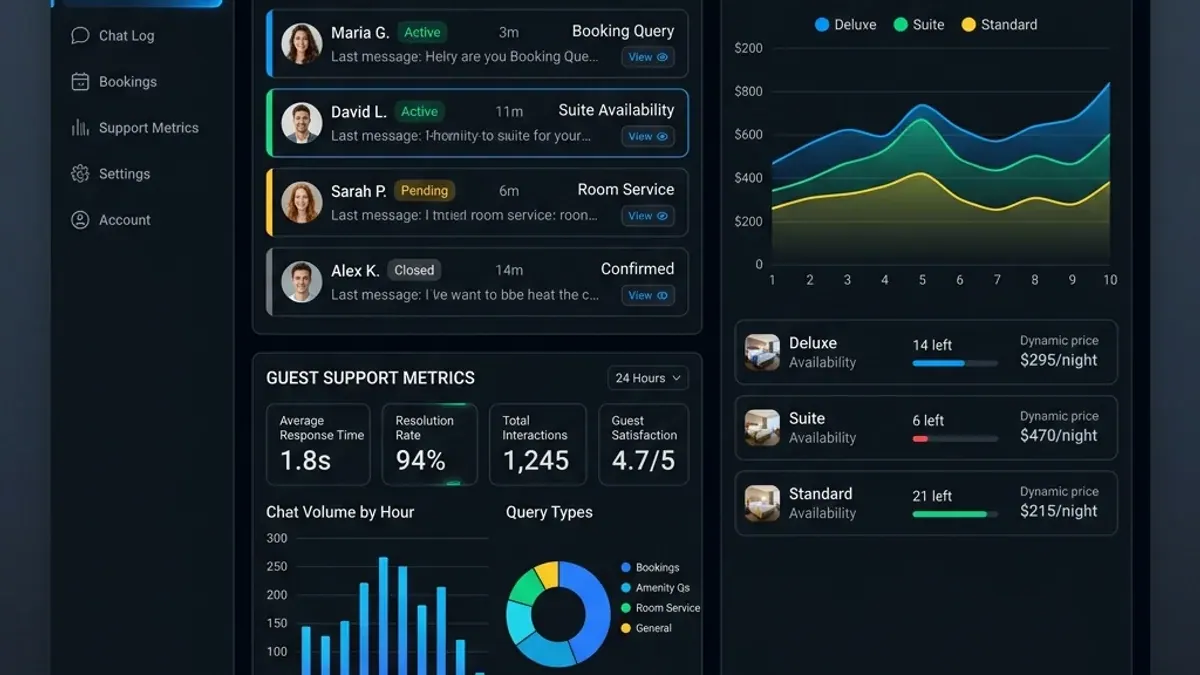
Short version: Modern AI chatbots resolve up to 97% of routine hotel inquiries and recapture significant revenue from OTAs. By integrating directly with Property Management Systems, hotels are achieving up to 259% growth in direct chatbot-attributed revenue and eliminating physical front-desk queues.
The hospitality industry is currently navigating a structural transformation, heavily influenced by an intersection of persistent labor shortages, rising guest expectations for instantaneous digital service, and the escalating distribution costs associated with Online Travel Agencies (OTAs). For decades, hotel operators have largely accepted the 15% to 30% commission rates levied by OTAs as an unalterable cost of doing business. Concurrently, modern travelers conditioned by algorithmic personalization in other sectors demand continuous, 24/7 support across a multitude of digital touchpoints. In this high-stakes, margin-compressed environment, AI chatbot solutions for hotels have transitioned from experimental novelties into indispensable operational infrastructure.
Modern hospitality AI chatbots, driven by Generative Artificial Intelligence (GenAI) and Large Language Models (LLMs), operate far beyond the capabilities of legacy rule-based FAQ deflection tools. These advanced systems function as autonomous booking agents, digital concierges, and central operational hubs capable of orchestrating complex transactions across the entire guest lifecycle. When architected correctly and integrated deeply with a property's backend technology stack, these intelligent agents can autonomously resolve up to 97% of routine interactions, recapture substantial revenue from third-party distribution channels, and fundamentally improve the on-site guest experience.
This detailed industry report delivers an exhaustive analysis of AI chatbots within the travel and hospitality sector. It examines their underlying architectural features, synthesizes granular data from real-world hotel AI chatbot case studies, quantifies measurable business impacts on direct bookings and revenue, and outlines the strategic implementation frameworks necessary to maximize return on investment (ROI).
The Evolution and Market Trajectory of Hospitality Conversational AI
The evolution of automated guest support has progressed through distinct technological phases, reflecting broader advancements in artificial intelligence and computational linguistics. Understanding this developmental arc is important for hospitality technology buyers seeking to implement a future-proof hotel AI booking assistant that drives tangible commercial outcomes.
Historically, first-generation chatbots were rigid, rule-based systems operating on static decision trees. These early iterations required users to select from pre-defined menus and routinely failed when confronted with unexpected phrasing, leading to high abandonment rates and significant guest frustration. The secondary phase introduced basic Natural Language Processing (NLP), allowing systems to map user intents to pre-written templates. While an improvement, these systems remained inherently disconnected from core hotel operations; they could quote a cancellation policy but could not actually execute a cancellation.
The current third generation represents a paradigm shift. Today's AI chatbot solutions for hotels use sophisticated LLMs capable of deep natural language understanding (NLU), dynamic response generation, and complex, multi-turn conversational reasoning. More importantly, these agents employ semantic search and automated function calling to interact directly with external databases, transforming them from informational wikis into transactional engines.
The commercial adoption of these advanced systems is accelerating rapidly. The global market for Artificial Intelligence in the hospitality sector was valued at $2.3 billion in 2022 and is projected to reach $9.5 billion by 2030, representing a Compound Annual Growth Rate (CAGR) of 20.3%. Furthermore, the specific sub-segment of AI-powered chatbots within hospitality is expected to surge from $400 million in 2022 to over $1.5 billion by 2028. Survey data indicates that 70% of hospitality companies plan to increase their AI investments by 20% over the next two years, driven by the realization that AI-powered dynamic pricing and conversational commerce can deliver a 6% to 10% uplift in average revenue.
Essential Features of High-Performing Hotel AI Chatbot Solutions
Evaluating the expansive market of conversational AI requires a nuanced understanding of technical capabilities. An isolated system that merely answers questions creates another communication channel for staff to monitor; a deeply integrated system that completes tasks actively reduces operational overhead. The following architectural features distinguish enterprise-grade AI solutions from superficial digital widgets.
Deep Property Management System (PMS) Integration
The fundamental differentiator of an elite automated guest support platform is its capacity to interface with the hotel's operational backbone. Advanced chatbots require bi-directional API connectivity with the Property Management System (PMS) like Oracle OPERA, Mews, or Cloudbeds, as well as the Central Reservation System (CRS) like SynXis.
Without this foundational integration, an AI agent can only provide probabilistic guesses regarding room readiness or standard pricing tiers. With bi-directional access, the AI becomes a fully autonomous transactional agent. It can instantly retrieve a guest's profile, confirm real-time room assignments, process early check-in requests, apply dynamic pricing rules, and autonomously route maintenance issues directly to operational ticketing software. This integration ensures that when a guest inquires, "Is my room ready?", the bot queries the PMS live data and provides factual certainty rather than a generic policy statement. To learn more about how these operational connections affect overall booking management, read our detailed overview of AI hotel reservation systems.
Advanced NLP and Sentiment Analysis
Superior hotel direct bookings AI relies on advanced machine learning algorithms that understand context, sentiment, and intent across multiple languages. Generative AI enables the chatbot to formulate human-like, contextually accurate responses based on the specific parameters of the guest's inquiry, drawing from vast unstructured data repositories.
Furthermore, sophisticated sentiment analysis allows the system to continuously monitor the emotional state of the user. If a guest uses negative phrasing, demonstrates high frustration, or explicitly mentions a critical service failure (e.g., a burst pipe in the bathroom), the AI instantly halts the automated flow. It prioritizes the ticket and executes an immediate live agent handoff, ensuring that sensitive situations are managed with human empathy and urgency.
Omnichannel Architecture and Unified Inboxes
Modern travelers expect to communicate through their preferred digital mediums without friction. Elite AI chatbot solutions deploy a unified intelligence layer across a multitude of touchpoints: the hotel's native website, mobile applications, SMS, social media messengers, and ubiquitous platforms like WhatsApp.
The underlying architecture must maintain conversational context and user state across these disparate channels. For example, if a prospective guest initiates a booking inquiry via web chat on their desktop and later follows up via WhatsApp on their mobile device while in transit, the AI should continue the dialogue without requiring the user to repeat their reservation details. All of these interactions are subsequently routed into a unified omnichannel inbox, providing human staff with a detailed, chronological view of the guest's entire digital journey.
Behavioral Marketing and Contextual Upselling
Advanced AI solutions monitor real-time user behavior on the hotel website, analyzing metrics such as dwell time, page depth, and scroll behavior, to identify high-intent booking moments.
If a prospective guest lingers on a premium suite page for over ninety seconds, the AI can proactively trigger a personalized widget campaign offering a time-sensitive direct booking incentive in the user's native language. Post-booking, the AI uses historical CRM data to propose contextual, highly relevant upsells, such as offering a curated spa package to an anniversary couple or a late checkout to a corporate traveler with a documented evening flight. This targeted, data-driven approach significantly outperforms traditional blanket promotional emails.
| Capability Area | Basic Rule-Based Chatbots | Advanced GenAI Hotel Assistants |
|---|---|---|
| Conversational Flow | Rigid, menu-driven decision trees with high failure rates. | Fluid, multi-turn natural language capable of handling complex, compound queries. |
| Data Accessibility | Limited to static FAQs and pre-programmed responses. | Real-time access to PMS, CRS, and CRM data via bi-directional APIs. |
| Booking Execution | Redirects users to external booking engine URLs. | Processes reservations, secure payments, and modifications natively within the chat interface. |
| Upselling Strategy | Generic, untargeted offers applied uniformly to all users. | Contextual, data-driven recommendations based on stay history and real-time behavioral triggers. |
| Human Agent Handoff | Disconnected; loses conversation history and frustrates the user. | Immediate; passes full conversational context, guest profile data, and sentiment alerts to staff. |
Enterprise-Level Hotel AI Chatbot Case Studies
The theoretical advantages of natural language processing hotel bots are substantiated by extensive deployment data across the global hospitality sector. Analyzing these enterprise-level implementations reveals how major conglomerates are applying conversational AI to manage massive data volumes and fundamentally alter the traveler search paradigm.
IHG Hotels & Resorts: Scaling Conversational Data
IHG Hotels & Resorts executed one of the most expansive AI-powered messaging rollouts in the industry. The hospitality giant deployed an AI chatbot across its massive portfolio, handling 12 million guest interactions in a single year, an 84% year-over-year spike in conversational volume. By transitioning communications to digital channels earlier in the booking journey, IHG successfully captured critical guest preferences and loyalty data prior to arrival. This proactive data ingestion mitigates the friction of repetitive manual data entry at the front desk, ensuring that loyal customers automatically receive their requested room configurations and amenities without friction.
Hyatt Hotels: Revolutionizing Natural Language Search
Hyatt Hotels focused its AI deployment on completely rebuilding the booking search interface. Recognizing that the traditional "dropdown menu" search format (selecting city, dates, and guests) is inherently rigid, Hyatt architected its web search around conversational AI. Guests can now input complex, natural queries, akin to asking a human concierge for a recommendation. Internal data tracking over multiple quarters indicates that this alignment with natural human behavior has directly increased conversion rates and total native search revenue for the brand.
Hilton: AI Trip Planning
Hilton has aggressively integrated AI, testing over 41 distinct use cases across operations, guest experiences, and cost optimization. Among these initiatives is "Connie," an IBM Watson-powered robot concierge stationed at reception areas to assist with local information while learning from interactions. Furthermore, Hilton's deployment of a conversational AI trip planner has yielded remarkable commercial outcomes, with the chain reporting a 50% jump in direct bookings following the implementation of AI chat systems. The technology effectively captures guests during the inspiration phase of the travel funnel, converting them before they migrate to third-party OTA aggregators.
Wyndham Hotels: Voice AI at Unprecedented Scale
Wyndham Hotels partnered with Canary Technologies to deploy an AI voice tool, Wyndham Connect Plus, across more than 5,000 properties. This system autonomously handles hundreds of thousands of inbound guest calls. The sheer scale of this deployment highlights a critical shift: AI is actively managing voice channels in addition to supplementing text chat. Public data ties this massive rollout directly to conversion gains for Wyndham franchisees, prompting the company to direct over $425 million in total AI investment toward intelligent booking and service systems.
Mid-Market and Independent Hotel Chatbot Statistics: Direct Bookings and Revenue
While global brands possess the capital to build proprietary GenAI systems, independent operators and mid-sized groups are using sophisticated SaaS-based AI platforms to achieve enterprise-level operational efficiency. The following data highlights the profound impact of these systems on revenue generation and cost deflection.
Driving Direct Revenue and Recapturing OTA Margins
A primary commercial objective for independent hotels is reducing reliance on OTAs. According to a HiJiffy case study, GHT Hotels, a regional group, implemented an AI booking assistant to combat abandoned digital queries and inefficient customer service. By deeply integrating the chatbot with their booking engine, the AI autonomously resolved 89% of incoming queries, managing over 21,526 conversations. The commercial impact was profound: the AI directly generated €733,000 in revenue via 1,427 direct bookings processed entirely within the chat interface. This represented 16% of total direct website bookings and marked a staggering 259% growth in chatbot-attributed revenue compared to the baseline year.
Similarly, Hôtel l'Élysée Val d'Europe, a 4-star independent property, used targeted widget campaigns triggered by an AI chatbot to secure 1,648 additional direct overnight stays over an eight-month period. During active promotional campaign windows, the property observed a 3.5-fold increase in bookings and a 4-fold increase in revenue compared to non-campaign periods, effectively filling an average of seven additional rooms per night through direct channels. Zafiro Hotels also recorded an 11% increase in direct sales following the implementation of specialized conversational AI.
Operational Deflection and Front-Desk Efficiency
Operational efficiency and labor cost reduction form the second major pillar of chatbot ROI. Hotel Gran Bilbao integrated an AI communications hub with their PMS to combat chronic front-desk queues. By deploying automated WhatsApp campaigns for digital registration, the property increased its online check-in rate by 200%, reaching an overall digital check-in rate of 60%. The chatbot autonomously handled over 58,000 conversations across their portfolio with a 90% automation rate, maintaining a high Customer Satisfaction (CSAT) score of 83% while entirely eliminating physical queues in the lobby.
At a broader operational level, Choice Hotels redesigned its call routing and support architecture around Capacity's AI platform, successfully automating 97.4% of incoming support queries. This process optimization saved the organization nearly $2 million in support center costs over an 8-month period. Leonardo Hotels eliminated 14,000 hours of manual work, equivalent to the labor of eight full-time employees, by using HiJiffy's conversational AI to process 281,000 queries with a 93% automation rate.
Strategic Upselling and RevPAR Enhancement
AI chatbots drive incremental revenue throughout the guest lifecycle by using behavioral data. Holiday Inn Express generates an additional $1,700 monthly in upselling revenue through strategic AI deployment focused entirely on guest preferences rather than mere inventory availability. Sweet Accommodations reported a 20% increase in upselling success and a 30% rise in online check-ins using automated WhatsApp campaigns. Industry-wide data indicates that properties using strategic AI upselling report an 8% to 12% boost in RevPAR and a 23% higher average order value for ancillary services, as personalized recommendations feel inherently more helpful than generic marketing blasts.
| Strategic Objective | Implementing Brand | Measurable Business Outcome |
|---|---|---|
| Increase Direct Bookings | GHT Hotels | 259% revenue growth; €733,000 generated via chatbot bookings. |
| Reduce Staff Workload | Leonardo Hotels | 93% automation of 281,000 queries, eliminating 14,000 manual hours. |
| Eliminate Physical Queues | Hotel Gran Bilbao | 200% increase in online check-ins; 90% automation rate. |
| Campaign ROI Optimization | Hôtel l'Élysée | 3.5x more bookings and 4x more revenue during active widget campaigns. |
| Call Center Cost Reduction | Choice Hotels | 97.4% of calls automated, yielding nearly $2 million in cost savings. |
Analyzing the Best AI Chatbots for Hotels: A Vendor Landscape
The market for hospitality technology is heavily saturated with conversational agents, but a select group of platforms has emerged as industry leaders by proving their ability to scale and integrate deeply with complex hotel ecosystems. Evaluating these providers requires aligning their distinct architectural strengths with a hotel's specific operational requirements.
Specialized Hospitality SaaS Platforms
- HiJiffy: Positioned as a detailed, multi-channel guest communications hub, HiJiffy unifies web chat, WhatsApp, SMS, and OTA inboxes into a single, centralized dashboard. Powered by algorithms trained on extensive hospitality-specific datasets, it frequently achieves automation rates exceeding 85%. HiJiffy is highly regarded for its booking engine integrations, automated campaign widgets, and advanced sentiment analysis that effectively prioritizes urgent guest issues for human escalation.
- Quicktext (Velma): Quicktext uses a proprietary AI named Velma to focus aggressively on driving direct sales, capturing high-value leads, and executing behavioral marketing. Its standout capabilities include dynamic campaigns that push personalized messages based on specific URL tracking, real-time OTA price comparison widgets embedded natively within the chat interface, and advanced syntax and semantic analysis designed to parse complex user intents.
- Duve: Duve differentiates itself through dynamic personalization executed at scale. Rather than relying on a static knowledge base, Duve's AI dynamically generates a fresh, context-rich dataset for every incoming query by cross-referencing live PMS availability with highly detailed CRM guest profiles. This architecture allows large hotel groups to centralize their communications teams without sacrificing the personalized touch typically associated with boutique concierge services.
- Runnr.ai: Focusing intensely on WhatsApp as the primary vector for guest engagement, Runnr.ai integrates tightly with property management systems to automate the entire in-stay journey. It excels at sending proactive, timely notifications like digital key delivery, housekeeping opt-outs, and targeted breakfast upsells, resulting in guest engagement rates frequently exceeding 80%.
- Akia: Akia functions as a broader guest experience platform, using AI to replace physical touchpoints with digital "mini-apps." By offloading repetitive front desk tasks, Akia's agents manage early check-ins, digital registration cards, and post-stay surveys via SMS and chat, checking live availability and applying pricing rules autonomously without requiring staff intervention.
The Role of Custom Enterprise AI Development
While specialized SaaS products provide excellent out-of-the-box functionality, complex hotel groups, global aggregators, and large-scale travel agencies often require bespoke infrastructure. Standardized bots may struggle with unique legacy systems, highly specific proprietary workflows, or strict data sovereignty requirements.
In these instances, partnering with specialized AI development agencies is paramount. Firms like FNA Technology design, engineer, and deploy custom enterprise software and AI-powered solutions specifically tailored to complex operational environments. By developing custom Large Language Models, engineering bespoke API connectors to disparate backend systems, and crafting tailored business process automations, these technology partners allow travel brands to maintain total data sovereignty. Examples of such specialized deployment include the Khedmah AI chatbot for digital services and the Imageverse vision AI tools, demonstrating capabilities far beyond standard text retrieval. Working with an expert partner ensures that intelligent agents flawlessly align with a brand's unique voice and complex technical architecture.
Strategic Implementation Frameworks for Hospitality Conversational AI
The most frequent catalyst for AI chatbot implementation failure in the hospitality sector is not technological inadequacy, but poor process integration. A recurring theme across highly successful deployments is that technology amplifies human capability; it does not replace the requirement for rigorous operational design. To ensure a successful rollout and maximize ROI, hotel operators must adhere to the following strategic implementation frameworks.
Define a Singular, Measurable Business Objective
Implementations that attempt to solve every operational problem simultaneously frequently collapse under their own complexity. The most successful hotels define a highly specific initial focus, whether that is aggressively driving direct bookings (as seen with Hilton and GHT Hotels) or drastically reducing front-desk call volume (as executed by Choice Hotels). Operators should focus the AI's initial training and workflow design on mastering one specific domain before progressively expanding its operational scope.
Prioritize Deep System Interoperability
As established, an AI chatbot isolated from the PMS, CRS, and CRM is practically useless for transactional tasks. Research from Conduit AI indicates that query resolution rates improve from 90.6% to 95.5% when chatbots connect directly to operational systems rather than functioning as standalone FAQ engines. Hotel technology buyers must prioritize vendors or custom development partners who guarantee real-time, bi-directional data flow between the AI and existing operational infrastructure. The bot must possess the authority to read live inventory and write data back to the central guest profile.
Architect an Immediate Human Handoff Protocol
Automation is designed to handle the mundane, not the highly emotional. The system must be configured to instantly recognize user frustration, complex complaints, or VIP loyalty status, and immediately transfer the chat session to a live human agent. Crucially, this escalation protocol must pass the entire conversational context, guest history, and sentiment analysis to the staff member's interface. Forcing a guest to repeat a complex problem they just articulated to a bot is a primary driver of abysmal AI satisfaction scores; currently, only 23% of hotel guests report being satisfied with AI chatbot interactions, largely due to broken handoff protocols. When executed correctly, escalation workflows maintain context and reduce response times from 30 seconds down to 18 seconds.
Transition Staff into AI Supervisors
The introduction of a highly capable AI chatbot fundamentally shifts the role of front desk and reservation staff. Rather than acting as glorified data-entry clerks answering repetitive questions regarding pool hours or Wi-Fi passwords, staff must transition into loop supervisors and dedicated relationship managers. Internal training programs must be aggressively updated to allow employees to use the AI's operational insights, step into conversations organically when prompted by sentiment alerts, and use the vast amount of time saved to deliver high-value, personalized on-site service that builds long-term brand loyalty.
Establish Continuous Data Optimization Loops
AI chatbots generate massive, unprecedented volumes of conversational data. Every guest interaction serves as a real-time focus group, highlighting precise guest pain points, emerging search trends, and areas of friction on the property's website. Management teams must establish rigorous protocols to regularly review chat analytics and semantic clustering. For example, if the AI is repeatedly queried about parking logistics or shuttle schedules, it is a definitive indicator that the website's existing transportation information is insufficient or hidden. This continuous feedback loop is invaluable for optimizing not just the chatbot, but the broader operational efficiency of the entire property.
Conclusion
The global travel and hospitality industry is rapidly approaching a technological inflection point where conversational AI is no longer viewed as a novel competitive advantage, but rather as a baseline operational requirement. As digital search paradigms shift inevitably toward natural language interfaces, and modern guests increasingly prioritize the friction-free autonomy of sophisticated self-service, properties lacking intelligent digital infrastructure will face escalating customer acquisition costs, deteriorating margins, and severely compromised guest satisfaction.
The empirical data extracted from real-world deployments is unequivocal: when thoughtfully architected, strategically focused, and deeply integrated into core property management systems, AI chatbot solutions for hotels dramatically reduce dependency on expensive third-party OTAs, unlock significant ancillary revenue streams through contextual upselling, and liberate human capital to focus on genuine, empathetic hospitality. The operators who succeed in this new paradigm will be those who view AI as a foundational mechanism for redesigning the entire guest journey from inspiration to post-stay loyalty rather than a localized cost-cutting IT tool.
Next Step: Engineer Your Digital Transformation
Are you prepared to transform your property's digital infrastructure, significantly increase direct booking revenue, and effortlessly automate complex guest communications? Whether your organization requires a highly specialized, bespoke AI booking assistant or enterprise-grade process automation across a global portfolio, expert guidance is required to navigate complex technical integrations and ensure data sovereignty.
We encourage hospitality technology leaders to book a free consultation with FNA Technology to discover how custom AI solutions can be precisely engineered to meet the exact strategic requirements of modern travel brands. Uncover the potential of AI to redefine your operational efficiency today. You can also explore our about us page to understand our engineering principles, or review our project portfolio to see real outcomes.
AI Chatbot Development for Hospitality