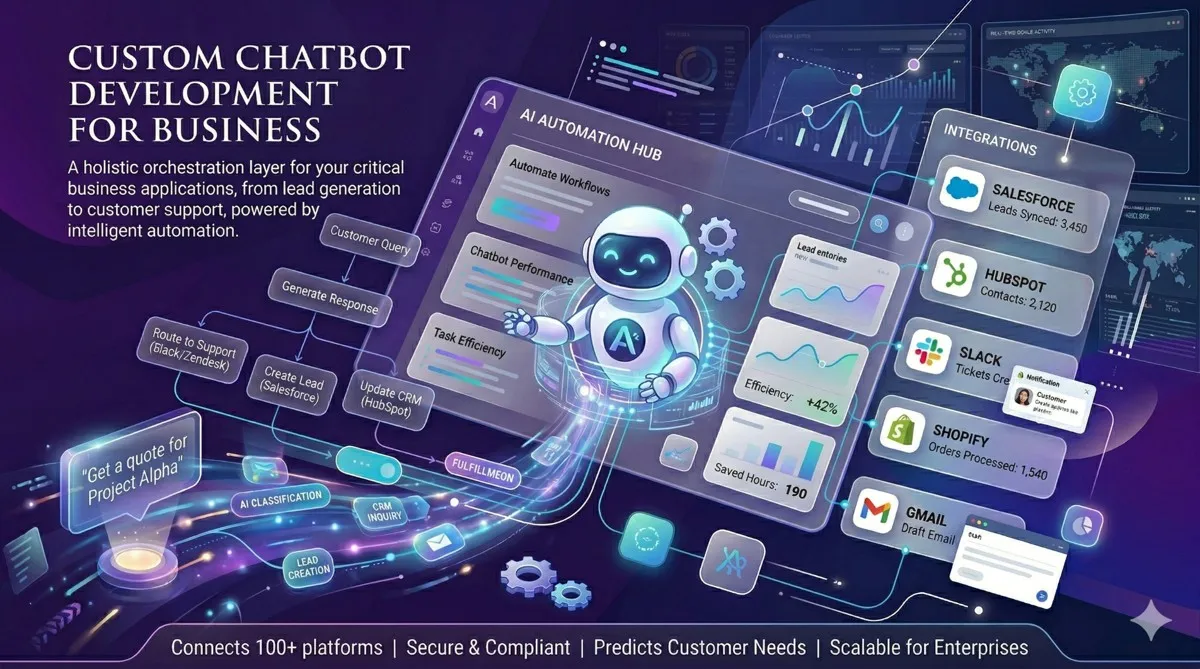
Short version: AI chatbots reduce customer support costs by up to 30%, provide 24/7 availability, and accelerate response times. When properly implemented, they automate repetitive tasks, generate leads, and drive revenue, paying for themselves within six to nine months.
Customer expectations have shifted permanently. People want answers in seconds, not days, and they want them at 2 a.m. on a Sunday just as easily as at 2 p.m. on a Tuesday. That single shift is why AI chatbots have gone from a novelty feature to a core piece of business infrastructure in just a few years.
If you are weighing whether AI chatbots for business are worth the investment, the short answer is yes. The how and where matter far more than most articles on this topic let on. Below, we break down the ten most significant, evidence-backed benefits of AI chatbot implementation, supported by real numbers and real company examples, along with the operational nuance most lists skip entirely.
What are the cost savings of AI chatbots?
The most quoted benefit of AI chatbots is cost reduction. A human agent typically handles a routine support query for somewhere between $8 and $15 in the UK and US, and $4 to $8 in lower-cost markets like India, while a well-trained AI chatbot resolves the same query for a fraction of that cost.
Independent research backs this up at scale. A 2026 analysis by IBM found that AI chatbots can reduce contact center operational costs by up to 30%, and Gartner projects conversational AI will save $80 billion in global contact-center labor costs by the end of 2026. This isn't hypothetical; it is a documented, repeatable structural cost shift.
The nuance most articles miss is that savings compound only when the chatbot is scoped correctly. A well-implemented AI customer service chatbot typically cuts support costs by 30 to 40% in the first year and pays back within 6 to 9 months for mid-market deployments. That depends on clean knowledge bases and honest scope, not just switching the bot on.
How does 24/7 availability impact business?
Unlike human teams, an AI chatbot doesn't need shifts, breaks, holidays, or overtime pay. It answers the first question at midnight the same way it answers the hundredth question at noon. For businesses serving customers across time zones, or competitors who never close their digital doors, 24/7 chatbot support directly removes the friction that costs conversions.
This is particularly valuable for e-commerce, travel, SaaS, and healthcare businesses where a delayed answer often means a lost customer to a faster competitor.
Do chatbots improve response times and satisfaction?
Speed is now a competitive differentiator, not a nice-to-have. A 2026 study by HubSpot and Salesforce shows that 81% of customers prefer to try self-service options before contacting a human support representative. Businesses that deploy high-quality chatbot experiences see meaningfully higher engagement as a result.
Instant, accurate answers reduce the anxiety and drop-off that come with waiting in a queue. When paired with a clear escalation path to a human agent for complex issues, chatbots improve both perceived and measured customer satisfaction, because customers get speed without sacrificing resolution quality.
How do AI chatbots help with lead generation?
AI chatbots function as one of the most underused lead generation and lead qualification channels available to modern businesses, rather than purely a support tool. A chatbot embedded on a pricing page or product page can ask qualifying questions in real time, capture contact details, and route hot leads directly to sales, all while the visitor is still actively engaged.
This window of high intent is something static contact forms simply cannot replicate. Businesses using conversational AI for lead capture typically see stronger form completion rates because the interaction feels like a conversation, not a form to abandon.
Can chatbots reduce employee burnout?
There is a human side to chatbot ROI that gets overlooked in most cost-focused articles, and that is agent morale. When repetitive, low-value questions ("What are your hours?", "Where's my order?", "How do I reset my password?") are automated away, human agents are freed to focus on complex, relationship-building conversations. Those are the kind that actually require empathy and judgment.
This translates to measurable financial impact. Teams handling fewer repetitive tickets report lower burnout and turnover, which reduces the very real cost of hiring and retraining customer service staff. This is a cost most ROI calculators leave out entirely.
How do AI chatbots provide scalability?
Traditional customer service scales linearly: more customers usually means more agents, more training, and more management overhead. AI chatbots break that relationship. A chatbot handling 500 conversations a day can, with the right infrastructure, handle 5,000 without a corresponding cost increase.
This matters enormously for seasonal businesses like retail during holidays or travel during peak booking season. Fast-growing startups also benefit, as they cannot predict demand far enough in advance to hire and train proportionally.
Why is consistent messaging important?
Human agents, however well-trained, introduce natural variation in tone, accuracy, and policy interpretation. An AI chatbot delivers the same accurate, on-brand answer whether it is the first conversation of the day or the ten-thousandth. For regulated industries like finance, healthcare, and insurance, this consistency also reduces compliance risk, since the bot will not improvise an answer outside approved guidelines.
What business intelligence do chatbots provide?
Every chatbot conversation is a data point. Over time, chatbot transcripts reveal exactly what customers are confused about, which products generate the most questions, where the buying journey stalls, and what language customers actually use to describe their problems.
This data is a goldmine for product teams, marketing teams, and support leadership alike. It often surfaces friction points that surveys and NPS scores never catch, because it captures behavior in the moment rather than sentiment after the fact.
How does multilingual support work?
Expanding into new markets traditionally means hiring native-language support staff, a slow and expensive process. Modern AI chatbots can converse fluently across dozens of languages instantly, giving even small businesses the ability to serve global customers without building out regional support teams from scratch. This is one of the fastest, lowest-cost ways for a growing business to test demand in a new geography before committing to local hires.
Do AI chatbots drive revenue?
The most sophisticated chatbot deployments actively drive revenue alongside cutting costs. Proactive chat triggers, personalized product recommendations, abandoned-cart recovery messages, and post-purchase upsell prompts all turn the chatbot into a revenue channel rather than a pure cost center. AI chatbots have been shown to deliver conversion improvements of 20% or more, with proactive chat triggering lifts of up to 40%.
Real-world proof backs this at scale. According to a 2026 report by Crisp, Vodafone reduced its cost-per-chat by 70% after deploying AI-powered support, while NIB Health Insurance saved $22 million and cut costs by 60% with AI customer service. These are not edge cases; they are what happens when chatbot strategy is treated as infrastructure investment rather than a quick software install.
How to choose the right chatbot strategy?
Not every business needs the same type of chatbot. Before implementation, it is worth mapping your goals against the right approach:
- Rule-based chatbots — Best for narrow, predictable use cases like FAQs, order status, and appointment booking. Lower cost, faster to deploy, more limited in scope.
- AI-powered conversational chatbots — Best for businesses handling varied, nuanced queries, multi-turn conversations, and personalized recommendations. Higher upfront investment, significantly higher ceiling on impact.
- Hybrid chatbot and human escalation models — Best for regulated industries or high-stakes conversations, where the bot handles volume and a human takes over for complexity or sensitivity.
A custom AI-powered chatbot built around your actual customer conversations, not a generic off-the-shelf template, is almost always what separates the businesses that see 30%+ cost reductions from the 61% of projects that, according to industry benchmarks, fail to hit their year-one targets.
Real-world example: Khedmah Chatbot
One of the clearest illustrations of chatbot ROI in practice comes from our own work building the Khedmah Chatbot. This AI customer-support assistant for Oman's trusted digital services platform delivers real-time order tracking at scale for a high-volume, always-on customer base. It is a practical example of cost efficiency and speed working together, without being competing priorities.
What are the common mistakes in implementation?
Even with strong ROI potential, chatbot projects fail more often than vendors admit. The most common causes include:
- Deploying without a clean knowledge base — A chatbot is only as accurate as the information it is trained on.
- No clear escalation path — Customers abandon a bot the moment it cannot help and there is no easy way to reach a human.
- Treating it as set and forget — The best-performing chatbots are reviewed and retrained regularly based on real conversation data.
- Choosing a generic template over a business-specific build — Off-the-shelf bots rarely reflect your actual product catalog, policies, or customer language.
Avoiding these four mistakes is often the real difference between a chatbot that pays for itself in months and one that quietly gets abandoned within a year.
Final thoughts: Is an AI chatbot right for your business?
The evidence is clear: AI chatbots for business deliver measurable benefits across cost, speed, scalability, data, and revenue. They deliver all of these simultaneously when implemented correctly. The businesses seeing the strongest results treat chatbot implementation the way they would treat any serious infrastructure investment: with a clear strategy, clean data, and a plan for ongoing improvement rather than a one-time setup.
If you are exploring AI development services or want to understand what a custom-built chatbot could realistically save and earn for your specific business, the fastest way to find out is to talk it through with a team that has built these systems before, including for platforms like Khedmah, serving customers at national scale. Explore our full range of AI-powered solutions or browse our project portfolio to see what is possible.
Get a clear, honest assessment of where an AI chatbot could save you money, save your team time, and start generating revenue without generic templates or sales pressure.
AI & Chatbot Development Services