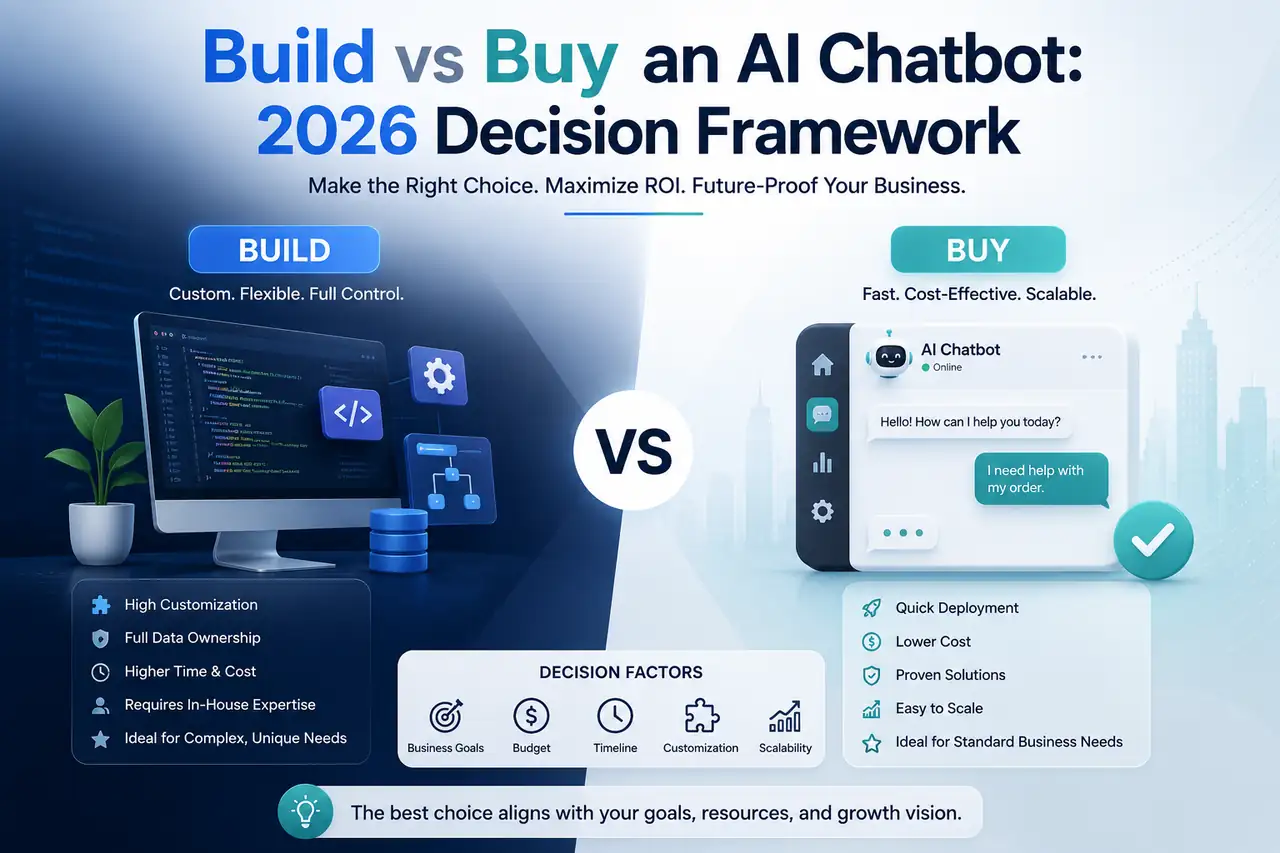
The short version: Buy a SaaS chatbot if your use case is standard customer support FAQ deflection on a budget under $10,000 with under 2,000 monthly conversations. Build a custom AI chatbot if you require proprietary data privacy, deep database read/write integrations, conversational volume scaling past 2,000–5,000 chats/mo where per-resolution fees scale exponentially, or bespoke UI integration.
The decision to build vs. buy an AI chatbot is one of the most consequential software architecture choices product and engineering leaders face in 2026.
If you mistakenly choose a SaaS platform when your workflows demand custom database integrations, you will spend months fighting rigid widget constraints and paying thousands in per-resolution overages. Conversely, if you build a custom bot when a standard SaaS tool would suffice, you risk burning engineering bandwidth reinventing commoditized features like basic chat history UIs and analytics dashboards.
As an engineering studio that builds enterprise AI systems, we regularly advise clients on both sides of this decision. In this guide, we break down the financial break-even math, uncover the hidden costs of both paths, and provide a 6-part decision framework for CTOs, product managers, and business leaders.
Side-by-side comparison: SaaS chatbot vs. Custom AI build
Before analyzing the financials, compare the operational differences between both deployment models:
| Evaluation Dimension | Off-the-Shelf SaaS Chatbot (Intercom, Zendesk, Ada) | Custom AI Chatbot Build (Next.js, LangChain, Custom RAG) |
|---|---|---|
| Time to Launch | 3 days to 2 weeks | 4 to 8 weeks |
| Upfront Capital Expense | $0 to $2,500 (Setup / onboarding) | $8,000 to $35,000 (One-time engineering build) |
| Ongoing Monthly Cost | $250 to $4,000+ / mo (Base fee + per-resolution charges) | $50 to $300 / mo (Direct LLM token usage + cloud hosting) |
| Data Privacy & Governance | Multi-tenant cloud (Vendor controls data pipeline) | 100% self-hosted or dedicated VPC (Full GDPR/HIPAA control) |
| Backend Integration Depth | Limited to pre-built plugins (Zapier, standard CRMs) | Unlimited (Direct SQL queries, proprietary APIs, custom webhooks) |
| User Interface Flexibility | Standard iframe widget with brand color themes | 100% custom UI embedded natively into web and mobile apps |
| Conversational Autonomy | Bounded dialogue and document retrieval (Need multi-step action execution? See our AI Agent vs Chatbot guide) | Full agentic tool-calling and transactional API execution |
| Vendor Lock-in Risk | High (Proprietary workflows and conversation history) | Zero (Open architecture; swap underlying LLM models anytime) |
The financial break-even math: When custom becomes cheaper than SaaS
The fundamental difference between SaaS and custom AI lies in their pricing mechanics:
- SaaS chatbot pricing: Vendors charge a platform fee (typically $100 to $500/month) plus a per-resolution or per-conversation fee (ranging from $0.50 to $1.20 per resolved conversation).
- Custom AI chatbot pricing: You pay a one-time development fee upfront, after which your ongoing operational cost is purely the raw LLM API token cost (OpenAI, Anthropic, or open-source models) plus cloud infrastructure, which averages $0.01 to $0.03 per conversation.
12-Month TCO
$50k│                                                /
$40k│                                      /
$30k│                            /
$20k│─────────────────*─────────────────────────────────
$10k│       /
 $0k└──────────┴──────┴───────┴────────────────────────┴
     0         1k    1.7k    2.5k                     5k   chats/mo

  /  SaaS:   $3.6k platform fee + $0.80/chat
  ─  Custom: $19.2k year one + $0.02/chat
  *  Break-even: ~1,700 chats/mo, both paths ~$19.6k
The 12-Month Total Cost of Ownership (TCO) Breakdown
Examine the 12-month financial comparison across four conversational volume tiers (assuming an average SaaS cost of $0.80 per AI resolution and a custom build cost of $18,000):
| Monthly Volume (Chats) | 12-Month SaaS Cost (Platform + Resolutions) | 12-Month Custom Cost (Build + Tokens + Hosting) | Cost Advantage |
|---|---|---|---|
| 1,000 / month | $13,200 ($300/mo base + $800/mo chats) | $19,440 ($18,000 build + $1,440 ops) | SaaS Wins (Saves $6,240 in Year 1) |
| 5,000 / month | $51,600 ($300/mo base + $4,000/mo chats) | $20,400 ($18,000 build + $2,400 ops) | Custom Wins (Saves $31,200 in Year 1) |
| 20,000 / month | $195,600 ($300/mo base + $16,000/mo chats) | $24,000 ($18,000 build + $6,000 ops) | Custom Wins (Saves $171,600 in Year 1) |
| 50,000 / month | $483,600 ($300/mo base + $40,000/mo chats) | $31,200 ($18,000 build + $13,200 ops) | Custom Wins (Saves $452,400 in Year 1) |
The key insight: For low-volume startups handling under 1,500 conversations a month, SaaS is more economical in Year 1 because you avoid upfront development expenses. However, as interaction volume crosses 1,700 to 2,000 conversations per month, cumulative SaaS resolution fees escalate rapidly, making custom development cheaper over a 12-month horizon. At 5,000+ monthly chats, custom builds break even in under 5 months and save over $31,000 in Year 1.
The hidden costs of buying a SaaS AI chatbot
While SaaS platforms promise rapid deployment, enterprise teams frequently encounter hidden friction points after launch:
1. Resolution-based pricing penalties
Most modern SaaS chatbot platforms bill based on "AI resolutions"—defined as any interaction where the user does not request a human agent within a set timeframe. When your chatbot successfully deflects more tickets, your monthly software bill increases proportionally, creating an unintended penalty on support efficiency.
2. Data sovereignty and compliance lock-in
When using a multi-tenant SaaS chatbot, your internal customer communications, proprietary support logs, and sensitive knowledge documents are transmitted to and indexed by a third-party vendor. For healthcare (HIPAA), financial services (SOC 2), or European operations (GDPR), obtaining compliance sign-offs for third-party SaaS indexing can introduce extensive legal friction.
3. Limited backend execution capabilities
SaaS chatbots excel at reading documentation and generating text. However, when you need the bot to execute complex write-actions—such as validating an account in an internal PostgreSQL database, checking inventory across multiple warehouse APIs, or generating custom PDF contracts—you hit the architectural boundaries of pre-built integrations.
4. Rigid frontend customization
SaaS chatbots live inside standardized floating widgets with limited styling controls. If your product requires a native conversational interface embedded directly within your application workflow (e.g., an in-app copilot sidebar or customized mobile chat view), SaaS widgets feel disconnected from your core product experience.
The hidden costs of building a custom AI chatbot
Conversely, building custom software carries operational responsibilities that teams must factor into their planning:
1. Upfront development investment
Building a production-ready custom chatbot requires dedicated engineering: designing the data ingestion pipeline, setting up vector indexing (RAG), structuring prompt guardrails, and building fallback human handoff workflows.
2. Ongoing evaluation and regression testing
As foundation models evolve (e.g., upgrading from GPT-4o to newer frontier models), prompt outputs can drift. Maintaining a custom bot requires setting up automated evaluation benchmarks to test answer accuracy and response quality before deploying model updates to production.
3. Infrastructure maintenance
While modern managed services (such as AWS Bedrock, Pinecone, or Supabase pgvector) have reduced server maintenance to a minimum, your engineering team or development partner still owns uptime monitoring, API credential management, and vector index re-indexing.
6-question decision framework for CTOs and founders
Use this 6-question rubric to determine the right path for your organization:
                          ┌────────────────────────────┐
                          │  Decision Scorecard:       │
                          │  Build vs. Buy Assessment  │
                          └─────────────┬──────────────┘
                                        │
             ┌──────────────────────────┴──────────────────────────┐
             ▼                                                     ▼
   [ Choose SaaS If: ]                                   [ Choose Custom If: ]
   • Monthly volume < 2,000 chats                        • Monthly volume > 2,000 chats
   • Standard FAQ / support deflection                   • Deep database read/write actions
   • Need to launch in < 14 days                         • Strict data privacy / HIPAA / GDPR
   • Zero internal engineering support                   • Native in-app copilot UI required
- What is your anticipated monthly conversational volume?
- Under 2,000 chats/month: Buy SaaS (avoids upfront build costs while volumes remain low).
- Over 2,000–5,000+ chats/month: Build Custom (achieves rapid ROI and eliminates scaling resolution fees).
- Does the chatbot need to execute actions in proprietary backend databases?
- Read-only FAQ answers: Buy SaaS.
- Read/Write transactional API calls (SQL, ERPs, CRMs): Build Custom.
- What are your regulatory and data privacy requirements?
- Standard commercial data: Buy SaaS.
- Strict HIPAA, GDPR, or air-gapped on-premise requirements: Build Custom.
- How closely must the chat interface integrate into your product UI?
- Standard corner popup widget: Buy SaaS.
- Fully branded, embedded application copilot: Build Custom.
- What is your budget structure?
- Prefers operational expense (OPEX) with zero upfront cash: Buy SaaS.
- Prefers one-time capital investment (CAPEX) to eliminate high recurring per-chat fees: Build Custom.
- What is your time-to-market constraint?
- Must launch within 7 days: Buy SaaS.
- Can allocate 4 to 8 weeks for a fully tailored solution: Build Custom.
The progressive migration path: Prototype on SaaS, scale with custom
You do not have to make an irreversible decision on day one. Many of the most successful AI implementations follow a progressive two-phase strategy:
Phase 1: Rapid market validation on SaaS (Months 1–3)
Deploy a low-cost SaaS chatbot on your website within days. Use this phase to validate customer demand, identify the top 50 questions users ask, and build a clean library of verified answers with zero engineering overhead.
Phase 2: Migrate to a custom LLM architecture (Months 4+)
Once your conversational volume scales past 2,000 to 5,000 monthly interactions or your team requires deeper database integrations, extract your validated conversation logs and transition to a custom Next.js and vector-database architecture.
This approach gives you the speed of SaaS for early learning, followed by the cost efficiency, security, and integration power of custom software at scale.
Summary and next steps
The build vs. buy decision is not about whether custom code is better than SaaS—it is about matching your architectural choice to your scale, data privacy constraints, and integration depth.
- If you need a fast, low-maintenance FAQ assistant for a standard website, buy a SaaS chatbot.
- If you need a deeply integrated, high-volume conversational engine that interacts with internal databases and eliminates perpetual per-chat fees, build a custom AI chatbot.
At FNA Technology, we help businesses architect, build, and deploy production-grade custom AI chatbots and agentic systems tailored to their exact enterprise workflows.
Explore our related engineering breakdowns on AI Agent vs Chatbot: Which Does Your Business Need?, AI Chatbot Development Costs in India & UAE, and How to Choose an AI Chatbot for Customer Support.
Explore Custom AI Solutions