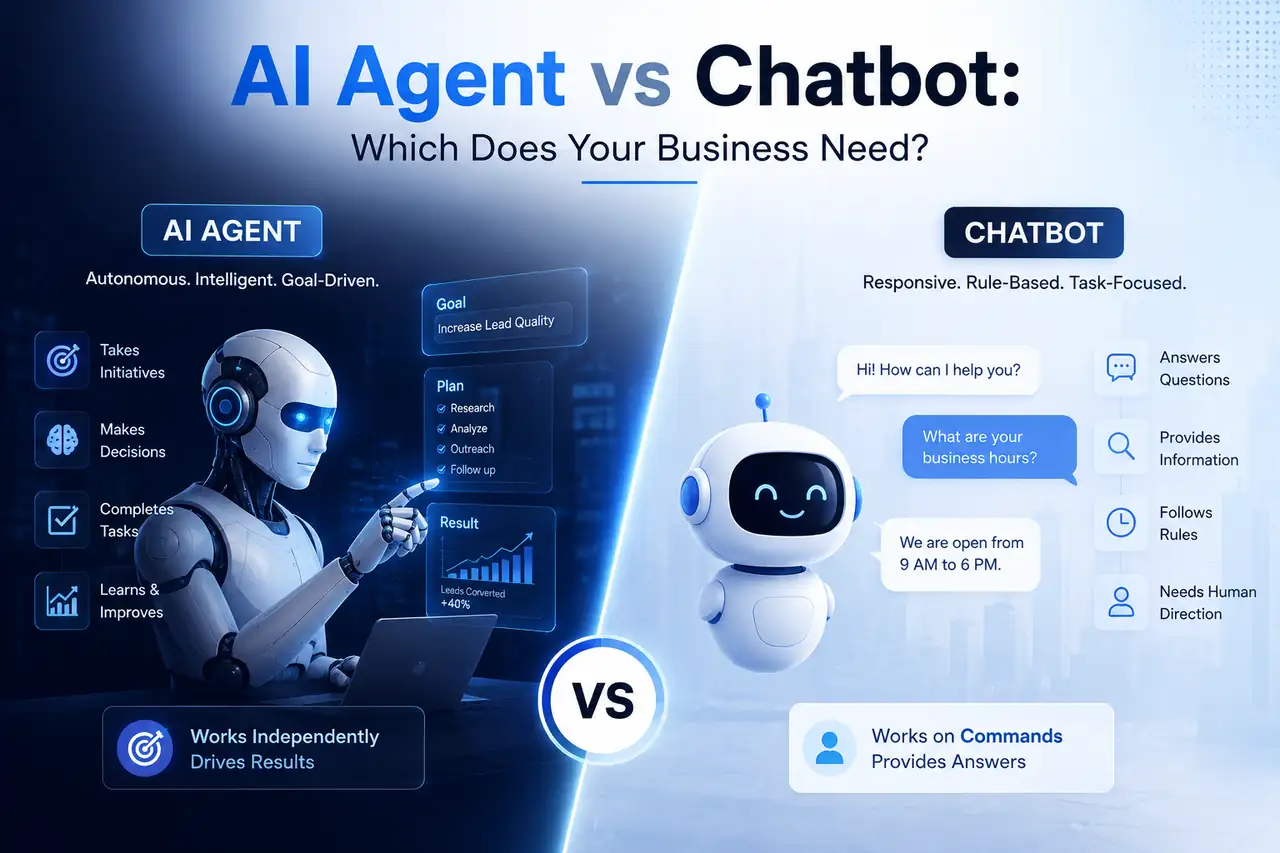
The short version: Chatbots answer questions within a conversation window; AI agents execute multi-step workflows across external tools, databases, and APIs without human intervention. If your goal is customer support deflection and knowledge retrieval, build a chatbot. If your goal is autonomous workflow execution, build an AI agent.
Every enterprise technology conversation in 2026 revolves around artificial intelligence, but teams frequently conflate two fundamentally different architectures: AI chatbots and autonomous AI agents.
Vendors often blur the lines for marketing purposes, labeling basic conversational bots as "autonomous agents" or selling complex agentic workflows to teams that only need an FAQ deflection assistant.
Choosing the wrong architecture creates expensive failure modes:
- Building an over-engineered AI agent for simple information retrieval wastes budget on unnecessary orchestration, complex evaluation pipelines, and high API token costs.
- Forcing a standard chatbot to handle multi-step operational workflows leads to hallucinated data, broken customer journeys, and frustrated operational teams.
This guide provides an engineering-grounded decision framework to help business leaders, CTOs, and product managers choose the exact architecture their business requires.
The core distinction: Conversational answers vs. Autonomous action
To understand which technology your organization needs, compare their operational objectives:
[ Chatbot ]   ──> Receives Query ──> Retrieves Context (RAG) ──> Generates Answer

[ AI Agent ]  ──> Receives Goal  ──> Reasons & Plans Steps   ──> Calls External APIs ──> Verifies Result
What is an AI chatbot?
An AI chatbot is a conversational system designed to interact with humans using natural language. Modern chatbots leverage Large Language Models (LLMs) paired with Retrieval-Augmented Generation (RAG) to understand user intent, query an indexed vector database of company documentation, and generate conversational responses.
Key characteristic: Chatbots are fundamentally reactive and conversational. They answer the user's prompt, provide links, clarify questions, and summarize information within the dialogue window. Once the answer is sent, the execution lifecycle pauses until the human types another prompt.
What is an AI agent?
An AI agent is an autonomous software entity designed to achieve a predefined objective by perceiving its environment, reasoning through sub-tasks, choosing appropriate tools, and executing actions across external software systems without human intervention at every step.
Key characteristic: AI agents are proactive and goal-driven. Instead of stopping at an answer, an agent formulates an execution plan, invokes external APIs (e.g., querying a SQL database, creating an invoice in QuickBooks, updating HubSpot, or triggering a GitHub build), evaluates the result of each step, and adjusts its plan until the objective is accomplished.
Technical architecture comparison
The difference between a chatbot and an AI agent lies in their internal software architecture:
| Architectural Dimension | AI Chatbot (Conversational / RAG) | Autonomous AI Agent (Agentic System) |
|---|---|---|
| Primary Function | Natural language dialogue & FAQ retrieval | Autonomous multi-step goal execution |
| Execution Loop | Single-turn or multi-turn prompt-response | Continuous Reason-Act-Observe (ReAct) loop |
| External Tool Access | Read-only search (Vector DB, Knowledge Base) | Read/Write access (APIs, Databases, CRMs, Web Browsers) |
| Decision Autonomy | Bounded to conversational generation | High (determines execution paths dynamically) |
| Memory & State | In-context conversation history | Ephemeral working memory + persistent episodic memory |
| Failure Risk Profile | Low (textual inaccuracies or hallucinations) | High (erroneous database writes, unintended API calls) |
| Typical Build Cost | $8,000 – $35,000 (Custom RAG build) | $15,000 – $50,000 (Single workflow) to $150,000 – $350,000+ (Multi-agent enterprise) |
| Monthly Operating Cost | $50 – $300 / month (Direct LLM tokens + hosting; SaaS: $250–$4,000+/mo at scale) | $500 – $5,000+ / month (High token inference volume & multi-agent execution) |
How a chatbot processes a request
When a customer asks a support chatbot: "What is your return policy for damaged items?"
- The chatbot embeds the user query into a vector representation.
- It queries a vector database (like Pinecone, Qdrant, or pgvector) for relevant policy documentation.
- The LLM synthesizes a 3-sentence summary explaining the 30-day return policy and provides a link to the return portal.
- Execution ends. The customer must still open the link, enter their order number, and initiate the return manually.
How an AI agent processes a request
When a customer gives an AI agent the objective: "Process a return for my damaged order #49102."
- Perception: The agent extracts the order ID (
#49102) and intent (return_damaged_item). - Tool Call 1 (Database Query): The agent calls the Shopify or ERP API to verify the order date, payment status, and delivery confirmation.
- Reasoning & Validation: The agent validates that the order falls within the 30-day return window.
- Tool Call 2 (Image Inspection API): The agent asks the user for a photo, calls a vision model to verify package damage, and logs the visual confirmation.
- Tool Call 3 (Shipping API): The agent invokes the FedEx / ShipStation API to generate a prepaid return shipping label.
- Tool Call 4 (CRM Mutation): It creates an RMA record in the internal warehouse management system.
- Action Completion: It delivers the label directly to the customer and schedules an automated refund trigger upon warehouse scan.
The chatbot explained the policy; the AI agent completed the business transaction.
5-part decision framework: Which does your business need?
To determine whether your organization should deploy an AI chatbot or invest in custom AI agent development, evaluate these five operational criteria:
                  ┌───────────────────────────────┐
                  │ Does the workflow require     │
                  │ executing write actions (APIs,│
                  │ database updates, bookings)?  │
                  └──────────────┬────────────────┘
                                 │
                     ┌─── YES ───┴───── NO ────┐
                     │                         │
                     ▼                         ▼
          ┌─────────────────────┐   ┌─────────────────────┐
          │  Build an AI Agent  │   │ Build an AI Chatbot │
          │ (Autonomous Action) │   │(Knowledge Retrieval)│
          └─────────────────────┘   └─────────────────────┘
1. Read-only information retrieval vs. Write-action execution
- Choose a Chatbot: If 90% of user queries can be resolved by retrieving and summarizing information from knowledge bases, documentation, product manuals, or PDF directories.
- Choose an AI Agent: If the task requires modifying database records, booking appointments, updating CRM fields, charging credit cards, or triggering background jobs.
2. Single-step interaction vs. Multi-step reasoning
- Choose a Chatbot: If user interactions follow a straightforward Question → Answer pattern where each response relies directly on the user's latest prompt.
- Choose an AI Agent: If solving the user's problem requires multiple sequential steps with branch logic (e.g., Check stock → If low, alert supplier → Else, create shipping quote → Email client).
3. Consequence of error and risk tolerance
- Choose a Chatbot: When the risk of a mistake is low. If a chatbot produces an imperfect answer, the user simply clarifies their question or escalates to a human.
- Choose an AI Agent: Only when you have the budget to build robust guardrails and evaluation frameworks. Because agents execute write-actions, an unchecked hallucination can alter customer records, send unintended emails, or issue duplicate payments.
4. Integration surface area
- Choose a Chatbot: When you only need to connect your frontend chat widget to a document vector store and an LLM API.
- Choose an AI Agent: When your application needs deep, authenticated bi-directional integrations across Slack, Jira, HubSpot, Stripe, PostgreSQL databases, and third-party SaaS APIs.
5. Budget and development timeline
- Choose a Chatbot: If your budget is under $35,000 (or under $10,000 for an off-the-shelf SaaS pilot / focused MVP) and you need to launch within 2 to 6 weeks. Chatbots have lower engineering overhead and simpler evaluation needs. (Evaluating whether to subscribe to a platform or commission a custom build? Read our Build vs Buy AI Chatbot 2026 Decision Framework.)
- Choose an AI Agent: If you have an established budget ($15,000–$50,000+ for single-workflow agents, scaling to $150,000–$350,000+ for multi-agent enterprise systems) and an 8 to 24-week timeline to build custom tools, stateful orchestration layers, and automated regression testing suites.
Real-world business use cases compared
To illustrate how this framework applies across industries, examine these side-by-side enterprise scenarios:
Scenario A: B2B SaaS Customer Support
- Chatbot Implementation: Ingests documentation from Zendesk and GitBook. When a developer asks how to authenticate an API endpoint, the bot provides code snippets and links to API references.
- AI Agent Implementation: Connects directly to server logging systems (Datadog) and customer tenant databases. When a developer reports a webhook timeout, the agent checks recent payload logs, isolates the failing IP address, restarts the webhook queue, and updates the support ticket status.
Scenario B: Real Estate Lead Qualification
- Chatbot Implementation: Answers visitor questions about square footage, property amenities, and neighborhood school districts based on listing PDFs.
- AI Agent Implementation: Qualifies buyer budget, queries the MLS database for matching off-market properties, checks the agent's Google Calendar for availability, books an in-person tour, and creates a pre-filled contract draft in DocuSign.
Scenario C: Internal HR and Employee Onboarding
- Chatbot Implementation: Answers employee questions about health insurance deductibles, holiday schedules, and 401(k) matching policies.
- AI Agent Implementation: Provisions the new hire's Google Workspace account, assigns Jira permissions, generates their initial laptop hardware ticket, sends automated introductory emails, and logs compliance signatures in BambooHR.
The Hybrid Approach: Conversational agents with supervisory guardrails
In enterprise deployments, the most successful architecture is often a hybrid system: a conversational front-end chatbot paired with specialized, supervised AI agents in the backend.
[ User Chatbot Interface ]
           │
           ▼
[ Intent Classifier ] ──> Simple FAQ? ──> [ Direct RAG Answer ]
           │
           ▼ (Requires Action)
[ Supervisory AI Agent ]
           │
           ├──> Step 1: Drafts API Action
           ├──> Step 2: Human Supervisor Approves (or Low-Risk Auto-Executes)
           └──> Step 3: Mutates Database & Confirms to User
By decoupling conversational dialogue from action execution, organizations maintain the fast response times of chatbots while selectively deploying autonomous agents with human-in-the-loop sign-offs for high-consequence operations.
Summary and next steps
Choosing between an AI agent and an AI chatbot comes down to one fundamental question: Do you need a system that answers, or a system that acts?
- If your business needs 24/7 customer service deflection, document search, or conversational product recommendations, an AI Chatbot delivers high ROI with low risk and fast deployment.
- If your business needs to automate end-to-end operational workflows, eliminate repetitive data entry, and execute multi-system transactions, an Autonomous AI Agent provides transformative operational leverage.
At FNA Technology, we design and build production-grade AI systems tailored to enterprise workflows—from high-accuracy RAG chatbots to multi-agent autonomous orchestration engines.
Explore our related engineering guides on Build vs Buy an AI Chatbot, AI Agent Development Costs, and How to Build a Custom WhatsApp AI Chatbot.
Explore Our AI Services