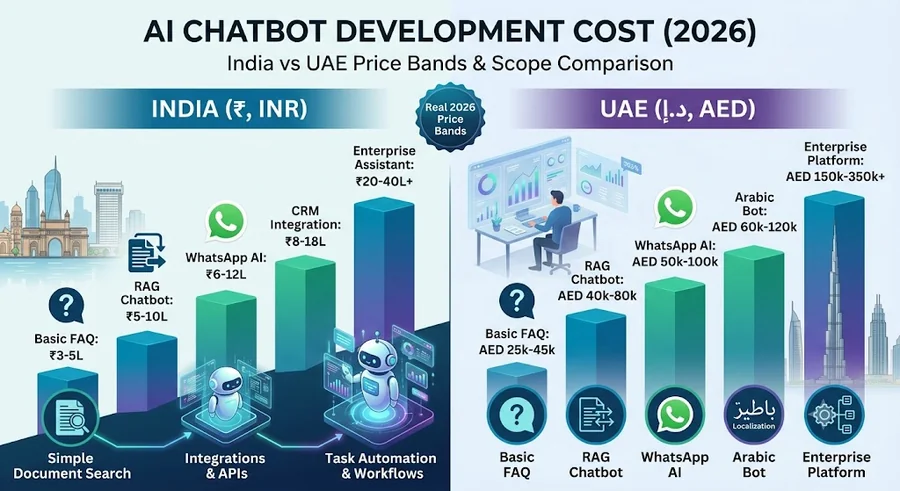
The short version: AI chatbot development typically costs ₹3–40 lakh in India and AED 25,000–350,000 in the UAE, depending on integrations, AI capabilities, deployment channels, and compliance requirements. Most businesses spend more on connecting existing systems than on the language model itself.
Every business owner eventually asks the same question.
"How much will an AI chatbot actually cost us?"
The answer isn't a single number.
The cost of developing an AI chatbot in 2026 typically ranges from ₹3–40 lakh in India and AED 25,000–350,000 in the UAE, driven largely by the complexity of integrations and business workflows rather than the AI model itself.
Based on our internal 2025 project data, we've seen businesses receive proposals for the same project ranging from ₹4 lakh to more than ₹35 lakh. Neither quote was necessarily wrong. They described different products under the same label: AI chatbot.
One proposal covered a chatbot that answered FAQs from uploaded PDFs.
The other included CRM integration, WhatsApp automation, multilingual conversations, live order tracking, human handoff, analytics, and AI workflows that could update customer records without manual work.
Those are completely different systems.
That's why comparing chatbot pricing without understanding the scope usually leads to disappointment. The cheaper quote often excludes integrations, testing, security reviews, or ongoing improvements. Six months later, the project costs far more than expected.
This guide explains what businesses in India and the UAE are actually paying in 2026, which features increase the budget, and where spending extra usually makes sense.
Should you build a custom chatbot or buy an off-the-shelf platform?
The decision between a custom build and a SaaS subscription depends on your integrations, data privacy needs, and business workflows.
For simple customer support, buying an off-the-shelf product is almost always the right choice. For complex internal workflows or deep CRM integrations, custom development provides better long-term ROI.
- Intercom / Zendesk AI: Best for standard customer support and ticketing. You pay per seat or per resolution. Minimal development required.
- Freshworks: Excellent for mid-market businesses needing straightforward IT or sales automation without heavy engineering.
- Microsoft Copilot / ChatGPT Enterprise: Best for employee productivity and internal document search. Not designed for customer-facing support.
- Custom AI Chatbot: The only option when you need to automate multi-step tasks across proprietary systems, maintain strict data sovereignty, or deploy across specialized channels like WhatsApp with custom business logic.
What affects AI chatbot development cost?
The AI model is rarely the biggest expense.
Most of the project budget goes into connecting business systems, preparing company knowledge, testing conversations, and making sure the chatbot behaves correctly in real situations.
A chatbot that only answers common questions from a knowledge base is much simpler than one that can retrieve invoices, book appointments, process refunds, or update CRM records.
Here are the biggest pricing factors.
1. Project scope
A basic AI assistant usually includes:
- Website chat
- FAQ responses
- Knowledge base search
- Basic analytics
A more advanced project might include:
- CRM integration
- ERP connectivity
- Ticket creation
- Payment workflows
- Customer authentication
- Appointment scheduling
- Multi-step AI workflows
Each integration increases development time because every external system has different APIs, permissions, and security requirements.
2. Number of integrations
This is where budgets often grow.
Connecting a chatbot to one CRM is relatively straightforward.
Connecting it to:
- Salesforce
- HubSpot
- SAP
- Microsoft Dynamics
- Shopify
- WhatsApp Business API
- Internal databases
requires separate development, testing, and monitoring.
A chatbot may spend only a few seconds generating text, but it can spend months interacting reliably with business software.
3. The Chatbot Complexity Framework (Architecture)
Not every chatbot uses the same architecture.
Some businesses only need document search.
Others need conversational memory.
Some require AI agents that perform tasks instead of only answering questions.
| Architecture | Typical use case | Relative project cost |
|---|---|---|
| FAQ chatbot | Basic customer support | Lowest |
| RAG chatbot | Company documents and knowledge bases | Low to medium |
| Workflow chatbot | CRM and ERP automation | Medium |
| Agentic AI assistant | Multi-step business processes | High |
Choosing a larger language model does not automatically produce a better chatbot. Clean documentation and reliable workflows usually matter more than model size.
4. Which AI model should you choose?
Your choice of foundational model impacts both the upfront development complexity and ongoing usage costs. There is no single "best" model—only the right model for your use case.
- OpenAI (GPT series): The industry standard. Excellent reasoning, massive ecosystem, and reliable API. Best for complex logic and general-purpose agents.
- Anthropic (Claude Opus 5, Claude Sonnet 5, Claude Haiku 4.5): Superior at processing massive documents and writing nuanced, human-like text. Often preferred for enterprise RAG systems.
- Google Gemini: Offers deep integration with the Google ecosystem and massive context windows.
- Open-source (Llama, Mistral): Essential for highly regulated industries (healthcare, finance) that require on-premise deployment or complete data privacy. Requires more engineering effort to host and fine-tune.
Model line-ups change every few months, so confirm the current generation and its pricing with your vendor before signing. The API rate you budget for today is rarely the one you pay in a year.
5. Deployment channels
Many businesses underestimate this factor.
Adding another communication channel isn't simply copying the chatbot.
Each platform has different capabilities.
| Channel | Additional development effort |
|---|---|
| Website | Low |
| Medium | |
| Microsoft Teams | Medium |
| Slack | Medium |
| Mobile App | Medium |
| Voice AI | High |
Voice systems introduce speech recognition, speech synthesis, latency management, and call routing, all of which increase engineering effort.
6. Security and compliance
This becomes especially important for healthcare, finance, insurance, and government organizations.
Security work may include:
- Role-based permissions
- Audit logs
- Data encryption
- PII masking
- Single Sign-On (SSO)
- Private cloud deployment
- Compliance documentation
These features rarely change how the chatbot looks.
They dramatically change how much work happens behind the scenes.
7. Knowledge quality
Here's something many vendors don't mention.
Poor documentation makes chatbot projects slower.
If policies exist across outdated PDFs, emails, Word documents, and spreadsheets with conflicting information, developers spend significant time organizing that content before AI can use it reliably.
I've seen documentation cleanup consume nearly a quarter of a project's implementation timeline.
It isn't glamorous work, but skipping it usually creates inaccurate answers later.
What do businesses typically spend money on?
The table below shows where budgets usually go during a custom chatbot project.
| Cost area | Share of project budget |
|---|---|
| Discovery and planning | 10–15% |
| Conversation design | 10–20% |
| Backend development | 20–30% |
| Integrations | 20–35% |
| AI implementation | 10–20% |
| Testing and deployment | 10–15% |
| Documentation and training | 5–10% |
One pattern appears in almost every successful implementation.
The AI model itself isn't the expensive part.
Building software that allows the AI to work safely with your business systems is where most engineering time goes.
How does chatbot development cost vary by company size?
Your company size generally dictates the compliance, security, and integration requirements of the project, which directly scales the budget.
| Business Size | Typical Investment (USD) | Common Use Cases |
|---|---|---|
| Startup | $4,000 – $8,000 | Basic website FAQ, lead capture, simple RAG for product docs. |
| SME | $10,000 – $25,000 | WhatsApp automation, basic CRM integration, multilingual support. |
| Mid-market | $15,000 – $40,000 | Multiple system integrations, employee self-service, custom AI agents. |
| Enterprise | $40,000+ | High-security on-premise deployment, complex ERP workflows, full compliance audits. |
How much does AI chatbot development cost in India?
India remains one of the most cost-effective places to build custom AI software. That doesn't mean every project is inexpensive. Pricing depends far more on the chatbot's capabilities than on where the developers are located.
A chatbot that answers FAQs from a knowledge base might take a few weeks to launch. An enterprise AI assistant connected to your CRM, ERP, WhatsApp, payment gateway, and internal databases can take several months.
The table below reflects typical pricing for production-ready projects in 2026.
| Project type | Typical investment (INR) | Estimated timeline |
|---|---|---|
| AI FAQ chatbot | ₹3–5 lakh | 2–4 weeks |
| RAG chatbot | ₹5–10 lakh | 4–8 weeks |
| WhatsApp AI chatbot | ₹6–12 lakh | 5–8 weeks |
| AI chatbot with CRM integration | ₹8–18 lakh | 8–12 weeks |
| Enterprise AI assistant | ₹20–40 lakh+ | 3–6 months |
These ranges usually include planning, chatbot design, backend development, testing, deployment, and a short support period after launch.
Typical developer rates in India
Most agencies build teams based on project requirements rather than assigning one developer to everything.
| Role | Typical hourly rate |
|---|---|
| Full-stack developer | ₹1,800–4,000 |
| AI / LLM engineer | ₹3,500–7,500 |
| DevOps engineer | ₹2,500–6,000 |
| Solution architect | ₹5,000–10,000 |
Hourly pricing is only one part of the equation.
A team charging a higher hourly rate but delivering in eight weeks can easily cost less than a lower-priced team that spends five months resolving integration issues.
What usually increases the budget?
Several features have a noticeable impact on development cost.
- Connecting multiple business systems
- Customer authentication
- Role-based access control
- Voice conversations
- Multilingual support
- Analytics dashboards
- Human handoff
- Workflow automation
- Private cloud deployment
Among these, integrations usually account for the largest share of engineering effort.
How much does AI chatbot development cost in the UAE?
Businesses across Dubai, Abu Dhabi, and the wider GCC increasingly expect AI chatbots to support multiple languages, meet regional compliance requirements, and integrate with enterprise software already in use.
Those expectations naturally increase project budgets.
Typical investment ranges look like this.
| Project type | Estimated investment (AED) |
|---|---|
| AI FAQ chatbot | AED 25,000–45,000 |
| RAG chatbot | AED 40,000–80,000 |
| WhatsApp AI chatbot | AED 15,000–80,000+ |
| Arabic AI chatbot | AED 60,000–120,000 |
| Enterprise AI platform | AED 150,000–350,000+ |
Large banking, healthcare, aviation, and government projects frequently exceed these estimates because they require additional compliance reviews, security testing, and deployment documentation.
Why UAE chatbot projects cost more
Higher pricing isn't simply the result of engineering salaries.
Many UAE organizations require additional deliverables such as:
- Arabic and English conversations
- UAE PDPL compliance
- Microsoft Azure deployment
- Private cloud hosting
- On-site workshops
- Longer maintenance agreements
- Security documentation
Each requirement adds engineering and testing time before the chatbot goes live.
Arabic support deserves special mention.
Supporting Arabic isn't limited to translation. Teams often need to validate Gulf Arabic, Modern Standard Arabic, mixed-language conversations, right-to-left interfaces, and localized business terminology before deployment.
Should you build your AI chatbot in India or the UAE?
Companies serving customers across both regions often compare proposals from Indian development firms and UAE software agencies.
India generally offers lower engineering costs, while UAE-based vendors often include regional consulting, compliance support, and local deployment services.
| Factor | India | UAE |
|---|---|---|
| Entry-level AI chatbot | ₹3–5 lakh | AED 25,000–45,000 |
| Enterprise AI chatbot | ₹20–40 lakh+ | AED 150,000–350,000+ |
| Average engineering cost | Lower | Higher |
| Arabic language support | Usually optional | Often expected |
| Compliance requirements | DPDP and sector-specific regulations | PDPL and sector-specific regulations |
| Discovery workshops | Mostly remote | Remote or on-site |
| Overall project budget | Lower | Higher |
For many international businesses, the best approach is a hybrid delivery model.
Engineering work happens in India, while project management, consulting, and deployment are coordinated from the UAE. This model often balances cost, communication, and regional compliance.
Why do enterprise AI chatbots cost significantly more?
When an enterprise requests a $40,000+ AI chatbot, they are not paying for a larger language model. They are paying for the engineering rigor required to deploy AI safely at scale.
Enterprise budgets expand because the software must integrate with legacy systems without breaking, pass rigorous security audits, and handle edge cases gracefully.
| Enterprise Requirement | Why it costs more |
|---|---|
| Integrations | Connecting to legacy ERPs (SAP, Oracle) often requires custom middleware and extensive testing. |
| Authentication | Implementing Single Sign-On (SSO) and role-based access control ensures employees only see what they are authorized to see. |
| Security | PII masking, data encryption at rest/transit, and penetration testing are mandatory. |
| Workflow automation | Building logic that allows the AI to take destructive actions (like issuing a refund) requires massive fail-safe engineering. |
| Testing | Rigorous red-teaming, adversarial testing, and user acceptance testing across departments. |
| Compliance | Generating necessary documentation for GDPR, HIPAA, or PDPL compliance audits. |
| Analytics | Custom dashboards tracking resolution rates, token usage, and unhandled intents. |
| AI agents | Connecting multiple specialized AI agents to handle different parts of a complex workflow. |
How do exchange rates affect these estimates?
The pricing throughout this guide uses approximate exchange values for easier comparison.
| Currency | Approximate value |
|---|---|
| ₹1 lakh | ~US$1,200 |
| ₹10 lakh | ~US$12,000 |
| ₹40 lakh | ~US$48,000 |
| AED 100,000 | ~US$27,000 |
| AED 350,000 | ~US$95,000 |
Exchange rates change regularly, so these figures should be used for planning rather than procurement.
One trend appears consistently across successful chatbot projects.
Geography affects pricing.
Scope affects it even more.
A ₹5 lakh chatbot that answers frequently asked questions and a ₹30 lakh AI assistant that automates customer service, updates CRM records, and processes business workflows are both described as "AI chatbots." They solve very different problems, which explains the difference in investment.
The next section breaks pricing down by chatbot type, making it easier to estimate the budget for your specific use case instead of relying on broad market averages.
How does pricing vary by chatbot type?
Not every AI chatbot requires the same level of engineering. The biggest pricing difference comes from what the chatbot is expected to do, not simply which AI model powers it.
Below are the most common chatbot categories businesses request in 2026.
AI FAQ chatbot
An AI FAQ chatbot answers common customer questions using a predefined knowledge base. It's the fastest and least expensive type of implementation.
Typical features include:
- Website chat widget
- Document search
- Frequently asked questions
- Contact form handoff
- Basic analytics
| India | UAE |
|---|---|
| ₹3–5 lakh | AED 25,000–45,000 |
This option works well for companies that receive repetitive support questions but don't need the chatbot to interact with business systems.
RAG chatbot
A Retrieval-Augmented Generation (RAG) chatbot searches company documents before generating responses.
Instead of relying only on the language model's training data, it references your own documentation, making answers more accurate for business-specific questions.
Typical features include:
- PDF search
- Website indexing
- Knowledge base retrieval
- Semantic search
- Source citations
| India | UAE |
|---|---|
| ₹5–10 lakh | AED 40,000–80,000 |
One limitation is worth mentioning.
A RAG chatbot usually answers questions well, but it doesn't complete business tasks such as issuing refunds or updating customer accounts unless additional workflows are built.
WhatsApp AI chatbot
WhatsApp remains one of the most requested deployment channels for customer support, sales, and appointment booking.
Projects generally include:
- WhatsApp Business API
- CRM integration
- Lead capture
- Automated replies
- Human agent handoff
- Broadcast workflows
| India | UAE |
|---|---|
| ₹6–12 lakh | AED 15,000–80,000+ |
Businesses should also budget separately for WhatsApp conversation charges and Meta platform fees, which are ongoing operational expenses rather than development costs.
Arabic AI chatbot
Arabic-language AI assistants are increasingly common across the UAE, Saudi Arabia, Qatar, and the wider GCC.
Development usually includes:
- Modern Standard Arabic support
- Gulf Arabic localization
- English-Arabic conversations
- Right-to-left interface testing
- Arabic search optimization
| India | UAE |
|---|---|
| ₹8–15 lakh | AED 60,000–120,000 |
Translation alone isn't enough.
Testing conversations with native speakers often becomes one of the longest stages of the project.
Voice AI chatbot
Voice assistants combine conversational AI with speech recognition and speech synthesis.
Typical use cases include:
- Customer service hotlines
- Appointment booking
- Call routing
- Order status
- Internal employee assistants
| India | UAE |
|---|---|
| ₹12–25 lakh | AED 100,000–200,000 |
Voice projects generally require more testing because latency, call quality, and interruption handling directly affect the customer experience.
Enterprise AI assistant
Enterprise implementations combine multiple AI capabilities into one platform.
Typical integrations include:
- Salesforce
- Microsoft Dynamics
- SAP
- Oracle
- HubSpot
- Shopify
- ERP systems
- Internal APIs
| India | UAE |
|---|---|
| ₹20–40 lakh+ | AED 150,000–350,000+ |
These projects usually involve several departments and follow phased rollouts rather than launching everything at once.
What are typical chatbot costs by industry?
Different industries require completely different capabilities from their AI systems. A healthcare provider pays heavily for HIPAA compliance, while an e-commerce brand invests in order-tracking integrations.
- Healthcare: High cost. Requires strict data privacy, HIPAA/PDPL compliance, and accurate medical triage routing.
- Real Estate: Medium cost. Focuses heavily on WhatsApp integration, lead qualification, and scheduling property viewings.
- Education: Low to Medium cost. Primarily used for student onboarding, course FAQs, and tuition payment queries.
- Finance: High cost. Demands bank-grade security, identity verification, and complex integrations with core banking systems.
- E-commerce: Medium cost. Requires integration with Shopify/Magento, inventory databases, and live order tracking APIs.
- Manufacturing: Medium to High cost. Often used internally to parse massive technical manuals or track supply chain logistics across ERP systems.
- Travel: Medium cost. Focuses on booking modifications, multilingual support, and real-time flight/hotel availability APIs.
- SaaS: Low to Medium cost. Usually centers around technical documentation search (RAG) and basic account management workflows.
What hidden costs should businesses budget for?
Development cost is only one part of the budget. Several ongoing expenses appear after deployment.
| Cost item | Cost Type | Typical frequency |
|---|---|---|
| AI API usage | Usage-based | Monthly |
| Cloud hosting | Fixed | Monthly |
| Vector database storage | Fixed | Monthly |
| Monitoring tools | Fixed | Monthly |
| Security patches | Fixed | Ongoing |
| Prompt optimization | Variable | Quarterly |
| Model upgrades | Variable | Biannually |
| Knowledge updates | Variable | Ongoing |
One mistake appears regularly. Companies approve the development budget but forget to plan for maintenance. Six months later, documentation becomes outdated, APIs change, and chatbot accuracy starts to decline.
You must budget for both fixed costs (like cloud infrastructure and vector databases) and usage-based costs (like OpenAI/Anthropic API tokens). Additionally, allocating a budget for ongoing prompt optimization and knowledge base updates ensures your chatbot remains accurate as your business evolves. Keeping content current is just as important as launching the chatbot.
How long is the typical development timeline?
The schedule depends on project complexity rather than team size.
| Phase | Estimated duration |
|---|---|
| Discovery workshop | 1 week |
| Solution design | 1–2 weeks |
| Development | 3–10 weeks |
| Integrations | 2–6 weeks |
| Testing | 1–3 weeks |
| Deployment | 1 week |
(Note: These phases often run in parallel. For example, development and integrations happen simultaneously, which is why a basic FAQ chatbot can launch in 2–4 weeks.)
Simple projects can launch within a month.
Enterprise deployments often take three to six months because integrations, security reviews, and user acceptance testing require multiple approval cycles.
How quickly can you expect an ROI?
When implemented correctly, a custom AI chatbot pays for itself by reducing operational overhead and increasing conversion rates.
Here is what realistic ROI looks like across different departments:
- Customer Support: A telecom company automating 40% of tier-1 support queries (password resets, billing inquiries) can save hundreds of human hours monthly, achieving ROI in under 6 months.
- Sales: A real estate agency using a WhatsApp bot to qualify leads 24/7 captures prospects who would otherwise bounce, often paying for the bot with a single additional closed deal.
- Healthcare: Automating routine appointment scheduling and insurance verification reduces administrative bloat, allowing staff to handle more complex patient needs.
- Education: Universities automating student onboarding reduce the massive seasonal spike in support tickets, eliminating the need for temporary call center hires.
- Manufacturing: Providing field technicians with an AI agent that instantly retrieves repair procedures from thousands of technical manuals drastically reduces equipment downtime.
Is a custom AI chatbot worth it for your business?
Custom AI chatbot development usually delivers the strongest return for organizations that:
- Handle hundreds of customer conversations every week.
- Use CRM or ERP platforms that benefit from automation.
- Have well-documented internal processes.
- Want AI to complete tasks instead of only answering questions.
- Expect customer demand to continue growing.
The investment becomes easier to justify when support teams spend large amounts of time on repetitive work.
Who should NOT build a custom AI chatbot?
Custom development isn't always the right decision.
You may be better served by an off-the-shelf chatbot if:
- Your business receives fewer than 100 customer conversations each month.
- Most answers fit into a handful of FAQs.
- Your internal documentation is incomplete.
- Your business processes change every few weeks.
- You don't have someone responsible for maintaining chatbot content after launch.
I've recommended simpler solutions to smaller companies because the additional engineering simply wasn't worth the cost. Spending less upfront can be the smarter business decision.
What should you check before requesting a chatbot proposal?
Before speaking to vendors, prepare a clear brief. The more specific you are, the more accurate their pricing will be.
Use this checklist to define your project:
- Goals: What specific business metric must this chatbot improve?
- Integrations: Exactly which software systems (and versions) must the bot connect to?
- Data sources: Are your documents clean and centralized, or scattered across formats?
- Languages: Do you need English, Arabic, or mixed-language support?
- Compliance: Do you require HIPAA, GDPR, or PDPL compliance?
- Budget: What is your realistic budget ceiling for year one?
- Timeline: When is the hard deadline for deployment?
- Success metrics: How will you measure if the bot is successful?
- Ownership: Do you require full IP and source code ownership?
- Maintenance: Who will manage the bot after the agency hands it over?
How should you compare chatbot development vendors?
Proposals often look similar at first glance.
The differences become clear once you ask detailed questions.
Before choosing a vendor, ask:
- Does the quoted price include integrations or only chatbot development?
- Which AI models will be used, and can they be changed later?
- Who owns the source code after delivery?
- What maintenance is included after launch?
- How are security updates handled?
- Is prompt engineering included?
- What happens if APIs change?
- Are API usage charges included in the estimate?
- What success metrics will be measured after launch?
- Can the chatbot be expanded without rebuilding the project?
A detailed proposal should answer these questions before development begins. If important assumptions are missing, ask for clarification before signing the contract.
What is the most important takeaway?
Price matters.
But it shouldn't be the first question.
The better question is what business outcome you're trying to achieve.
If your goal is simply answering frequently asked questions, an entry-level AI chatbot may be enough.
If you want AI to qualify leads, update CRM records, process customer requests, retrieve company knowledge, and automate repetitive work, the project will naturally require a larger investment.
I've reviewed chatbot proposals where the least expensive option became the most expensive decision after months of additional development. I've also seen companies overspend on enterprise platforms when a simpler implementation would have solved the problem.
Start with the workflow you want to automate.
Then choose the technology that supports it.
The budget usually becomes much easier to estimate.
Related resources
- Build vs Buy an AI Chatbot (2026 Framework)
- AI Agent vs Chatbot: Which Does Your Business Need?
- Custom AI Chatbot Development Guide
- How to Choose an AI Chatbot for Customer Support
- WhatsApp Chatbot GCC Guide (2026)
- AI Chatbot Complete Guide
- Best AI Chatbots in the UAE (2026)
- AI Agent Development Cost Guide
Build an AI Chatbot for Your Business