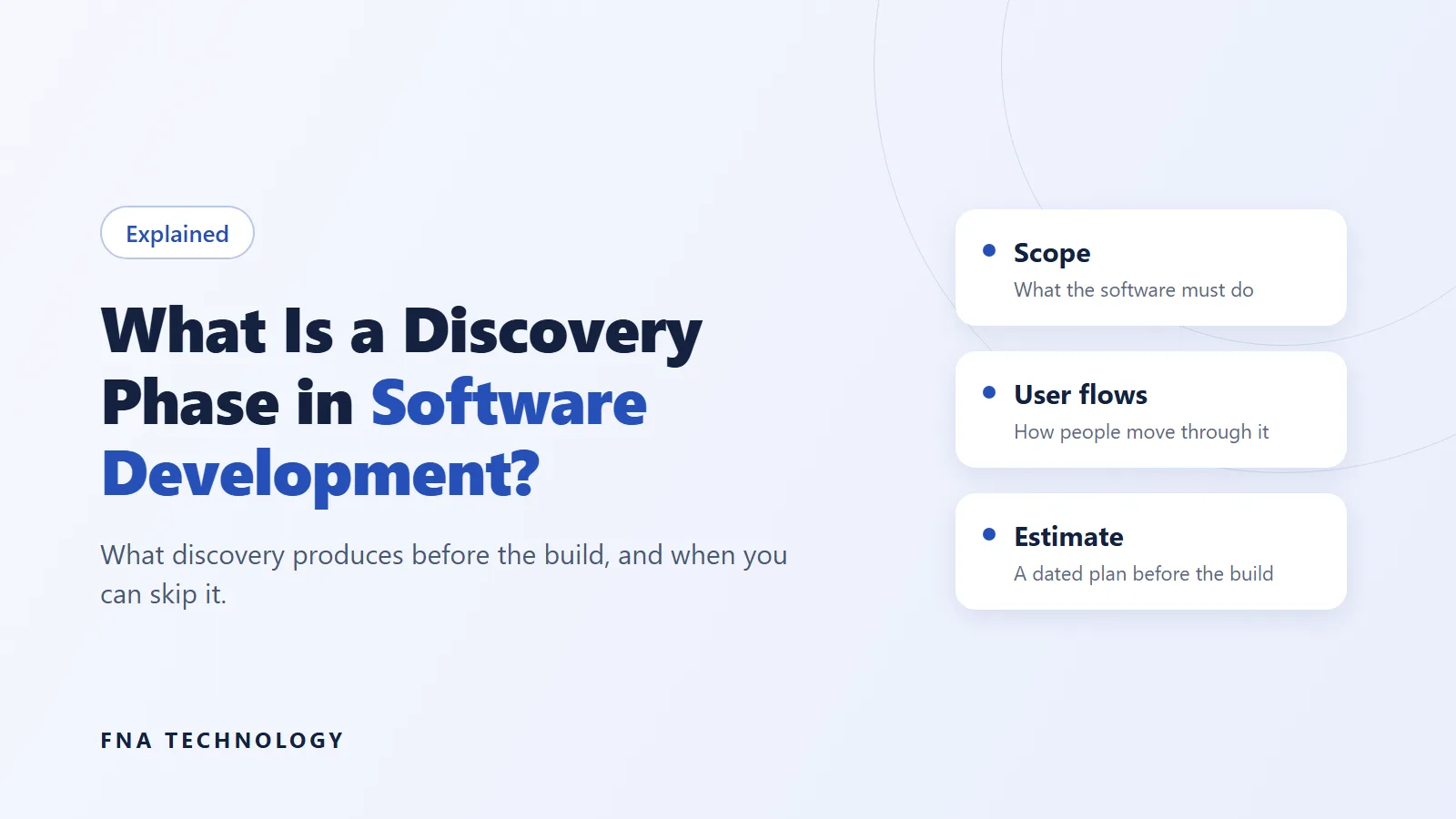
The short version: A discovery phase is the planning work done before a software team builds anything. You get a clear scope, user flows, an estimate and a list of risks, so you can decide whether and how to build. Skip it only when the work is small and well understood.
Commissioning software is expensive, and the first decisions are the ones that are hardest to undo. A discovery phase is the stage where you work out what should be built, for whom and what it will take, before the build starts. This guide explains what it is, what it should produce, how long and how much it can take for a UK business, when you can skip it and what goes wrong when you do.
We are FNA Technology. Our team is in Mumbai, India, and we work with UK businesses remotely. If you are still deciding what kind of software you need, read our bespoke software development for UK businesses, or read what bespoke software is first, and then our guide to bespoke software cost in the UK.
What is a discovery phase in app development?
A discovery phase in app development is the stage that comes before design and coding. Its job is to answer a few plain questions. What problem are we solving? Who will use the app? Which features matter most for a first release? How will it work, and what will it take to build?
The GOV.UK Service Manual puts the point simply: "Before you commit to building a service, you need to understand the problem that needs to be solved." The guidance is written for public services, but the logic holds for a private app too. GOV.UK Service Manual: how the discovery phase works
Discovery is not the building itself. It is the work that turns an idea into a plan you can check. Development then follows that plan, which is why a good discovery phase makes the build cheaper to control.
What does a software discovery phase deliver, such as scope, user flows and an estimate?
A discovery phase usually produces a small set of documents and diagrams. They exist to support a decision, so they need to be clear enough for your leadership team and detailed enough for engineers to estimate from. As general guidance, these are the outputs to expect.
| Output | What it covers | Why it helps |
|---|---|---|
| Scope | Features in, features out and the first release | Stops the build growing without a decision |
| User flows | The steps a user takes for each key task | Shows gaps and dead ends before code exists |
| Estimate | Effort, cost range and timeline, with assumptions | Gives you something to compare and approve |
| Risks | Unknowns, integrations, data and security concerns | Lets you reduce, accept or postpone each one |
Wireframes or a clickable prototype often come next, along with a short technical outline covering the stack, hosting and third-party systems. The MVP, meaning the smallest version that is still useful, is usually defined here too. For how we approach a first release, see our MVP development service.
The risk list is often the most valuable part. It might show that a system you rely on has no usable API, that customer data is messy, or that a compliance rule has not been checked. Once these are written down, you can choose what to do about each one.
After discovery, you get a dated plan from us. Use it to decide whether to go ahead, change the scope or wait.
How much does a software discovery phase cost for a UK business, and how many weeks does it take?
The honest answer depends on the problem. The GOV.UK Service Manual does not set a fixed length. It says: "Let the purpose of your discovery dictate how long you spend on it." It also notes that a problem nobody has researched before may need longer, while a problem you already know a fair bit about may need a shorter discovery.
The same page gives a rough typical figure for public services: "There's no set time period for a discovery, but around 4 to 8 weeks is typical." That figure comes from large public services, so treat it as a guide to scale, not as a quote for a small business tool.
The cost follows the work. It rises with the number of people to interview, the number of systems the new software must connect to and how much detail you want at the end. We quote clients outside India in US dollars or UAE dirhams, and invoices for UK clients are in US dollars.
Whole software projects with us typically cost between USD 5,000 and USD 200,000, depending on size. That range covers full builds, not discovery on its own. You see the price before development starts. Ask us for the dated plan you get after discovery, and check that it names the next steps and the price.
Most full projects with us take around two months, depending on size. Discovery comes before the build, so plan for it in your own timetable.
What should you prepare before a discovery phase?
You do not need a technical specification before discovery starts. You do need honest input and access to the people who understand the work. Before the first meeting, it helps to gather a few things.
- Examples of the current process, such as spreadsheets, forms, emails or screenshots.
- A list of the systems the new software may need to connect with.
- The pain points you already hear about from staff, customers or partners.
- Any legal, security or procurement rules the software must follow.
- A budget expectation, even if it is only a range.
- One named person on your side who can make decisions.
The more open you are about limits, the better the result. If the budget is tight, say so early. A good team can then shape a first release around the work that matters most to you, rather than designing a system you cannot afford to build.
How does a discovery phase work with a team in Mumbai?
Our team is in Mumbai, India. We work remotely with clients through video calls and progress updates, and each client has an account manager. We arrange call times to suit your time zone. Mumbai is 5 hours 30 minutes ahead of the UK in winter and 4 hours 30 minutes ahead in summer, so we plan calls around your working day.
Most clients start with a fixed scope. We also offer time and materials, or a dedicated team, if the work suits those better. Before you sign, our tech lead and project manager join meetings with you.
We sign the contract directly with you, and you own the source code. If you want access to the code repository during the project, we can arrange it on terms agreed in the contract.
Can a project skip the discovery phase, and when is that safe?
Yes, but only for work that is small and already well understood. Skipping a formal phase can be reasonable when all of the following are true.
- The change is minor, such as a new report on an existing admin tool.
- The users and their workflow are already understood.
- There are no complex integrations.
- The data is clean and easy to reach.
- The budget risk is low.
- The supplier can write a clear scope from what you already have.
Even then, do not skip the questions. A short call, a written scope and a rough estimate are still worth having before any code is written. The GOV.UK guidance treats discovery as a matter of degree. It says: "If it's a problem you know a fair bit about already, you might be able to have a slightly shorter discovery." A shorter discovery is still a discovery.
Skipping is the wrong choice when you are building a new product, replacing core business software, joining several systems, handling sensitive data or asking for a fixed price on requirements that are still unclear. It is also wrong when people inside your business disagree about what the system should do.
What risks come from starting development without a discovery phase?
Starting without discovery does not remove the questions. It moves them into the build, where answers cost more. The usual risks are these.
- The team builds features that users do not need, because nobody checked who the users were.
- Scope grows during the build, so the original estimate stops meaning anything.
- An integration turns out to be harder than expected, and the timetable slips.
- Decisions stall because no one agreed who owns the product and its priorities.
- The budget runs out before the most important features are finished.
Each of these tends to surface mid-build, when a change means reworking code that already exists. A short discovery phase brings the same questions forward, when they are cheap to answer.
What should discovery decide about AI?
If the software will use AI, discovery should decide which task the AI does, what data it may read, and how a wrong answer is caught before a customer sees it. Those answers shape both the build cost and the monthly running cost. We cover the approach in our AI integration services.
Should you ask for a discovery phase before you commission software?
For most new software, a discovery phase is a sensible first step. Discovery is the step that tells you whether the idea is worth building, what the first version should contain and what it will realistically cost. Use the questions in this guide to judge whether your project is small enough to skip the formal stage.
If you are about to commission software and cannot yet say who will use it, which systems it must connect to or what it should cost, a discovery phase is the safer first step. Tell us the process and the tools it touches, and we will tell you what a discovery phase would need to cover for your project. Talk to an engineer
Frequently Asked Questions
A discovery phase is the planning stage before design and coding start. It settles what the app should do, who will use it and what a first release should include. You finish with enough clarity to decide whether to build, and how.
Usually you receive a scope document, user flows, an estimate with its assumptions and a list of risks. Wireframes and a technical outline are common too. At FNA, after discovery you get a dated plan.
The length depends on the problem, not on a fixed rule. After discovery you get a dated plan, and you see the price before development starts. Invoices for UK clients are in US dollars.
Small, well understood changes can skip a formal phase, with a short call, a written scope and an estimate. New products, and work that touches several systems, usually should not skip it. The GOV.UK guidance says a problem you know well may need a shorter discovery, not none.
The main risks are building the wrong features, scope that grows during the build and integrations that prove harder than expected. These tend to show up as overruns, when changes cost the most. A short discovery phase makes most of them visible before the build starts.
You own the source code. We sign the contract directly with you, and the contract sets the terms for access to the code repository during the project.