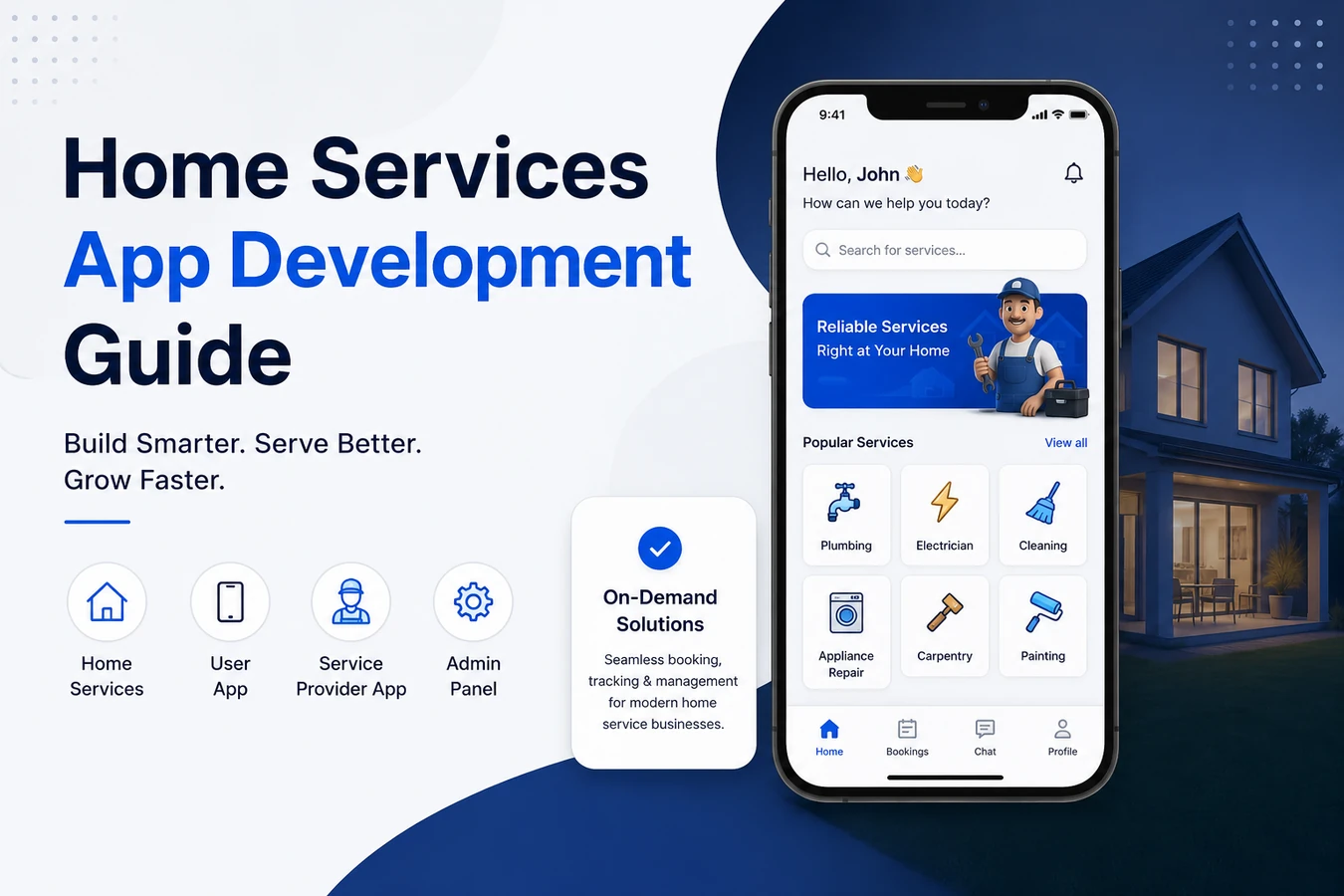
The short version: Building an on-demand home services app is not just about designing a clean booking screen; it requires managing a complex three-sided marketplace (customers, service professionals, and dispatch admins). Here is the technical architecture, database schema, and operational blueprint derived from building the Homento platform.
The on-demand home services market—spanning home cleaning, electrical maintenance, plumbing, appliance repair, and beauty services—has grown rapidly. But behind every smooth booking experience lies a complex engineering ecosystem.
Many startups fail because they view a home services app as a simple e-commerce storefront. In reality, an on-demand platform must coordinate real-time geographic dispatch, skill matching, worker availability, escrow payments, and service quality control simultaneously.
Using our experience building Homento—a production-grade home services dispatch and booking platform—and AI automated support ecosystems like Khedmah Chatbot, this guide outlines the complete architectural blueprint for founders and engineering teams.
The 3-Tier System Architecture of a Home Services Platform
A production home services platform consists of three distinct applications interacting through a unified cloud backend API:
+-----------------------------------------------------------------------------------+
|                                 CLOUD BACKEND API                                 |
|         (Node.js / Go microservices + PostgreSQL + Redis + WebSockets)            |
+-----------------------------------------------------------------------------------+
       ^                                  ^                                  ^
       |                                  |                                  |
       v                                  v                                  v
+-----------------------+      +-----------------------+      +-----------------------+
|  CUSTOMER BOOKING APP |      |  PROVIDER WORKER APP  |      |   ADMIN DISPATCH WEB  |
|  (iOS & Android)      |      |  (iOS & Android)      |      |   (Next.js Dashboard) |
|                       |      |                       |      |                       |
| - Service catalog     |      | - Job notifications   |      | - Dispatch overrides  |
| - Real-time booking   |      | - Accept/Reject toggle|      | - Provider background |
| - Dynamic slot picker |      | - Navigation & GPS    |      |   verification        |
| - In-app chat & calls |      | - Instant wallet pay  |      | - Financial analytics |
+-----------------------+      +-----------------------+      +-----------------------+
1. Customer Booking Application
The customer app must minimize friction from service search to checkout.
- Dynamic Category & Service Selector: Nesting categories (e.g., AC Repair -> Split AC -> Jet Servicing).
- Interactive Calendar Slot Picker: Real-time checking of available provider capacity before confirming booking time.
- In-App Messaging & Automated AI Support: Integrating masked calls (Twilio/Exotel) and conversational automated resolution assistants like Khedmah Chatbot for instant booking status queries.
2. Service Provider Application
The provider app must operate flawlessly under adverse conditions (weak cellular connectivity, older Android hardware).
- Instant Job Alert Audio Alarms: High-priority push notifications with custom sound alerts so providers never miss time-sensitive jobs.
- One-Tap Status Flow: State transitions (Accepted -> En Route -> Arrived -> Job Started -> Inspection -> Payment Pending -> Job Complete).
- Proof of Work Capture: Requiring providers to upload before-and-after photos directly inside the app before closing a job ticket.
3. Admin Dispatch & Operation Dashboard
The operational hub for platform managers.
- Live Map Grid: Visualizing active service requests, online providers, and ongoing jobs across geographic zones.
- Manual Override Dispatch: Allowing admins to manually reassign jobs if a provider encounters a vehicle breakdown or emergency.
- Automated Payout Engine: Processing daily or instant worker payouts into bank accounts after deducting platform commission fees.
Lessons from Homento: 4 Hard Engineering Challenges
During the development of Homento, we encountered technical hurdles that every home services founder must prepare for.
+-------------------------------------------------------------------------+
|                  HOMENTO ENGINEERING LESSONS & BLUEPRINT                |
+-------------------------------------------------------------------------+
| 1. GEOHASHING DISPATCH ENGINE   | Matches nearest available provider     |
| 2. DYNAMIC PRICING MATRIX      | Handles peak hour & spare part add-ons |
| 3. ESCROW PAYMENT WORKFLOW     | Holds funds until customer sign-off    |
| 4. QUALITY ESCALATION TRIGGER  | Auto-alerts admin on low service rating|
+-------------------------------------------------------------------------+
Challenge 1: Efficient Geohashing for Real-Time Dispatch
Querying spatial postgis coordinates for hundreds of active providers on every booking creates severe database bottlenecks.
The Solution: We implemented Redis Geohashing. Provider location updates from mobile devices update Redis spatial indexes (GEOADD). When a customer books a service, the backend performs a fast GEORADIUS query in sub-5ms to identify nearby active providers with matching skill tags.
Challenge 2: Handling Variable Job Costs & Spare Parts
Unlike buying a fixed-price product, home services frequently involve variable costs. A plumber might arrive for a ₹499 inspection fee, but discover the job requires ₹1,200 in replacement piping.
The Solution: Homento’s architecture includes an In-Job Add-On Pipeline. The provider selects required spare parts from an approved price list within their app. This sends a real-time authorization prompt to the customer’s app. Once approved by the customer, the invoice updates dynamically.
Challenge 3: Trust & Safety Controls
In home services, customer safety is paramount.
The Solution:
- OTP-Gated Job Commencement: The provider cannot mark "Job Started" without entering a 4-digit OTP provided by the customer upon arrival.
- KYC & Document Verification: Admin dashboard includes document OCR and manual verification checks before a provider profile goes live.
Challenge 4: Automated Quality Escalation & Dispute Triggers
When a customer rates a completed job poorly or flags an incomplete task, manual support triage causes delay and friction.
The Solution: Homento automates dispute handling by holding payout transfers in escrow, prompting the provider for before-and-after photo evidence, and flagging high-priority triage tickets in the admin dispatch dashboard.
Key Features Checklist for a Production Home Services App
Below is a feature audit matrix comparing basic MVP implementations against enterprise-grade platforms like Homento.
| Feature Area | Basic MVP App | Production-Grade Platform (Homento Level) |
|---|---|---|
| Dispatch System | Manual admin assignment | Automated geohash matching + manual override fallback |
| Pricing Engine | Fixed flat rate pricing | Dynamic rate cards, peak surge pricing, spare part add-ons |
| Payment Flow | Cash on delivery / basic gateway | Integrated online payments, escrow hold, instant provider payout |
| Real-Time Tracking | Static status text updates | Live GPS tracking map during provider transit |
| Dispute Handling | Generic support email link | In-app ticket raising, job photo evidence, auto-refund triggers |
Source: FNA Technology Product Architecture Practice, last verified August 2026.
Estimated Budget & Timeline for Home Services App Development
Building a platform of this scale requires a phased roadmap. Below is a realistic cost and timeline breakdown for 2026.
PHASE 1: Architecture & UI/UX (Weeks 1-3)
------------------------------------------
- Figma wireframes & interactive prototypes
- Database schema design & API contract specification

PHASE 2: Core Development & Integrations (Weeks 4-10)
-----------------------------------------------------
- Customer App, Provider App & Admin Panel builds
- Payment gateway, SMS OTP, and Map API integration

PHASE 3: QA, Field Testing & Store Launch (Weeks 11-14)
------------------------------------------------------
- Field load testing with real device GPS tracking
- iOS App Store & Google Play Store submission
Development Budget Guidance:
- Standard MVP (Single service category, basic dispatch): ₹6,00,000 - ₹9,50,000 ($7,500 - $11,500 USD)
- Full Platform (Multi-category, dynamic add-ons, wallet payouts): ₹12,00,000 - ₹22,00,000 ($14,500 - $27,000 USD)
Next Steps for On-Demand App Founders
If you are planning to build an on-demand home services, logistics, or dispatch application, explore our mobile app development services and web development capabilities.
You can also read our detailed guide on food delivery app development to understand similar real-time dispatch architectures.