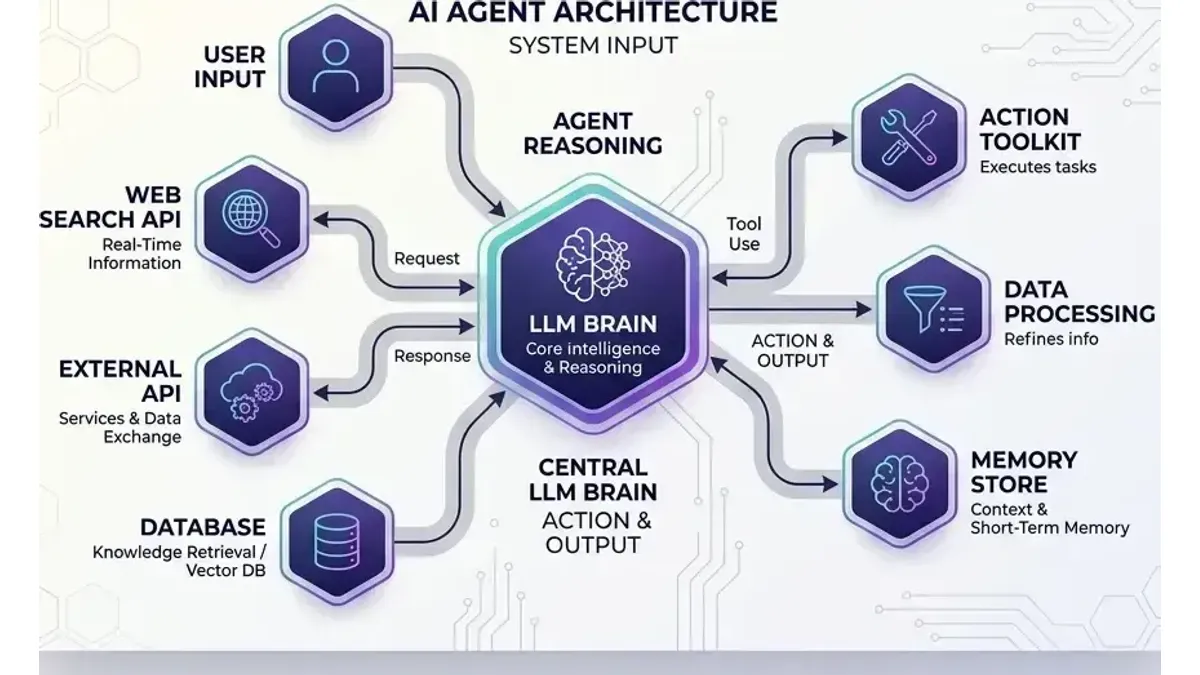
AI agents, advanced AI bots, and chatbots automate complex workflows and customer interactions by reasoning through multi-step processes and executing API calls. They move beyond scripted responses to autonomously solve problems, pull data, and execute tasks across your business systems.
Short version: Enterprise AI agents reduce manual operational load by executing tasks across systems. FNA Technology builds deterministic, ReAct-driven agents that integrate with your APIs to handle support, research, and data entry autonomously.
How do AI agents differ from AI bots & chatbots?
The core difference between a standard AI bot (or chatbot) and an AI agent is autonomy. A conversational AI bot retrieves context via RAG (Retrieval-Augmented Generation) and synthesizes an answer. An AI agent receives a goal, plans the necessary steps, selects from a toolbox of APIs, and acts on those tools until the goal is met.
| Capability | Conversational AI Bot | Autonomous Agent |
|---|---|---|
| Primary Function | Answer questions and summarize data. | Complete multi-step workflows. |
| Tool Use | None, or basic search retrieval. | Reads and writes via internal and external APIs. |
| State Management | Simple conversation history. | Complex memory structures and task graphs. |
Architecture of an Autonomous Agent
A production-grade agent requires rigid state management. We implement the ReAct (Reasoning and Acting) paradigm using graph-based orchestration tools like LangGraph. This enforces determinism by breaking tasks into cyclical nodes.
In this model, the agent first evaluates the state. It generates a "Thought" about what to do next. It then executes an "Action" by selecting an API tool and passing parameters. Finally, it receives an "Observation" from the API response. The cycle continues until a terminal condition is satisfied.
Mathematical Representation of ReAct
If is the context state at step , the model generates a thought and an action such that:
The environment returns an observation , and the new state becomes . This forces the LLM to ground its next decision on explicit evidence rather than hallucinated assumptions.
Core Technologies and Tooling
Building reliable agents requires an ecosystem of specialized frameworks. We utilize state-of-the-art tooling to guarantee execution speed and safety.
- LangGraph & AutoGen: Frameworks for defining stateful, multi-actor workflows as directed cyclic graphs.
- Function Calling Models: Models explicitly tuned for structured output generation (like GPT-4o and specialized Llama 3 variants) to guarantee valid JSON parameters for APIs.
- Vector Stores: Pinecone, Qdrant, or pgvector for fast semantic retrieval of standard operating procedures and entity memory.
Industry Applications for AI Agents
Agents provide the highest return on investment in operations heavily reliant on manual data reconciliation and multi-system updates.
For instance, in logistics, an agent can monitor inbound emails, extract shipping manifests, query an internal ERP for inventory status, and draft a response to the vendor, all autonomously. Based on our deployment metrics across FNA Technology client implementations, well-architected agents reduce the time spent on repetitive manual tasks by up to 60%.
What does an AI agent cost to develop?
Development costs scale directly with the complexity of tool integrations and the required autonomy level. Building a chatbot that queries a static internal document base is relatively straightforward, while orchestrating a fleet of agents that execute financial transactions requires extensive guardrails.
- Conversational RAG Chatbots: Typical investment ranges from $15,000 to $25,000, requiring 3 to 4 weeks. Ideal for internal knowledge bases and tier-1 customer support.
- Autonomous Agent Workflows: Orchestrated agents that write data to CRMs or execute backend logic range from $45,000 to $85,000, spanning 8 to 12 weeks.