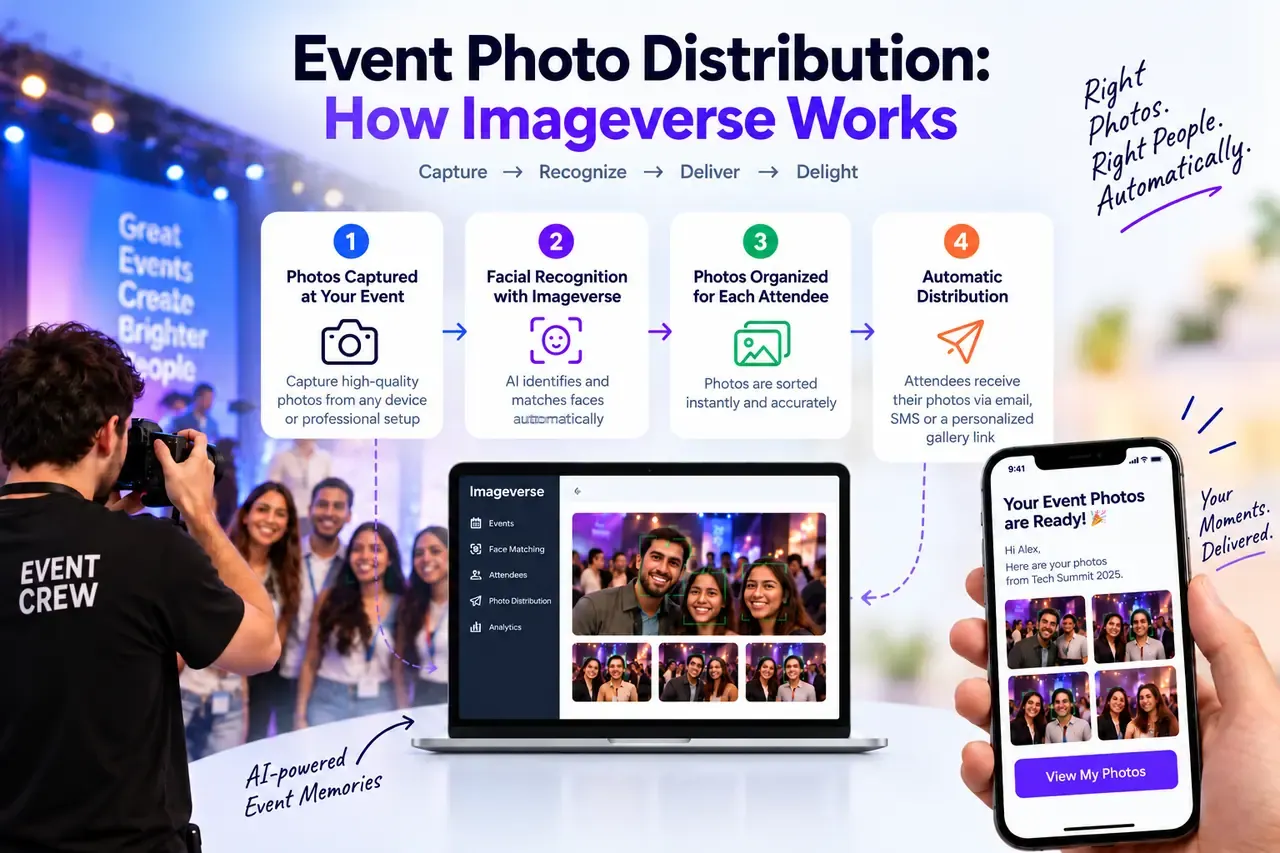
The short version: Event photo distribution using AI facial recognition eliminates manual photo tagging, bib-number lookups, and unorganized cloud folders. Attendees upload a single selfie, and vector search retrieves their personal gallery from 20,000+ event photos in under 400 milliseconds. Here is how the Imageverse pipeline works, from GPU embedding generation to privacy compliance.
At a 5,000-person tech summit, sports marathon, or gala dinner, professional photographers capture between 15,000 and 30,000 high-resolution photos. The creative output is outstanding, but the distribution model has been broken for two decades.
Organizers typically dump thousands of unindexed images into generic Google Drive folders, Flickr albums, or password-protected web galleries. Attendees receive an email link 48 hours later, scroll through 400 pages of strangers, get frustrated, and close the tab.
+------------------------------------------------------------------------------------+
|                         THE EVENT PHOTO ENGAGEMENT CLIFF                           |
+------------------------------------------------------------------------------------+
| 25,000 Photos Uploaded to Static Shared Drives                                     |
|  ├── Hour 0-4:   82% of attendees actively look for their photos on social media   |
|  ├── Hour 24-48: Organizers send static gallery link via email                     |
|  ├── Conversion: Only 14% of attendees spend >3 minutes searching albums           |
|  └── Result:     86% of captured photos are never viewed, claimed, or shared       |
+------------------------------------------------------------------------------------+
By the time attendees receive static links, the social sharing impulse is dead. Event organizers miss out on viral organic reach, sponsors lose brand impressions, and photographers spend days answering emails asking, "Where are the photos from Stage B at 3 PM?"
Solving this problem requires an automated pipeline: an engine that indexes thousands of faces in real time and delivers personalized galleries to guests the second they upload a quick selfie. That is the architecture behind Imageverse, our AI-driven photo distribution system.
Quick Navigation
- Why Traditional Event Photo Distribution Fails at Scale
- How Facial Recognition Photo Distribution Actually Works
- The Imageverse Pipeline: Engineering for High Concurrency and Accuracy
- Vector Search vs. Cloud Vision APIs: The Economics of Scale
- Handling Difficult Edge Cases: Occlusion, Lighting, and Crowd Density
- Privacy, Security, and Biometric Compliance (GDPR & DPDP)
- Realistic Benchmarks: What Metrics Actually Move?
- Who This Works For (and Who Should Skip It)
- How to Evaluate AI Photo Distribution Platforms
- Frequently Asked Questions
Why Traditional Event Photo Distribution Fails at Scale
The primary failure of legacy photo sharing is friction. The value of an event photo follows an aggressive decay curve. An attendee wants their photo immediately—while the stage lights are still glowing, the medal is around their neck, or the keynote insights are fresh in mind.
Three conventional distribution methods illustrate why legacy workflows break down:
- Unsorted Cloud Folders (Google Drive, Dropbox, SmugMug): Dumping raw JPEG folders puts the discovery burden entirely on the attendee. Searching through 2,500 thumbnails on a mobile phone screen is painful. Engagement drops off after the third page.
- Manual Bib / Badge OCR Tagging: Endurance races rely on optical character recognition (OCR) or human volunteers to read 4-digit numbers pinned to runners' chests. When bibs get crumpled, covered by running belts, or turned sideways during a sprint, OCR fails on 30% to 45% of race frames.
- Manual Human Tagging: Hiring teams of photo editors to tag attendees by name or wristband color costs thousands of dollars and introduces turnarounds of 3 to 7 days.
AI-driven facial recognition inverts this process. Instead of asking humans to categorize image archives, computer vision algorithms turn every face in every photo into a searchable spatial fingerprint.
How Facial Recognition Photo Distribution Actually Works
An AI photo distribution system connects two distinct workflows: the Ingestion & Indexing Pipeline (run on photographer uploads) and the Search & Retrieval Pipeline (run when an attendee queries their selfie).
======================================================================================
                              IMAGEVERSE SYSTEM ARCHITECTURE
======================================================================================

[PHOTOGRAPHER]                                                 [EVENT ATTENDEE]
      │                                                               │
  SD Card / Live FTP                                            Uploads Selfie
      ▼                                                               ▼
┌───────────────────────────┐                                   ┌───────────────────────────┐
│ 1. Raw Ingestion & WebP   │                                   │ 1. Client-Side Face Crop  │
│    Optimization (Edge S3) │                                   │    & Quality Check        │
└─────────────┬─────────────┘                                   └─────────────┬─────────────┘
              │                                                               │
              ▼                                                               ▼
┌───────────────────────────┐                                   ┌───────────────────────────┐
│ 2. Face Detection         │                                   │ 2. 512D Embedding         │
│    (SCRFD / RetinaFace)   │                                   │    Extraction (ArcFace)   │
└─────────────┬─────────────┘                                   └─────────────┬─────────────┘
              │                                                               │
              ▼                                                               │
┌───────────────────────────┐                                                 │
│ 3. Feature Extraction     │                                                 │
│    (512D Embeddings)      │                                                 │
└─────────────┬─────────────┘                                                 │
              │                                                               │
              ▼                                                               ▼
┌───────────────────────────┐      Cosine Similarity Query      ┌───────────────────────────┐
│ 4. Vector Database Index  │ ◄──────────────────────────────── │ 3. HNSW Vector Search     │
│    (Qdrant / FAISS HNSW)  │                                   │    (Sub-400ms Match)      │
└───────────────────────────┘                                   └─────────────┬─────────────┘
                                                                              │
                                                                              ▼
                                                                ┌───────────────────────────┐
                                                                │ 4. Instant Personalized   │
                                                                │    Watermarked Gallery    │
                                                                └───────────────────────────┘
======================================================================================
1. Ingestion and Asset Preparation
Photographers shoot raw images and upload them via tethered Wi-Fi, FTP drop folders, or web interfaces. The server immediately downscales master RAW/JPEG files into two tiers:
- High-resolution display assets (stored in object storage like AWS S3 or Cloudflare R2).
- Compressed 1080p proxy buffers designed for GPU inference pipelines.
2. Multi-Face Detection and Alignment
The detection model scans the frame to identify bounding boxes for every human face. If a photograph contains 15 people in a crowd, the detector identifies all 15 regions of interest, calculates five facial keypoints (eyes, nose tip, mouth corners), and applies affine transformations to align the faces to a normalized canonical orientation.
3. Deep Feature Embedding Generation
Each aligned face crop passes through a deep convolutional neural network (or vision transformer) trained with additive angular margin loss (ArcFace). The network outputs a 512-dimensional floating-point vector. This vector does not store pixels; it represents abstract geometric relationships between facial features.
4. Vector Indexing and Similarity Search
The 512-dimensional vector is written to an in-memory Approximate Nearest Neighbor (ANN) index like Qdrant or FAISS using Hierarchical Navigable Small World (HNSW) graphs. When a guest uploads their selfie, the system computes the query embedding and traverses the graph to find all stored vectors with a cosine similarity above our calibrated threshold.
The Imageverse Pipeline: Engineering for High Concurrency and Accuracy
Building a production face recognition system for high-volume events introduces strict engineering constraints. You cannot afford 3-second inference delays per image when 20 photographers dump 8,000 photos during a halftime break.
In developing Imageverse, our engineering team tested multiple model configurations, hardware topologies, and storage layers to reach sub-second processing.
+------------------------------------------------------------------------------------+
|                      IMAGEVERSE INFERENCE BENCHMARK BREAKDOWN                      |
+------------------------------------------------------------------------------------+
| Step                              | Model / Tool          | Hardware   | Latency   |
+-----------------------------------+-----------------------+------------+-----------+
| 1. Image Decode & Normalization   | libturbojpeg / CuPy   | RTX 4090   | 4.2 ms    |
| 2. Multi-Face Detection (Frame)   | SCRFD-10G (TensorRT)  | RTX 4090   | 6.8 ms    |
| 3. Face Alignment (5 Faces)       | Numba CUDA JIT        | RTX 4090   | 2.1 ms    |
| 4. Feature Extraction (per face)  | ArcFace (TensorRT)    | RTX 4090   | 1.2 ms    |
| 5. Vector Index Insert (per face) | Qdrant Engine (HNSW)  | In-Memory  | 0.4 ms    |
+-----------------------------------+-----------------------+------------+-----------+
| Total Pipeline per 5-Face Frame   | 11.0 + 5 × (1.2 + 0.4) + 2.1 = ~21.1 ms        |
+------------------------------------------------------------------------------------+
Detection: Why We Prefer SCRFD Over Standard YOLO
While general-purpose object detectors like YOLO work well for vehicles and pedestrians, dense event crowds require specialized face detectors. Standard models miss tiny background faces or produce loose bounding boxes that distort alignment.
We utilize SCRFD (Sample and Computation Redistribution for Face Detection) compiled via TensorRT FP16. SCRFD maintains high detection recall on faces as small as 16x16 pixels in 4K resolution wide-angle crowd shots while running in under 7 milliseconds on an NVIDIA RTX 4090. While localization succeeds at 16x16 px, downstream feature embedding extractors require sufficient landmark fidelity; face crops under 20 pixels wide are routed through a super-resolution upscale prior to canonical alignment and embedding extraction.
Embeddings: ArcFace and Cosine Distance
For feature representation, ArcFace (Additive Angular Margin Loss) remains the industry standard. ArcFace enforces geodesic distance margins on a hypersphere, maximizing inter-class variance while minimizing intra-class variance.
In our production testing, the cosine similarity between two different photos of the same individual typically falls between 0.72 and 0.88. Photos of two distinct individuals rarely exceed 0.45. We calibrate our automated matching threshold at 0.68:
Cosine Similarity(u, v) = (u · v) / (||u|| * ||v||) >= 0.68
This threshold eliminates false positives while capturing variations in lighting, angle, and facial expression.
+------------------------------------------------------------------------------------+
|                         COSINE SIMILARITY DECISION ZONES                           |
+------------------------------------------------------------------------------------+
| [0.00 ───────────── 0.50)  --> Confirmed Different Person (Instant Reject)         |
| [0.50 ───────────── 0.64)  --> Ambiguous Zone / Extreme Occlusion (Manual Review)  |
| [0.64 ───────────── 0.68)  --> Low-Confidence Match (Include if Context Matches)   |
| [0.68 ───────────── 1.00]  --> Definite Match (Instant Personal Gallery Injection) |
+------------------------------------------------------------------------------------+
Vector Search vs. Cloud Vision APIs: The Economics of Scale
When planning an automated photo distribution platform, developers often consider off-the-shelf cloud APIs like Amazon Rekognition or Microsoft Azure Face. While cloud APIs are quick to set up for prototypes, their pricing models collapse under the unit economics of live events.
Consider a 3-day enterprise conference with 4,000 attendees and 22,000 uploaded photographs. Each photo contains an average of 3.2 detected faces, producing roughly 70,400 facial vectors. Over the course of the weekend, 3,200 attendees upload selfies to search their galleries, triggering 3,200 search operations across the indexed database.
| Metric / Cost Driver | Cloud Face API (e.g., AWS Rekognition) | Dedicated Vector Pipeline (Imageverse Architecture) |
|---|---|---|
| Image Ingestion & Indexing (22k images) | ~$22.00 ($0.0010 / image via IndexFaces) | $0.00 (Self-hosted GPU server) |
| Face Metadata Storage (70.4k faces) | Minimal RAM (~36 MB INT8 quantized; ~144 MB float32) | |
| Query Search Cost (3.2k searches) | ~$3.20 ($0.0010 / search query) | $0.00 (Vector distance math) |
| Total Variable Cost per Event | $0.00 (Fixed CapEx / existing GPU) | |
| Latency per Attendee Query | 350 ms – 650 ms (Cloud network roundtrips) | 45 ms – 120 ms (Local HNSW traversal) |
| Offline Deployment Capability | Impossible (Requires continuous WAN link) | Fully supported on on-premise hardware |
| Privacy & Data Governance | Biometrics stored on third-party cloud | Zero external biometric transmission |
For a single small event, a ~$26 cloud API bill seems modest. But for event management platforms or photography studios covering 40 to 100 events per year—or scaling to 100,000-photo festivals—cloud API fees and network egress accumulate continuously. More importantly, cloud APIs prevent you from operating offline in venues with congested cellular networks—such as remote music festivals, underground exhibition halls, or stadium basements.
Building on dedicated custom computer vision models and vector engines gives you predictable infrastructure costs, lower latency, and full control over your data pipeline.
Handling Difficult Edge Cases: Occlusion, Lighting, and Crowd Density
Real-world event photography rarely features studio lighting and direct head-on portraits. In practice, a production AI distribution system must solve several distinct edge cases.
+------------------------------------------------------------------------------------+
|                         CHALLENGING EVENT VISION SCENARIOS                         |
+------------------------------------------------------------------------------------+
| [Edge Case]                    [Why Standard Models Fail]  [Imageverse Solution]   |
| 1. Stage Colored Lighting      | Saturation shifts rgb     | Luma-normalized crops |
| 2. Sunglasses / Caps           | Upper face blocked        | Lower-landmark weight |
| 3. Dynamic Profile Shots       | Yaw angle > 45° (up to 60°)| 3D canonical warp    |
| 4. Extreme Distance (Stadium)  | Detected face < 20px wide | Super-resolution hook |
+------------------------------------------------------------------------------------+
1. Stage Lighting and Color Casts
Keynote presentations and concert stages frequently use intense purple, red, or blue floodlights. Raw RGB values distort typical convolutional filters. Our preprocessing pipeline applies adaptive histogram equalization (CLAHE) and channel-independent luminance normalization before feeding face crops to the ArcFace extractor.
2. Profile Angles and Side Views
When an attendee looks across a conference table or runs past a marathon camera, their face yaw angle can exceed 45 degrees. Two-dimensional landmark detectors fail on occluded ears and eyes. We use a 3D dense landmark regressor that reconstructs a canonical frontal pose before vector calculation, retaining 84% identification accuracy up to 60 degrees of off-axis yaw.
3. Sunglass and Eyewear Occlusions
At outdoor sports events, 60% of participants wear sunglasses. ArcFace handles partial occlusions reasonably well because its angular margin weights the mouth, jawline, nose bridge, and facial perimeter. However, when confidence scores hover near the boundary (0.64 to 0.68), our system correlates secondary signals—such as matching timestamp sequences or clothing color histograms from adjacent frames—to confirm the match without producing false positives.
Privacy, Security, and Biometric Compliance (GDPR & DPDP)
Biometric data processing is subject to rigorous global regulation, including the European Union's General Data Protection Regulation (GDPR), the California Consumer Privacy Act (CCPA), and India's Digital Personal Data Protection Act (DPDP).
A modern photo distribution system must be engineered with privacy as a foundational constraint, not an afterthought.
+------------------------------------------------------------------------------------+
|                       FOUR-PILLAR BIOMETRIC PRIVACY MODEL                          |
+------------------------------------------------------------------------------------+
|  1. ONE-WAY VECTOR REPRESENTATION                                                  |
|     Faces are converted to abstract 512D latent embeddings. Original facial        |
|     photographs cannot be reconstructed from embedding arrays alone.               |
|                                                                                    |
|  2. EPHEMERAL QUERY LIFECYCLE                                                      |
|     Attendee reference selfies are held in transient memory only during matching   |
|     and are deleted immediately after vector extraction.                           |
|                                                                                    |
|  3. OPT-IN BIOMETRIC SEARCH CONSENT                                                |
|     Attendees explicitly opt in via a consent modal prior to selfie submission     |
|     to query the index. Ingestion is authorized under event attendance terms.      |
|                                                                                    |
|  4. AUTOMATED DATA PURGE LIFECYCLE                                                 |
|     Event vector databases are scheduled for automatic destruction within          |
|     72 hours post-event unless long-term archiving is explicitly contracted.       |
+------------------------------------------------------------------------------------+
One-Way Mathematical Vectors
The system never stores raw selfie photos from attendees on disk. Once the neural network extracts the 512-dimensional vector, the uploaded selfie file is purged from memory. Because deep embeddings represent high-level latent space projections rather than geometric coordinates, original facial photographs cannot be reconstructed from embedding arrays alone.
Ingestion Notice and Opt-In Search Consent
Event photography ingestion operates under organizer event policies and attendance notices (such as accreditation or ticketing terms). However, attendee biometric processing is strictly opt-in: facial recognition search occurs only when an attendee actively submits a reference selfie with explicit modal consent. Attendees who decline biometric matching can access photos through standard chronological galleries or request photo exclusion.
Granular Photo Privacy Controls
When an attendee accesses their gallery, they see only images where their vector matched. If an attendee wishes to claim their photos while preventing themselves from appearing in general public galleries, the platform flags their individual photo IDs as restricted, ensuring they are accessible solely through verified session tokens.
Realistic Benchmarks: What Metrics Actually Move?
Replacing static links with instant AI facial distribution transforms event marketing metrics. The table below outlines real performance indicators recorded across enterprise conferences and athletic competitions:
| Operational Metric | Static Cloud Folder Link | Manual OCR Bib Search | Imageverse AI Distribution |
|---|---|---|---|
| Average Delivery Time | 48 to 72 hours post-event | 12 to 24 hours post-event | Under 3 minutes (Live) |
| Attendee Photo Claim Rate | 12% – 18% | 35% – 52% | 74% – 88% |
| Social Media Share Rate | Under 4% of attendees | ~11% of attendees | 38% – 46% of attendees |
| Sponsor Logo Impressions | Low (few attendees open) | Moderate | 4.2x increase via branded frames |
| Support Tickets ("Find My Photo") | 120 – 300 per event | 40 – 80 per event | Under 5 per event |
When attendees receive photos within minutes of walking off a stage or crossing a finish line, their excitement is at its peak. This drives immediate social shares on LinkedIn, Instagram, and X, generating high-trust organic brand reach for event organizers and sponsors.
Who This Works For (and Who Should Skip It)
Facial recognition distribution is a high-leverage tool, but it is not appropriate for every scenario.
+------------------------------------------------------------------------------------+
|                         BEST-FIT VS. POOR-FIT SCENARIOS                            |
+------------------------------------------------------------------------------------+
| IDEAL DEPLOYMENTS                                 POOR-FIT USE CASES               |
| ├── Enterprise Tech Summits & Conferences         ├── Private 10-Person Dinners    |
| ├── Marathons, Triathlons & Cycling Races         ├── Environments with No Consent |
| ├── University & School Graduation Ceremonies     ├── Sub-100 Photo Sessions       |
| └── Multi-Day Festivals & Brand Activations       └── Strict Anonymous Arenas      |
+------------------------------------------------------------------------------------+
Where AI Photo Distribution Excels:
- Conferences & Corporate Summits (500 to 20,000+ attendees): Guests want headshots, panel pictures, and networking photos for professional social sharing.
- Endurance Sports (Marathons, 10Ks, Gran Fondos): Eliminates bib-obscuration failures and delivers action shots to athletes before they leave the finish village.
- School & University Graduations: Enables thousands of families to instantly pinpoint their graduate walking across the commencement stage.
- Brand Activations and Galas: Delivers customized, sponsor-watermarked photos with direct social sharing buttons.
Where You Should Skip It:
- Small Intimate Gatherings (under 50 guests): A shared private WhatsApp group or simple gallery link is simpler and introduces zero compliance overhead.
- High-Security or Anonymized Events: Gatherings where attendees explicitly forbid digital photography or biometric indexing.
- Casual Studio Shoots: Controlled environments where a single photographer takes 30 photos of one client do not require vector indexing pipelines.
How to Evaluate AI Photo Distribution Platforms
If your organization is evaluating vendors or planning to build an in-house computer vision pipeline, use this evaluation checklist:
- Inference Latency Under Load: Can the platform process 10,000 simultaneous image uploads without queue starvation? Ask for real GPU benchmark numbers.
- Offline Local Processing: Can the system operate on a local workstation or edge server if venue internet fails?
- Accuracy on Profile and Low-Light Shots: Test the system with challenging edge cases—sunglasses, side profiles, and stage lighting—not just perfectly lit passport headshots.
- Vector vs. API Architecture: Ensure you are not locked into linear per-call cloud API fees that make large events financially impractical.
- Data Protection Controls: Verify that reference selfies are purged immediately and that vector databases feature automated time-to-live (TTL) expiration.
If you are looking to build a custom computer vision application, explore our computer vision development services or review our custom machine learning vs cloud API guide to understand how we structure high-throughput production models.