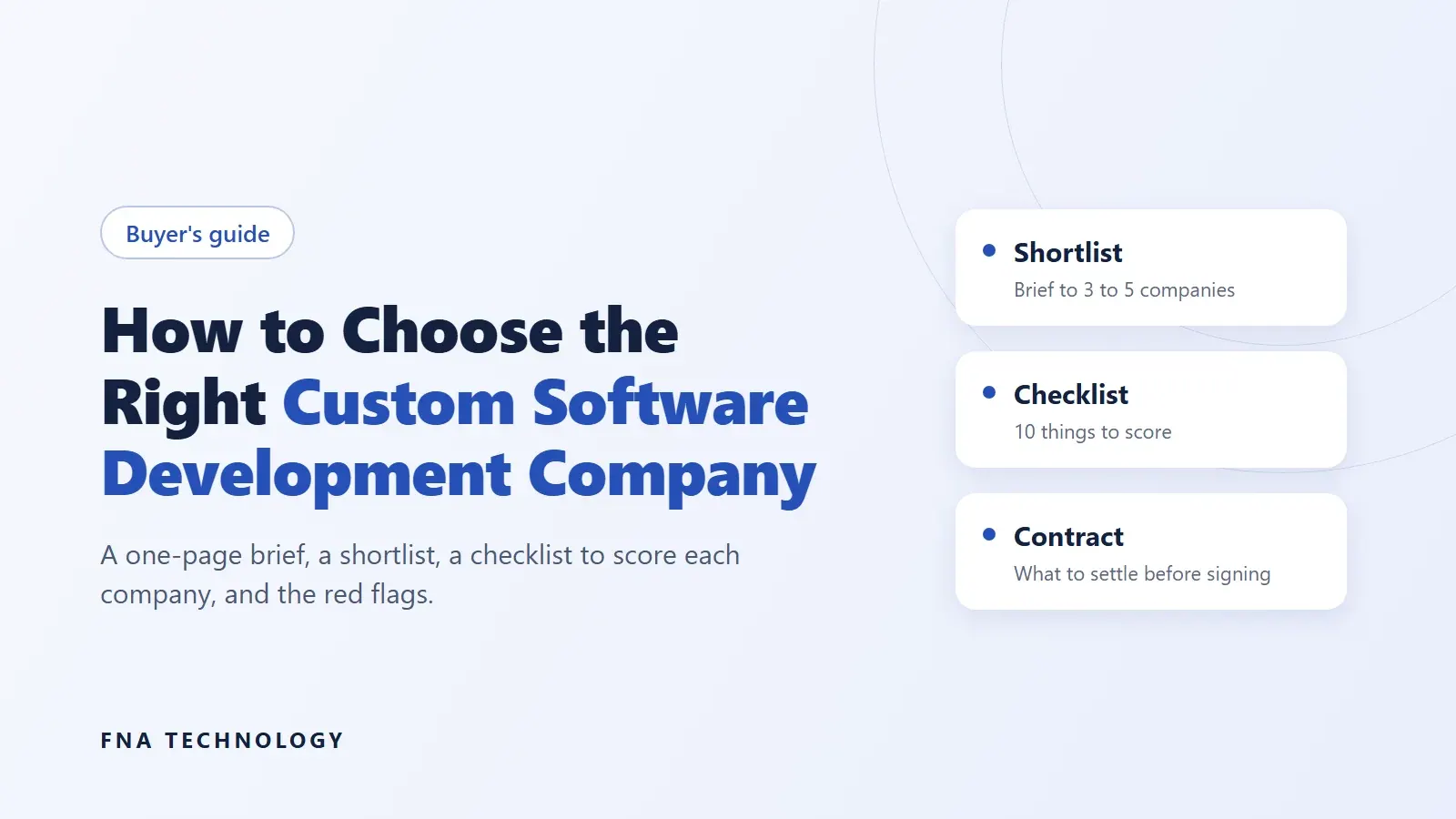
The short version: Write a one-page brief, send it unchanged to three to five companies, score your finalists on the same checklist, check their past work yourself, compare proposals on equal scope, and start with a small paid phase. Pick the clearest plan and strongest evidence, not the lowest quote.
This guide is for business owners and managers hiring a company to build custom software for the first time, or after a project that went badly. It covers the brief, the shortlist, the checklist to score each company, how to check past work, how to compare proposals, the red flags, and what to settle in the contract.
We are FNA Technology, a custom software development company with our team in Mumbai, India, so we see this process from the other side. Use the same checklist on us as on anyone else. If you are still deciding whether you need custom software at all, start with what bespoke software is; if you already know what you need built, see our custom software development service.
Before you contact anyone: write a one-page brief
Companies can only quote what you describe. If each one reads a vague request differently, you get quotes for different projects and cannot compare them. One page is enough:
- The problem in business terms, such as "orders are retyped from email into our system and errors cost us refunds", not "we need an app".
- Who will use it, their roles, and the three to five things each must be able to do.
- What is in the first release and what can wait.
- The systems it must connect to, such as your accounting, CRM or payment provider.
- Your budget range and the date that matters, and why it matters.
- Who on your side makes decisions and how quickly they can answer questions.
Send the same brief to every company, unchanged.
Build a shortlist
Start with five to eight names from people you trust who have had software built, from review directories such as Clutch and GoodFirms, and from case studies that look like your project. A company that has built the same kind of system, such as a portal with several user roles and an accounting integration, is more useful than one that only shares your industry.
Cut the list quickly. Drop any company that cannot show one comparable project in detail, cannot give you a client to call, has no overlap with your working hours, or is far too large or too small for your budget. Send the brief to the three to five that remain, with the same written questions, and ask for written answers before any sales call. Keep two or three finalists.
The checklist: score every company the same way
Score each finalist from 1 to 5 on each row. The warning signs matter more than the scores.
| What to check | What to ask | A good answer | Warning sign |
|---|---|---|---|
| Comparable work | Show us a project like ours. What exactly did you build? | A live product, their part named, a client you can call | Logos and screenshots only |
| The real team | Who will lead the build, and can we meet them now? | Named tech lead and project manager you meet before signing | "We will assign people after you sign" |
| Understanding | What do you need to know before you can estimate? | Questions about your users, data and edge cases | A firm price after one short call |
| Process | How often will we see working software? | A demo every week or two, and a written change process | Only status reports, no demos |
| Quality | How do you test, and who reviews the code? | Code review, automated tests and a test environment | "We test it ourselves at the end" |
| Security | How are sign-in, permissions and personal data handled? | Specific answers for your data and any rules you must meet | "We take security seriously" |
| Price | What is included, excluded and assumed? | Itemised scope, exclusions, milestones and running costs | One total with no assumptions |
| Ownership | Who owns the code, designs and accounts? | You do, with access to the code repository whenever you ask | Code or cloud accounts held by the vendor |
| After launch | Who fixes bugs, how fast, and at what cost? | Written warranty period and support terms | Nothing agreed beyond launch day |
| Communication | Who is our contact, and how quickly do they reply? | One named contact and an agreed meeting rhythm | Slow, vague answers before you have even signed |
If two companies score about the same, choose the one that asked you the sharpest questions and told you about a risk you had not thought of.
How to check a company's past work
A portfolio is a claim. Treat it as one until you have checked it.
- Use the live product. Open the website or download the app, and for an app, check who publishes it in the App Store or Google Play and when it was last updated. Client apps are often published under the client's own account, so ask the company to show you their part.
- Ask what exactly they built: the whole system, the design only, one feature, or maintenance after someone else built it.
- Ask for a walk-through of a past project by the tech lead, including one decision they would change today.
- Call two clients, and pick at least one yourself from their client list rather than taking only the ones they offer.
Questions worth asking a reference:
- What went wrong, and what did the team do about it?
- Did the same people stay on the project from start to finish?
- Were the estimates close, and how were changes priced?
- Is the software still running, and who looks after it now?
- Would you hire them again for something harder?
Read the middling and negative reviews on the directories too, and how the company replied to them.
Compare proposals on the same scope
A low price often means a smaller project, not a cheaper one. Before comparing totals, line the proposals up on:
- What is delivered in the first release, and what is excluded
- Which integrations, data migration and testing are included
- Who is on the team, how senior they are and for how long
- The payment milestones and what has to be accepted at each
- The running costs after launch: hosting, third-party services and support
- How changes are estimated and approved
- What you need to provide, and by when
Ask each company the same question about any gap you find, in writing.
Red flags
- A firm price before anyone has asked about your users, data or integrations
- A quote far below the others, with no assumptions or exclusions listed
- Agreeing to every feature and every deadline without a single question
- A senior person in the sales calls who disappears after signing
- No access to the code until the final payment
- Payments not tied to working, accepted software
- Pressure to sign this week
- No answer to "what happens after launch?"
One red flag can have an innocent explanation. Ask about it directly; the reply tells you a lot.
If the company disappears or the project stalls
Projects do stall: a key developer leaves, the company runs out of money, or the relationship breaks down halfway. You can recover if four things were true from the start:
- The code is in a repository you can open yourself, not only on the company's machines
- The cloud, domain and app store accounts are in your name, or shared with you in writing
- Each milestone ends in working software you have tried, not only a progress report
- Decisions, set-up steps and how to deploy are written down as the work goes, not left for the end
With those in place, another team can read the code and the documents, run the software and carry on. Without them, a stalled project often means starting again.
When custom software is the wrong choice
Custom software is the wrong choice when a product you can buy already does the job well enough, when the process it would support is still changing every month, or when nobody in your business has time to answer the developers' questions and test what they build. Fix those first, or start with an off-the-shelf tool. If you are unsure, our guide to what bespoke software is covers when off-the-shelf is enough.
Start small before the full build
For anything beyond a small project, start with a paid first phase of a few weeks: a discovery that ends in a written scope and a dated plan, a clickable prototype, or a proof of concept of the hardest part. You learn how the team asks questions, writes decisions down and keeps to its own estimates, and you can stop with something useful if it is the wrong fit.
Settle these in the contract
- You own the source code, designs and documentation once paid, and you can get access to the code repository whenever you ask
- Who holds the cloud, domain and app store accounts, and how they are handed over
- The named key people and what happens if one leaves
- What "done" means for each milestone, and how you accept it
- How changes are requested, priced and approved
- A warranty period for bugs, and support terms and prices after it
- Confidentiality, and how personal data is handled
- How either side can end the contract, and what you receive if they do
Have a lawyer read it before you sign.
How FNA fits this checklist
We work as a fixed-scope project, on time and materials, or as a dedicated team. Projects typically cost USD 5,000 to USD 200,000 and most take around two months, and we can build a working demo or proof of concept of your problem in one day. You own the source code, an account manager is your point of contact, and we have shipped software for clients in India and the GCC. For a first version of a new product, see MVP development; for businesses in the UAE, see custom software development in Dubai; and for UK businesses, see bespoke software development for the UK.
Have Your Software Built
Custom Software Development
Internal platforms, customer portals, workflow systems and integrations, scoped and priced before development starts.
MVP Development
A focused first version of a new product, scoped to test one assumption.
Bespoke Software for UK Businesses
Custom software for UK companies, built remotely from Mumbai.
Frequently Asked Questions
Talk to us about your project
Send us your one-page brief, and an engineer will tell you how we would approach it, what we would build first and what it would cost.