The short version: Choose the hiring route that matches the size of your app and how long you will need it. Before you pay anyone, agree who owns the code and store accounts, who supports the app after launch and how the price is built up.
Hiring an app developer is a business decision as much as a technical one. You need to know what the app must do, who will build it, who owns the result and who will look after it once it is live. This guide is for business owners and founders who have an app idea but are not developers themselves.
Should I hire a freelancer, an agency or an in-house app developer?
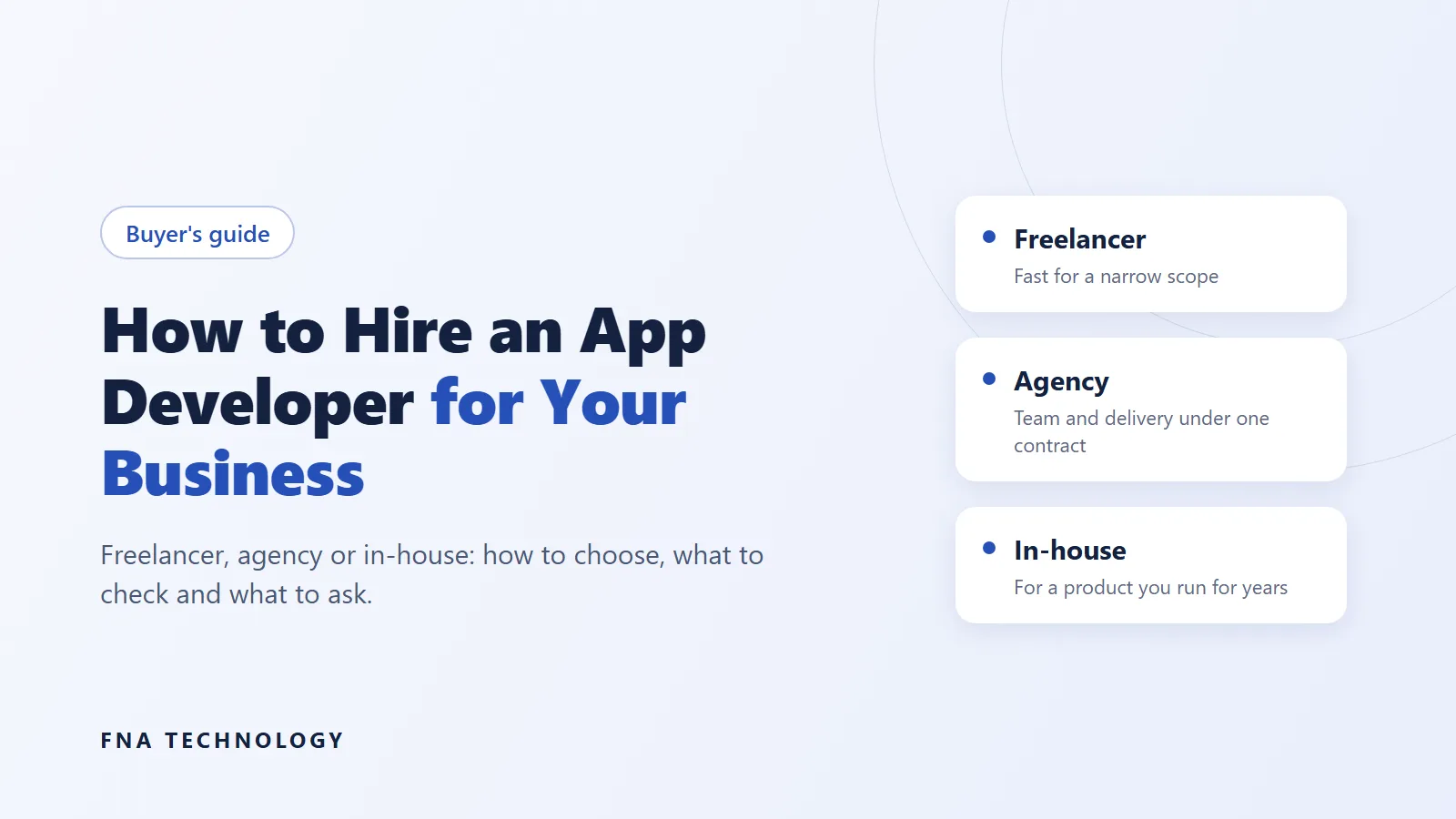
Each route suits a different kind of project. A freelancer suits a small app with a clear scope that you can manage yourself. An agency suits a full app that needs design, development, testing and launch. An in-house developer suits a business with ongoing product work every week.
| Route | Suits | Main risk |
|---|---|---|
| Freelancer | A small app with a clear scope | One person may not cover design, backend, testing and launch |
| Agency | A full app with a team and a project plan | Higher cost and more coordination |
| In-house developer | An app that needs work all year | Salary, recruitment and reliance on one person |
If you want us to build the app, see our mobile app development company page.
Most first-time owners should start with a project rather than a salary. Whatever route you pick, ask each candidate for a quote on the same brief, so you compare like with like.
What should I check for each hiring route?
Freelancer
Ask for a portfolio of apps the freelancer built, and speak to at least one previous client. Ask who does design, testing and app store submission, and get the answer written into the quote. Agree payment against finished milestones rather than open hours. Ask what happens if the freelancer is ill, busy or stops replying. Confirm in writing that you own the source code and the app store accounts.
Agency
Ask who the project manager and tech lead are, and whether they join the first meetings before you sign. Ask for a written scope, timeline and price, including what is left out. Ask who you will speak to day to day, and how often you will get progress updates. Check how change requests are priced, and whether support after launch is included or sold separately.
In-house developer
Confirm there is enough ongoing work to keep one person busy for a year. Budget for salary, benefits, tools, recruitment and the time you spend managing them. Ask how the knowledge will be shared, so the app does not depend on one person.
Vetted talent network
Ask what tests and interviews the network runs before it introduces anyone. Ask whether the developer works for you directly or through the network, and who holds the contract. Ask what happens if the developer is not a good fit, and how quickly you can replace them. Check the same code ownership terms you would ask of a freelancer.
How do I find an app developer?
Start with developers who have shipped live apps. Ask for the apps in the App Store or Google Play, download them and test them yourself, then compare two or three proposals against the same brief.
How to find an app designer?
Look at the designer's own app work and ask who built each app. Check that the designs were used in apps people use every day, and ask how the design files are handed over to you.
How to find mobile app developers?
Ask for apps they have released on both iPhone and Android, and ask which framework each one uses. Compare how they test, release and support an app after launch.
How to hire a programmer for an app?
A programmer writes the code, but an app also needs design, testing and store setup. Decide who owns each job, and make sure the contract names who owns the source code and the store accounts.
Where can I hire a reliable app developer for a business app?
There is no single best source, so combine a few and compare the evidence. Useful places to look include:
Referrals from other founders and business owners who have launched an app. Ask them who built it and whether they would hire the team again.
Developers and companies whose portfolios show apps with similar users, features and devices. Screens that look good matter less than the flows behind them.
Specialist app development companies. FNA Technology is one of these, and you can read about our service on our mobile app development company page.
Professional networks and founder communities, where you can ask for introductions to people who have shipped apps.
Freelance marketplaces, which suit narrow tasks such as a prototype, an audit or a short fix. For a full app, check more carefully before you rely on one.
Which companies vet app developers before introducing them to clients?
Some vetted talent networks and technical recruiters screen developers before they introduce them to clients. They usually combine a skills test, a live technical interview, a review of past work and reference checks. Their methods differ, and this guide does not rank them.
Ask each network to describe its steps in writing. Then check the developer you are offered against the same questions you would ask any candidate, including who owns the code and what happens if the fit is wrong.
How do I test an app developer's skills if I am not technical?
You do not need to read code to get useful evidence. Start with these checks:
Ask to see two or three live apps the developer built, and install them on your own phone. Check that the developer or company is named on the store listing.
Ask the developer to explain a past problem in plain words, such as a crash or a delayed launch, and what they changed as a result. A clear answer shows that they understand their own work.
Give two candidates the same short brief and compare the questions they ask. Good developers ask about users, integrations, devices and what is out of scope.
Start with a small paid step, such as a prototype or a discovery phase, before committing to a full build. This shows how the developer communicates and plans, at a cost you can afford to lose.
What questions should I ask an app developer before hiring them?
Put these questions to every candidate and keep the answers in writing:
Who will own the source code, the app store accounts and the designs?
Can I see the code during the project, and on what terms?
Who will be my day to day contact, and how often will I get updates?
Who does design, testing and app store submission?
What is included in the price, and what is not?
What happens if a feature takes longer than planned?
Who fixes bugs and handles security updates after launch?
Can I speak to a previous client?
What can go wrong if a freelancer disappears mid-project?
The usual problem is that work stops while the code, designs and store accounts sit with the freelancer rather than with you. You may then have to pay someone new to read and rebuild what was done, which adds cost and delay.
You can limit the damage before it happens. Open your own Google Play and Apple developer accounts from the start, pay in stages against finished work, and agree in the contract that you own the code and that you can ask for it at any time. If the developer goes quiet, ask in writing for the code, the designs and the account details, and take them to a second developer for review.
How much does it cost to hire an app developer?
The price depends on what the app must do, the platforms it runs on, the design work, the integrations and the support you need after launch. Ask each route for a written quote on the same brief, and compare what each quote includes and excludes. Here are the published figures we checked:
- In-house: the median annual wage for software developers was $135,980 in May 2025, according to the US Bureau of Labor Statistics. That is salary only. The employer also pays benefits, equipment and recruiting.
- Agency: Clutch reports that most software development companies it lists charge between $24 and $49 an hour.
- Freelancer: rates vary too widely to quote from one source, so ask each freelancer for a written quote on the same brief.
Two costs you can check on the official sites are the store fees. Google Play says: "There is a US$25 one-time registration fee." Apple says: "The Apple Developer Program annual fee is 99 USD." Put both accounts in your company's name, and budget for them from the first week.
For FNA, projects typically cost USD 5,000 to USD 200,000 depending on size, and you see the price before development starts.
What should I ask about AI features?
If the app uses AI, we use OpenAI or Claude for AI features, such as chat from your content, smart search and document reading. Ask which model the app uses, where the data goes, and who pays the monthly AI bill.
Who provides dedicated app developers on a monthly contract?
FNA Technology can provide a dedicated developer on a monthly contract. Our projects can also run on fixed scope or on time and materials, and most clients start with a fixed scope.
If you want a monthly developer from any provider, ask for the contract and the notice period. Ask who manages the developer, whether they work only on your app, and what happens if they leave. Check that you own the code they write from the first day.
What is it like to hire FNA for an app project?
Our team is in Mumbai, India, and we work with clients remotely through video calls and progress updates. Each client has an account manager as the point of contact, and our tech lead and project manager join meetings before you sign. We sign the contract directly with you, and we quote clients outside India in USD or AED.
We build native iPhone and Android apps in Swift and Kotlin, and cross-platform apps in React Native or Flutter. Most projects take around two months, depending on size; our guide to how long it takes to build an app explains the phases. You own the source code. If you want access to the code repository during the project, we can arrange it on terms agreed in the contract.
After launch, support and maintenance covers bug fixes, security updates, monitoring and new features. If your app needs to run on both platforms from one codebase, our cross-platform app development page sets out how we build it.
Frequently Asked Questions
Good places include referrals from other business owners, developers whose portfolios show apps like yours, specialist app development companies and vetted talent networks. Whichever you choose, ask to see live apps with similar users and features, and speak to a previous client.
FNA Technology can provide a dedicated developer on a monthly contract, as well as fixed-scope and time-and-materials work. Whichever provider you choose, ask for the contract, the notice period, who manages the developer and what happens if that person leaves.
A freelancer suits a small app with a clear scope that you can manage yourself. An agency suits a full app that needs design, development, testing and launch, and an in-house developer suits a business with ongoing work every week.
Some vetted talent networks and technical recruiters screen developers with tests, interviews and reference checks before introducing them. Their methods differ, so ask each one to describe its steps and check them against the developer you are offered.
Costs depend on scope, platforms, design, integrations and support, so ask each option for a written quote on the same brief. In-house, the median US software developer salary was $135,980 a year in May 2025 according to the US Bureau of Labor Statistics, and most agencies listed on Clutch charge $24 to $49 an hour. FNA projects typically cost USD 5,000 to USD 200,000 depending on size, and you see the price before development starts.
Ask who will own the source code and the app store accounts, who does design and testing, and what is included in the price. Also ask who fixes bugs and handles security updates after launch, and how often you will get progress updates.
Work can stop, and the code, designs or store accounts may sit with the developer rather than with you. Prevent this by keeping your own app store accounts, paying in stages against finished milestones and agreeing in writing that you own the code.
Look at live apps they built and check that the developer or company is named on the store listing. Give two candidates the same short brief and compare the questions they ask, since good developers ask about users, integrations and what is out of scope.
How do I start a project with FNA?
Tell us what your app must do, who will use it, and when you need it live. We will talk through the options, the likely scope and the price range before you commit to anything.