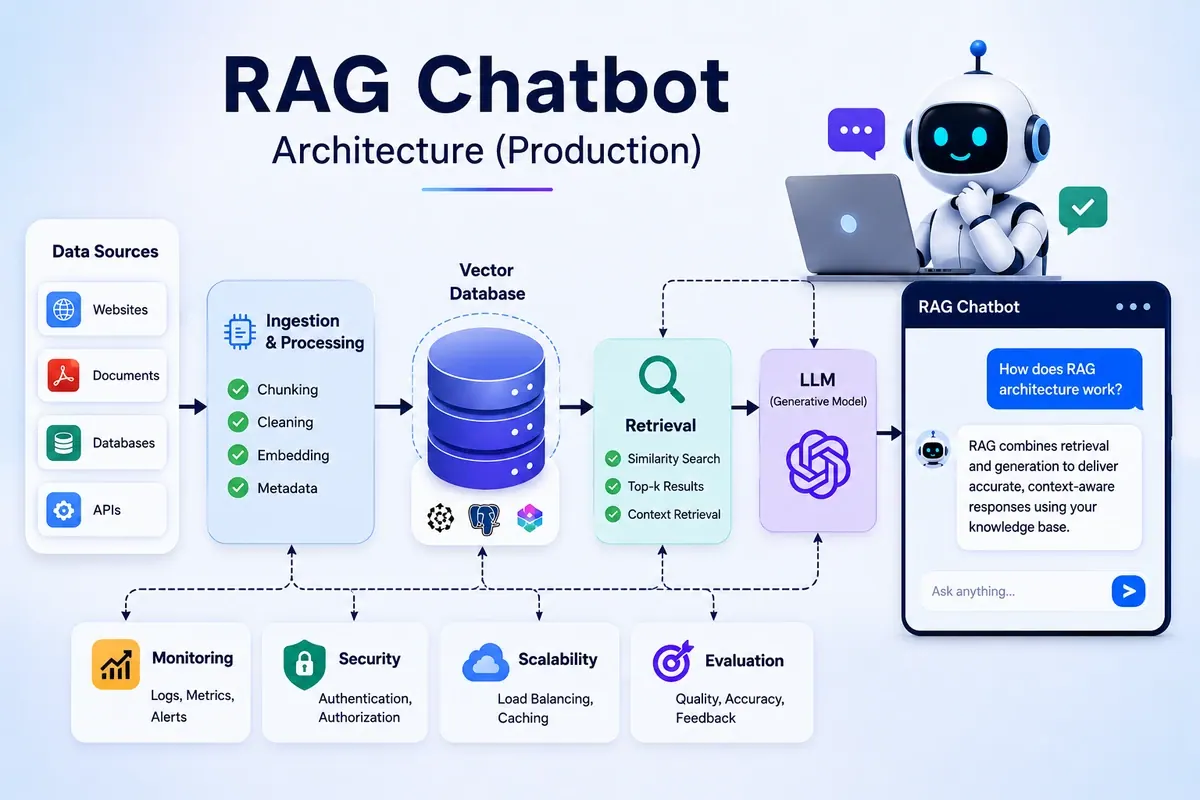
The short version: Building a production RAG chatbot requires far more than connecting an embedding model to a vector database. To stop hallucinations and handle high-volume user traffic, you need hybrid retrieval (BM25 + dense vectors), cross-encoder reranking, and dynamic context windows. Here is our exact production blueprint derived from deploying systems like Khedmah.
Most tutorials show how to build a Retrieval-Augmented Generation (RAG) chatbot in ten lines of Python code using a demo framework. You upload a PDF, calculate vector embeddings, store them in memory, and query an LLM.
In local development, that works. In production, it breaks down quickly.
When real users ask questions, they do not format queries like clean textbook prompts. They type incomplete sentences, misspell product names, search for exact numerical transaction IDs, and switch between languages. Simple vector similarity searches fail to find the right chunk, top-k context windows fill up with irrelevant text, and the language model starts hallucinating answers.
Having designed and deployed production conversational platforms across various enterprise verticals—such as our work on the Khedmah Chatbot serving thousands of daily utility users—we follow a battle-tested architecture that guarantees sub-2-second response times and high factual precision.
Quick Navigation
Why Naive RAG Fails in Production
Naive RAG relies solely on embedding text snippets and retrieving the top-k nearest matches using cosine distance. In real-world customer support and internal enterprise tools, this naive pipeline encounters four fatal failure modes:
+------------------------------------------------------------------------------------+
|                         FOUR FATAL FAILURES OF NAIVE RAG                           |
+------------------------------------------------------------------------------------+
| 1. Keyword & ID Blindness   | Misses exact SKUs, order codes, error numbers        |
| 2. Chunk Boundary Loss      | Critical context is sliced across two separate chunks |
| 3. Lost-in-the-Middle Noise | Irrelevant top-k chunks push key data out of focus   |
| 4. Outdated Index Sync      | Knowledge base edits require slow batch re-indexing  |
+------------------------------------------------------------------------------------+
1. Keyword & ID Blindness
Dense embedding models map conceptual semantics, not exact characters. If a user asks "Why is bill invoice #OM-9821 pending?", cosine similarity matches general paragraphs about bill processing rather than locating the specific record containing #OM-9821.
2. Chunk Boundary Loss
Fixed-character chunking (e.g. 500 characters with 50-character overlap) frequently splits key tables or conditional logic across two chunks. Neither chunk alone contains enough context to answer the user query accurately.
3. Lost-in-the-Middle Noise
When you pass 8 to 10 raw vector chunks into an LLM context window, irrelevant paragraphs dilute the prompt. Language models pay heavy attention to the start and end of prompt contexts while missing subtle instructions placed in the middle.
4. Outdated Index Sync
When underlying source documents, policies, or product prices update, vector indices require re-embedding and re-indexing. Without real-time event triggers or transactional synchronization, the retrieval engine continues serving stale, incorrect chunks.
Our Production RAG System Blueprint
To overcome naive retrieval weaknesses, we separate ingestion, hybrid indexing, query transformation, and generation into distinct, monitored microservices.
+-----------------------------------------------------------------------------------+
|                        PRODUCTION RAG RETRIEVAL PIPELINE                          |
+-----------------------------------------------------------------------------------+
|                                                                                   |
|  [User Query] ──> [Query Rewriter & Intent Classifier]                           |
|                            │                                                      |
|             ┌──────────────┴──────────────┐                                       |
|             ▼                             ▼                                       |
|     [Full-Text / BM25 Search]   [Dense Vector Embeddings]                         |
|     (PostgreSQL tsvector)       (pgvector / Qdrant)                               |
|             │                             │                                       |
|             └──────────────┬──────────────┘                                       |
|                            ▼                                                      |
|              [Reciprocal Rank Fusion (RRF)]                                       |
|                            ▼                                                      |
|               [Top-30 Candidate Chunks]                                           |
|                            ▼                                                      |
|          [Cross-Encoder Reranker (Cohere / BGE)]                                  |
|                            ▼                                                      |
|               [Top-4 High-Signal Contexts]                                        |
|                            ▼                                                      |
|             [Tool Calling & Database Lookup] (If needed)                          |
|                            ▼                                                      |
|              [Structured LLM Generation] ──> [Streaming Response to User]        |
|                                                                                   |
+-----------------------------------------------------------------------------------+
1. Parent-Child Chunking Strategy
Instead of sending small chunks to the LLM, we use a hierarchical parent-child indexing pattern:
- Child Chunks (150-250 tokens): Generated for precise dense vector matching.
- Parent Documents (800-1200 tokens): When a child chunk matches a user query, the system retrieves the entire parent context section and injects it into the prompt.
This ensures high vector search precision while providing the LLM with complete contextual paragraphs.
2. Query Transformation & HyDE
Before querying the database, the user query passes through an intent router:
- Hypothetical Document Embeddings (HyDE): For abstract or conceptual questions, a small model generates a hypothetical answer, and we embed that answer to find closer semantic matches.
- Query Decomposition: Complex multi-part questions are split into two parallel sub-queries before searching the index.
Hybrid Search & Cross-Encoder Reranking
Production accuracy requires combining full-text lexical search with dense vector similarity.
+------------------------------------------------------------------------------------+
|                         HYBRID RETRIEVAL & RERANKING FLOW                          |
+------------------------------------------------------------------------------------+
| 1. PARALLEL RETRIEVAL                                                              |
|    - Sparse Lexical Query: Finds exact term matches, SKUs, and transaction IDs     |
|    - Dense Vector Query  : Finds conceptual synonyms and intent matches            |
|                                                                                    |
| 2. RECIPROCAL RANK FUSION (RRF)                                                    |
|    - Score = 1 / (60 + BM25_Rank) + 1 / (60 + Vector_Rank)                         |
|    - Merges and normalizes the top 30 raw candidate snippets.                      |
|                                                                                    |
| 3. CROSS-ENCODER RERANKING                                                         |
|    - Evaluates [Query + Chunk] pairs jointly through deep attention layers.        |
|    - Discards 26 low-scoring chunks; delivers top 4 cleanest snippets to LLM.       |
+------------------------------------------------------------------------------------+
Dense vectors capture conceptual meaning, while BM25 / lexical full-text search handles alphanumeric tokens, account numbers, and exact technical terminology. Merging both candidate lists through Reciprocal Rank Fusion guarantees that neither exact keyword hits nor conceptual paraphrases get overlooked.
Passing the merged candidates through a cross-encoder model (such as Cohere Rerank v3 or BGE-Reranker-Large) scores the exact semantic relationship between the query and each chunk. This single step eliminates up to 80% of hallucination-inducing noise.
Engineering Lessons from Khedmah
When we engineered the Khedmah Chatbot platform—a mission-critical customer support ecosystem for utility payments, digital services, and order tracking in Oman—we had to address real operational constraints that textbook RAG frameworks ignore.
+------------------------------------------------------------------------------------+
|                       KHEDMAH PRODUCTION ENGINEERING LESSONS                       |
+------------------------------------------------------------------------------------+
| 1. BILINGUAL ARABIC/ENGLISH TOKENIZATION | Handles dialectal nuances smoothly      |
| 2. LIVE DATABASE TOOL CALLING            | Blends static policy with live SQL data |
| 3. DETERMINISTIC ESCALATION GUARD        | Routes unconfident intents to humans    |
| 4. DEFLECTION AT SCALE                   | Automated 65%+ tier-1 support volume    |
+------------------------------------------------------------------------------------+
1. Bilingual Tokenization (Arabic & English)
Arabic text introduces unique morphological variations, prefixes, and dialectal spelling shifts. Relying solely on generic English-centric embeddings leads to poor semantic recall. For Khedmah, we used multilingual embeddings and custom text normalization to ensure identical retrieval accuracy whether users messaged in Arabic or English.
2. Blending Static Policy RAG with Live Transaction Data
A pure RAG system can explain payment refund policies, but it cannot tell a customer whether their specific electricity bill went through.
We engineered Khedmah as a hybrid agent: the router checks whether a question requires knowledge retrieval (RAG) or live data inspection. For account queries, the agent triggers secure API calls to Khedmah's core backend transaction ledger, authenticating the request and injecting real-time status into the response.
3. Graceful Human Escalation
When user sentiment drops or Reranker confidence scores fall below our 0.65 threshold, the bot does not loop endlessly. It packages the conversation summary, extracts the user intent, and hands off the ticket directly to human support desks via WhatsApp and internal dashboards.
For teams comparing intelligent assistant types, our breakdown on AI Agent vs Chatbot outlines when to pick API tool calling over pure RAG.
Choosing the Right Vector & Relational Database
Founders often ask whether they need specialized vector cloud databases. In our production builds at FNA Technology, we evaluate storage based on operational complexity and data synchronization overhead.
| Database | Architecture Type | Search Latency (100k vectors) | Strengths | Trade-offs |
|---|---|---|---|---|
| PostgreSQL + pgvector | Relational + Extension | 12ms - 28ms (HNSW index) | ACID transactions, zero data sync lag, metadata filtering | Memory tuning needed for large indices |
| Qdrant | Dedicated Vector DB (Rust) | 4ms - 10ms | High RPS throughput, rich payload filtering, fast indexing | Additional cluster to maintain |
| Pinecone | Managed Cloud SaaS | 15ms - 45ms (Network round-trip) | Zero server maintenance, serverless scaling | Proprietary lock-in, recurring monthly SaaS cost |
| OpenSearch / Elasticsearch | Search Engine + Vector Plugin | 20ms - 50ms | Superior BM25 search, excellent enterprise logging | Heavy RAM and JVM infrastructure overhead |
For 85% of commercial applications, PostgreSQL with the pgvector extension and native full-text search (tsvector / pg_trgm for typo handling) is our recommended architecture. Keeping vector embeddings inside the same database as user profiles, billing records, and access logs eliminates duplicate network hops and ensures rock-solid data integrity.
Where Production RAG Still Struggles
Being realistic about what RAG can and cannot do saves engineering months:
- Complex Numerical Aggregations: RAG is not an analytical engine. Asking "What was our average customer churn in Q3 across all retail accounts?" will fail if you attempt to answer it by embedding quarterly PDF reports. This requires Text-to-SQL workflows connected directly to analytics warehouses.
- Rapidly Updating Live Inventories: If inventory prices or seat availabilities change every 5 seconds, vector re-indexing causes unacceptable lag. Use direct API tool calling rather than vector lookups for dynamic variables.
- Vague One-Word Inquiries: When a user types "invoice", vector similarity returns 50 different document categories. The system must ask clarifying follow-up questions before initiating retrieval.
Infrastructure Cost Breakdown
Here is the realistic monthly infrastructure cost breakdown for a mid-market company running an enterprise RAG chatbot processing 50,000 queries per month:
| Cost Item | Infrastructure Layer | Unit Pricing | Monthly Cost (50k queries) |
|---|---|---|---|
| Primary Database & Vector Store | Managed PostgreSQL (pgvector) | 4 vCPU / 16GB RAM instance | $120 - $160 |
| Embedding Generation | OpenAI text-embedding-3-large | $0.00013 / 1k tokens | $15 - $30 |
| Cross-Encoder Reranker | Cohere Rerank v3 API | $1.00 / 1k search queries | $50 - $75 |
| LLM Generation Engine | Fast Reasoning Model (Claude / GPT) | Token-based payload pricing | $90 - $220 |
| Hosting & API Gateway | Container Node on AWS / GCP | Managed container compute | $45 - $80 |
| Total Infrastructure Cost | — | — | $320 - $565 / month |
Note: Unit prices derived from provider standard rate cards as of August 2026. Custom fine-tuned models or self-hosted GPU nodes will adjust baseline fixed costs.
To build an enterprise RAG system or custom conversational assistant tailored to your company's data, explore our dedicated AI chatbot development services or view our full suite of AI services.