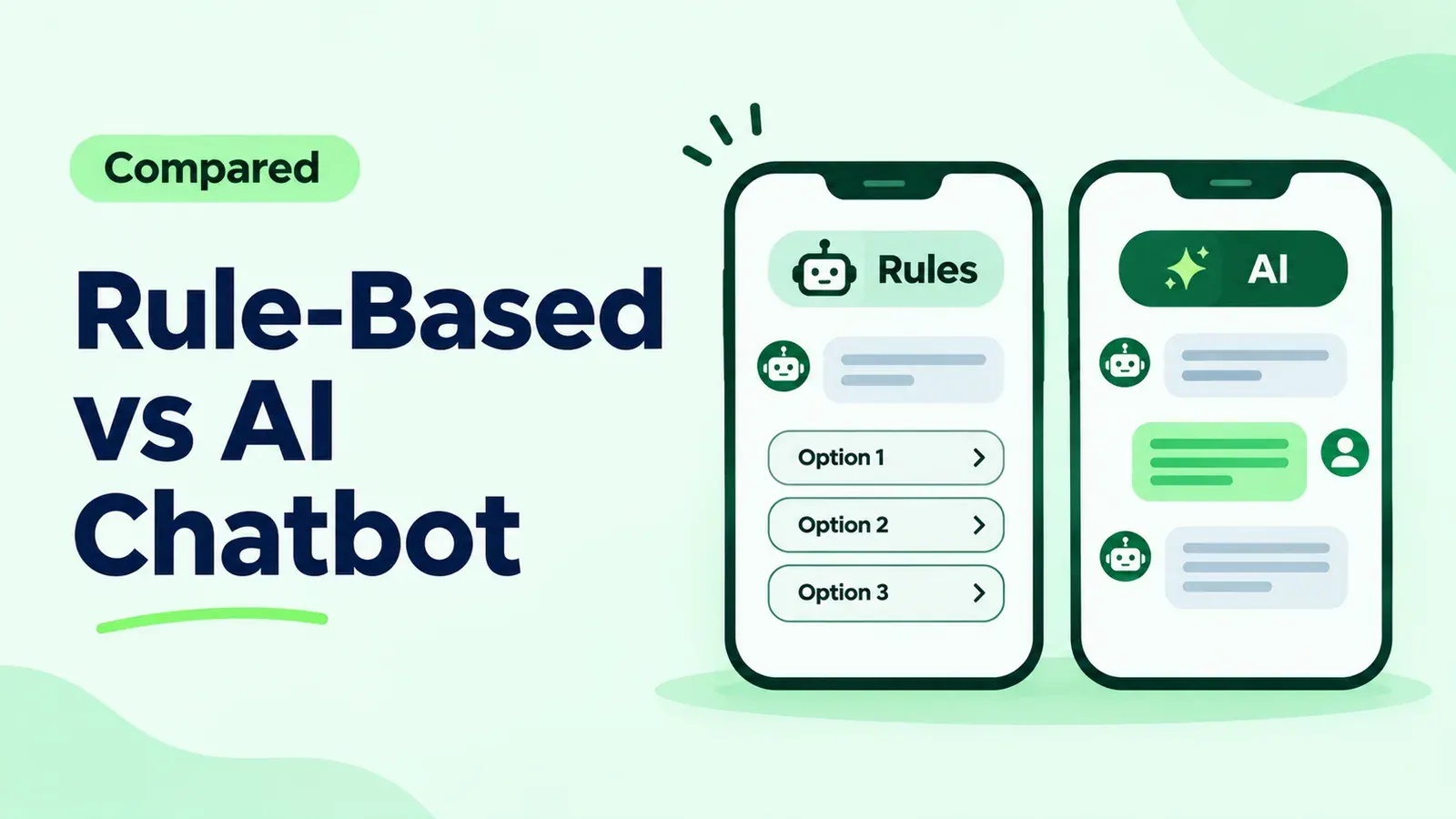
The short version: If customers ask a short, predictable list of questions, use a rule-based bot: it is cheaper, faster to set up and never invents an answer. If they type freely, in their own words or in Arabic and English, you need AI. Most businesses end up with both: fixed flows for the steps that must not vary, AI for everything else.
This guide compares rule-based and AI chatbots for businesses in the UAE and the wider Gulf: how each one works, a side-by-side on cost, set-up, risk of wrong answers and Arabic support, when a simple FAQ bot is enough, when you need AI, how the two work together, and what each costs to run.
We are FNA Technology, a software company with our team in Mumbai, India, and we build custom AI chatbots for businesses in the UAE and the wider GCC, working remotely. We also tell clients when they do not need one. If you already know you want a chatbot built, see our AI chatbot development service.
How each one works
A rule-based chatbot is a script. You decide in advance what it can be asked and what it says back: the customer taps a button or types a keyword, and the bot follows the branch you wrote. It is a flowchart with a chat window on top. It cannot answer anything you did not write, and it can never make up an answer.
An AI chatbot reads the customer's message as written, works out what they want, and answers from the content you give it, such as your FAQs, policies or product details. A good one also knows when the answer is not in that content and passes the chat to a person instead of guessing. It handles questions you never scripted, but it can also be confidently wrong if it is not limited to approved content and tested.
The same customer question shows the difference. "What time do you close?" is easy for both. "I bought a sofa last week, it arrived damaged and I lost the invoice, what can I do?" breaks most scripts, because no one wrote that branch; an AI chatbot can recognise a damaged-delivery complaint, explain the return policy and hand the case to your team.
Side by side
| Rule-based chatbot | AI chatbot | |
|---|---|---|
| How it answers | Fixed answers behind buttons, menus and keywords | Reads the message and answers from content you approve |
| Questions it can handle | Only the ones you scripted | Varied wording, follow-ups and unscripted questions |
| Set-up | Quick: write the questions, answers and paths | Longer: prepare the content, set limits, test with real messages |
| Cost to build | Low, often a no-code tool or a short project | Higher: content preparation, testing and safeguards |
| Cost to run | A subscription or hosting, plus channel fees such as WhatsApp messages | The same, plus the AI model's charge for every reply it writes |
| Risk of wrong answers | Low: it only sends answers you wrote, but a keyword can match the wrong one | Real unless answers are limited to approved content, tested and watched |
| When it fails | The customer gets stuck in a menu or a "Sorry, I did not understand" | The customer gets a fluent answer that is wrong |
| Arabic support | Only the Arabic menus and answers you write | Understands free Arabic text, including Gulf dialect and mixed Arabic and English, if built and tested for it |
| Updating it | Edit every affected branch by hand | Update the content it answers from, then test again |
| Best for | Opening hours, locations, booking steps, order status menus, lead forms | Product questions, troubleshooting, policies, sales conversations |
When a simple FAQ bot is enough
Often you do not need AI at all. A rule-based bot, or even WhatsApp quick replies and a clear FAQ page, is enough when:
- Most customers ask the same handful of questions, and you can write them all down
- The answers rarely change
- Nobody needs the bot to look anything up, such as an order, a booking or an account
- The wording must be exactly the same every time, for legal or policy reasons
- You want to test whether customers use a chatbot at all before spending more
A quick way to check: export a month of real customer messages from WhatsApp, email or your website chat, and sort them by topic. If a short list of topics covers most of them, start with rules. If the list keeps growing and every customer asks in a different way, you will spend more time writing branches than an AI chatbot would cost.
When you need an AI chatbot
- Customers describe their problem in their own words, with details that matter
- The same question arrives in many forms, and in both Arabic and English
- Answers come from long or changing content, such as policies, product catalogues or manuals
- Conversations need follow-up questions before the answer is clear
- The bot must check your systems, such as an order, a booking or an account, and explain the result
An AI chatbot is only as good as the content behind it. If your FAQs and policies are out of date or contradict each other, fix them first, or the AI will repeat the mistakes fluently.
Most businesses need both
In practice the choice is rarely one or the other. A good business chatbot uses fixed flows for the steps that must always happen the same way, and AI for the conversation around them:
| Part of the conversation | Use rules | Use AI |
|---|---|---|
| Greeting and choosing a language | Yes | |
| Free-text questions about products, policies or services | Yes | |
| Booking, payment and refund steps | Yes | |
| Checking identity before showing account details | Yes | |
| Explaining a policy in the customer's own situation | Yes | |
| Legal or regulated wording | Yes | |
| Passing the chat to a person | Yes, when the customer asks or a rule says so | Yes, when the answer is not in the content |
The AI understands what the customer wants; the rules decide what the bot is allowed to do about it. Either way, the customer should always be able to reach a person, and the person should see the conversation so far.
Arabic changes the decision
In the UAE, many customers write in Arabic, in English, or in both in the same message, and often in Gulf dialect rather than formal Arabic. A rule-based bot can show Arabic menus and fixed Arabic answers well, as long as customers tap rather than type. Once they type freely, keyword rules miss much of what they write.
An AI chatbot can understand free Arabic text, but "it supports Arabic" is not enough to go on. Ask to see it answer your own real Arabic messages, including dialect, spelling variations and mixed Arabic and English, before you buy. Our Arabic AI chatbot page explains how we build and test for this.
What each costs to run
Both kinds have the same base costs: a platform subscription or hosting, and the fees of the channel they run on. On WhatsApp, Meta charges per delivered message. Since 1 October 2026 each business number gets 1,000 free service messages a month, and Meta charges from the 1,001st. Our WhatsApp chatbot guide for GCC businesses explains the categories, and Meta's pricing page has the current rates.
An AI chatbot adds one cost a rule-based bot does not have: the AI model's charge for every reply it writes, which grows with the number of conversations, the length of each one and the model used. A hybrid bot keeps that cost down, because menus and fixed steps cost nothing extra and only the free-text questions reach the AI. Before deciding, ask any vendor for the expected cost per conversation at your real volume, not only the build price.
Ready-made comparisons quote monthly figures, but they vary so widely with volume and model that the only useful number is one measured on your own conversations. For how ready-made tools compare on price, see our guide to the best AI chatbots in the UAE.
Should you replace an old rule-based bot?
Read a month of your current bot's chats first. If most of them end in "Sorry, I did not understand" or a request for a person, add AI for the free-text questions and keep the fixed flows that already work, such as bookings. If they do not, keep the bot and fix the answers that fail.
Either way, chatbots hold names, phone numbers and order details. In the UAE, personal data generally falls under Federal Decree-Law No. 45 of 2021; DIFC and ADGM have their own rules, so check with a legal advisor.
How to decide
- Collect a month of real customer messages and sort them by topic.
- If a short list of topics covers most of them and the answers are fixed, start with a rule-based bot or quick replies.
- If customers type freely, in Arabic and English, or need answers from long or changing content, you need AI.
- If the bot must take actions, such as bookings, payments or refunds, keep those steps in fixed flows even if the rest is AI.
- If a wrong answer could cost money or break a rule, limit the AI to approved content and send unsure cases to a person.
- Whatever you choose, give customers a clear way to reach a person.
How we approach it at FNA
We build chatbots that combine both: fixed flows for the steps that must not change, such as bookings, payments and refunds, and AI for free-text questions, answering from content you approve and handing the chat to your team when the answer is not there. If a simple FAQ bot or WhatsApp quick replies would do, we will tell you. Projects typically cost USD 5,000 to USD 200,000, depending on size, quoted in USD or AED, and we can build a working demo of your problem in one day.
Get a Chatbot Built
AI Chatbot Development
Chatbots for your website, app and WhatsApp that answer from content you approve and hand off to your team.
WhatsApp Chatbot Development
WhatsApp chatbots with menus, free-text answers and hand-off, set up on the official WhatsApp Business Platform.
Arabic AI Chatbot
Chatbots built and tested for Arabic, Gulf dialect and mixed Arabic and English messages.
Frequently Asked Questions
Not sure which one you need?
Tell us what your customers ask, and we will say which fits: a simple FAQ bot, an AI chatbot or both.