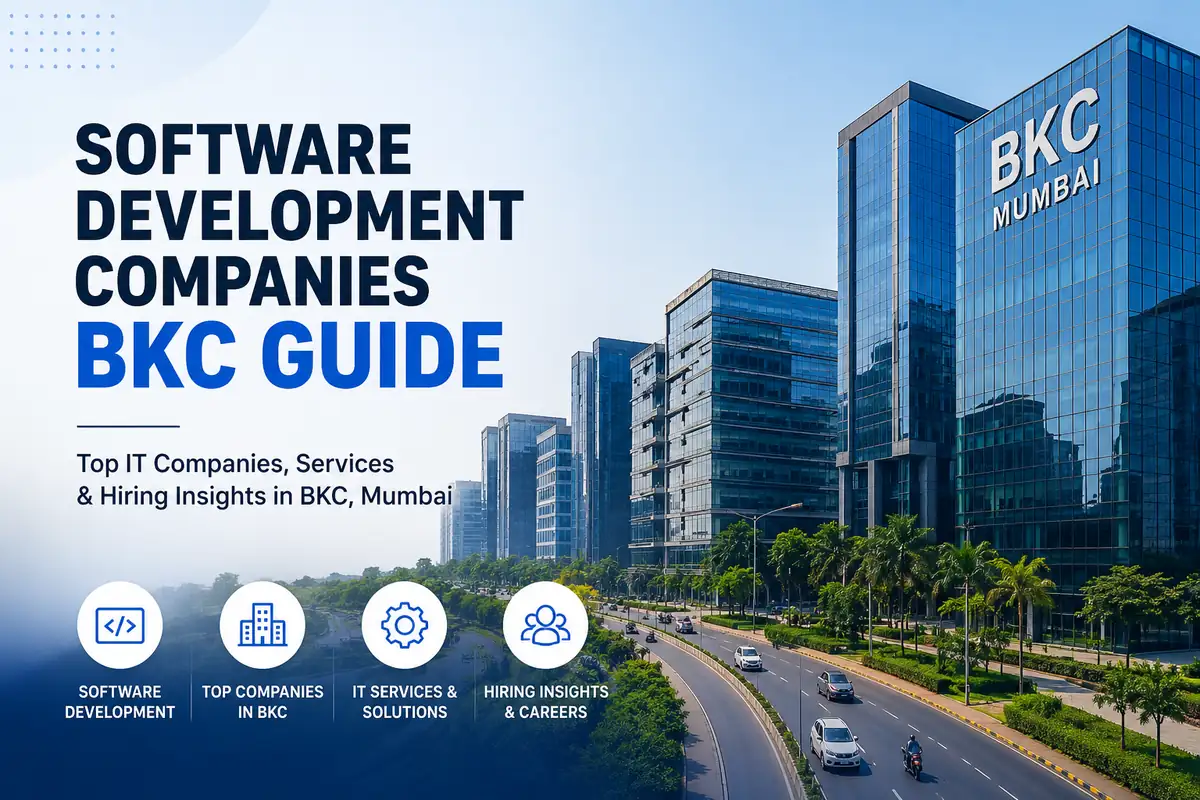
The short version: Enterprise software evaluation in Bandra Kurla Complex (BKC) has shifted from low-cost RFP bidding to risk-adjusted vendor audits. Here is the evaluation matrix BKC CTOs and procurement heads use to vet software partners, verify security compliance, and audit real-world evidence like the Impex Keyfob ecosystem.
Bandra Kurla Complex (BKC) houses India’s premier financial institutions, private equity firms, and global corporate headquarters. When a BKC enterprise hires a custom software agency, the decision process looks entirely different from how an early-stage startup hires developers.
For a BKC CTO, a software failure is not just an annoying glitch; it is a regulatory compliance breach, an RBI audit penalty, or an enterprise security vulnerability.
Over the past four years, we have participated in dozens of enterprise vendor evaluations across BKC financial and corporate teams. This guide outlines the exact framework enterprise buyers use to separate capable software engineering firms from superficial agency presentations.
The 4 Pillars of Enterprise Vendor Evaluation in BKC
Corporate procurement teams in BKC structure vendor evaluation around four non-negotiable criteria:
+-------------------------------------------------------------------------+
|                          1. SECURITY & COMPLIANCE                       |
|   - DPDP Act compliance, static code security scanning, SOC 2 controls  |
+-------------------------------------------------------------------------+
                                     |
                                     v
+-------------------------------------------------------------------------+
|                       2. PROVEN EVIDENCE ANCHORS                        |
|   - Production hardware/software systems (e.g. Impex Keyfob case)       |
+-------------------------------------------------------------------------+
                                     |
                                     v
+-------------------------------------------------------------------------+
|                      3. ARCHITECTURAL TRANSPARENCY                      |
|   - Clean microservices, clear API boundaries, no vendor lock-in        |
+-------------------------------------------------------------------------+
                                     |
                                     v
+-------------------------------------------------------------------------+
|                     4. CONTRACTUAL & IP LEGAL SAFETY                    |
|   - Full source code ownership, escrow provisions, enforceable NDAs     |
+-------------------------------------------------------------------------+
1. Data Sovereignty & DPDP Compliance
With the enforcement of India's Digital Personal Data Protection (DPDP) Act 2023 and Reserve Bank of India (RBI) payment data localization directives, BKC enterprises require strict data isolation. Vendor applications must ensure that personal identifiable information (PII) is encrypted at rest and in transit.
During technical audits, enterprise security teams verify whether vendor systems store data on sovereign Indian cloud infrastructure (such as AWS ap-south-1 in Mumbai) and whether third-party LLM or analytics integrations pass data to unauthorized external endpoints.
2. Physical & Hardware-Software Evidence Anchors
Enterprise software rarely exists in a vacuum. BKC corporate facilities and logistics operators increasingly require software that interfaces directly with access control hardware, physical telemetry, or encrypted hardware keys.
A prime example is our work on the Impex Keyfob Management System. Impex needed an enterprise-grade authorization management platform to issue, revoke, and track physical RFID keyfobs across corporate facilities.
+------------------+         +------------------+         +-------------------+
|  IMPEX KEYFOB    |  RFID   |  LOCAL GATEWAY   |  TLS 1.3|  ENCRYPTED CLOUD  |
|  HARDWARE DEVICE | ------> |  CONTROLLER      | ------->|  ADMIN DASHBOARD  |
|  (Physical Key)  | Encrypt |  (Edge Firmware) | Token   |  (Backend & Audit)|
+------------------+         +------------------+         +-------------------+
Building the Impex Keyfob platform required:
- Low-latency synchronization between physical reader hardware and cloud databases.
- Sub-100ms response times for key validation to prevent access gate queues.
- Tamper-proof audit logs recording access attempts, credential updates, and administrator actions.
When BKC buyers evaluate software vendors, proof of handling complex hardware-software synchronization like the Impex Keyfob system provides far greater credibility than generic web design portfolios.
Enterprise RFP Scorecard: What BKC Buyers Look For
When evaluating proposals, BKC procurement departments assign weighted scores to vendor submissions. Below is the standard scorecard breakdown used by corporate IT committees.
| Evaluation Criteria | Weight | What Earns Maximum Points | What Causes Immediate Disqualification |
|---|---|---|---|
| Security & Compliance Audit | 30% | Penetration test reports, automated SAST scan logs, DPDP data flow maps | Storing plaintext credentials, missing CORS policies, public S3 buckets |
| Production Case Evidence | 25% | Hardware/software case studies (e.g. Impex Keyfob), live platform demos | Unverified testimonials, NDA-masked claims without architecture detail |
| Code Ownership & IP Terms | 20% | 100% IP transfer on milestone payment, unencumbered repository access | Proprietary framework lock-in, licensing surcharges for custom code |
| Architecture & Stack | 15% | TypeScript strict mode, Next.js, Go/Node backends, automated CI/CD | Obsolete monoliths, lack of containerization (Docker), zero unit testing |
| Financial & SLA Stability | 10% | Clear 99.9% uptime SLA commitments, escalation matrices, local support | Vague support terms, refusal to accept financial penalty clauses |
Source: FNA Technology Enterprise Procurement Practice, last verified August 2026.
Selecting the Right Vendor Model: Boutique Studio vs. Global IT Integrator
BKC enterprise buyers routinely weigh whether to hire a global IT consultancy (such as Infosys or TCS) or a specialized engineering studio like FNA Technology.
                  BOUTIQUE STUDIO                     GLOBAL IT CONGLOMERATE
           +-----------------------------+       +-----------------------------+
           | Speed: 2-4 week sprints     |       | Speed: 3-6 month discovery  |
           | Direct access to architects |       | Account manager buffer layer|
           | Lean team: 4-10 senior devs |       | Large team: 50+ mixed level |
           | Best for: Custom IP & Apps  |       | Best for: Legacy SAP / BPO  |
           +-----------------------------+       +-----------------------------+
In our experience across enterprise projects:
- Global IT consultancies excel when you need 200 developers to maintain a legacy ERP system across 15 countries.
- Specialized studios win when you need to deploy a high-performance web platform, build an enterprise mobile tool, or create custom IoT software in weeks.
3 Fatal RFP Mistakes BKC Buyers Should Avoid
1. Evaluating Vendors Purely on Hourly Rates
Selecting a vendor charging $20/hour over one charging $65/hour often costs 3x more overall. Junior developers writing low-cost code frequently create structural debt, security flaws, and performance bottlenecks that require complete rewrites within 12 months.
2. Accepting Proprietary Framework Lock-In
Some software agencies build custom applications on top of their own closed-source CMS or proprietary frameworks. If you decide to end the agency relationship, your internal engineering team cannot maintain or extend the codebase. Always insist on open, industry-standard technology stacks like Next.js, Node.js, and clean API design.
3. Deferring Security Testing to Post-Launch
Security cannot be slapped on right before production deployment. Mandate that your vendor runs static code analysis (SAST) and dependency vulnerability scans inside their continuous integration (CI) pipeline from sprint one.
How to Get Started with Your Vendor Evaluation
If your enterprise team in Bandra Kurla Complex is preparing a software RFP or needs a specialized engineering partner to build business-critical applications, review our custom web development services and AI automation capabilities.
You can also read our analysis of best AI development companies in Mumbai to understand local agency capabilities.