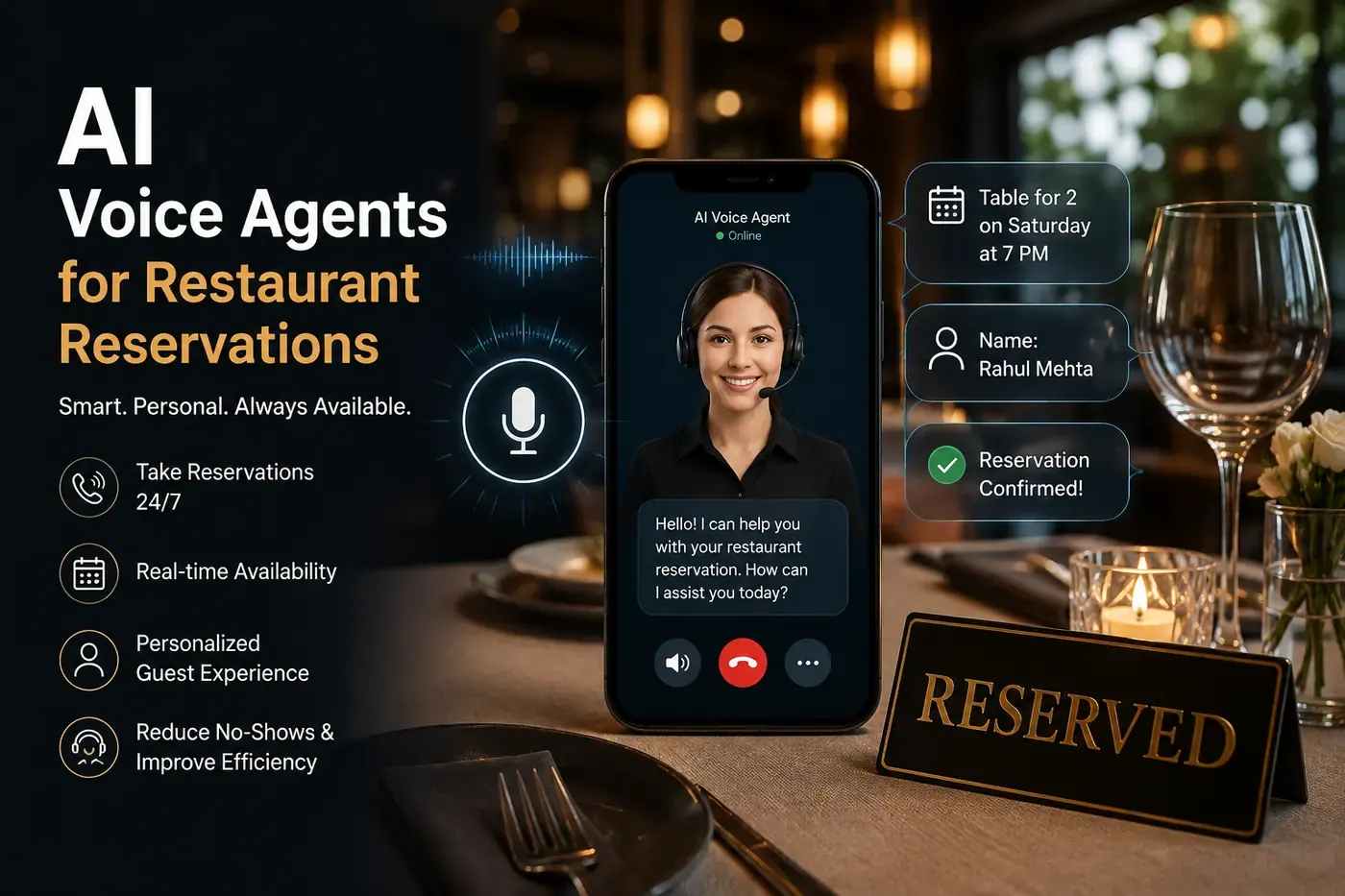
The short version: AI voice agents answer inbound restaurant phone calls, verify table availability against live booking engines like OpenTable or SevenRooms, and confirm reservations in under 90 seconds. Here is the technical pipeline architecture, latency benchmarks, POS integration workflow, and cost breakdown.
During peak dinner service between 6:30 PM and 8:30 PM, the host stand is chaotic. Servers need seating assignments, guests line up at the door, and the restaurant phone rings non-stop.
Most hospitality venues face a frustrating operational bottleneck: staff cannot pick up the phone while seating guests, yet unanswered calls mean lost table bookings. During peak shifts, nearly a third of incoming calls go unanswered as staff prioritize the dining room floor. When the average ticket is $90 per table, missed phone calls bleed thousands of dollars in monthly revenue.
Traditional Interactive Voice Response (IVR) phone trees fail because diners hang up the moment they hear "Press 1 for hours, Press 2 to book." Modern AI voice agents solve this by holding fluid, human-like voice conversations that query reservation systems in real time.
Quick Navigation
- Why Restaurants Miss Inbound Phone Revenue
- How a Voice AI Reservation Pipeline Works
- Integrating with Table Management Systems & POS
- Engineering for Sub-500ms Latency: Lessons from Imageverse
- Cost Breakdown: Operating an AI Voice Reservation Agent
- Where Voice Reservation Agents Struggle (Honest Limitations)
- Who Should Deploy This Technology
- Frequently Asked Questions
Why Restaurants Miss Inbound Phone Revenue
The economics of restaurant table turnover rely on maximizing capacity across specific seatings. Yet phone reservations remain the most neglected communication channel in hospitality operations.
+------------------------------------------------------------------------------------+
|                         THE PEAK-HOUR RESERVATION BOTTLENECK                       |
+------------------------------------------------------------------------------------+
| 100 Inbound Calls During Friday Dinner Rush                                        |
|  ├── 28 Calls: Abandoned due to continuous ringing or busy signals (Lost Tables)   |
|  ├── 35 Calls: Routine queries (Parking, dress code, corkage fee, opening hours)   |
|  ├── 25 Calls: Standard table bookings (2 to 6 guests)                             |
|  └── 12 Calls: Complex requests (Large private dining, dietary allergies)          |
+------------------------------------------------------------------------------------+
When front-of-house staff split attention between incoming physical guests and ringing handsets, three problems occur:
- Revenue leakage: Diners who receive no answer immediately dial the next competing restaurant down the street.
- Staff burnout: Hosts spend hours repeating routine details (operating hours, parking locations, dietary policies) instead of attending to in-house diners.
- Reservation entry errors: Distracted staff write incorrect phone numbers or party sizes into the table management software.
Automating these calls does not mean replacing hospitality. It means handling routine table confirmations instantly while routing VIP inquiries and large banquet events to managers.
How a Voice AI Reservation Pipeline Works
A voice agent is not a single model. It is an orchestrated pipeline connecting real-time telephony, speech recognition, language reasoning, and audio synthesis through bidirectional WebSockets.
+-----------------------------------------------------------------------------------+
|                        REAL-TIME VOICE AI SYSTEM ARCHITECTURE                     |
+-----------------------------------------------------------------------------------+
|                                                                                   |
|   +-------------------+         WebSocket Audio Stream        +---------------+   |
|   |  Inbound Caller   | <===================================> | Twilio / Telnyx|  |
|   |  (PSTN / Mobile)  |                                       | SIP Trunk     |   |
|   +-------------------+                                       +---------------+   |
|                                                                       |           |
|                                                                       v           |
|   +-------------------+          Partial Text Stream          +---------------+   |
|   | Fast LLM Engine   | <------------------------------------ | Deepgram Nova |   |
|   | (Tool Calling)    |                                       | Streaming STT |   |
|   +-------------------+                                       +---------------+   |
|             |                                                         ^           |
|             v (Function Call: check_table_availability)               |           |
|   +-------------------+                                       +---------------+   |
|   | Reservation API   |                                       | Cartesia /    |   |
|   | (OpenTable / Resy)|                                       | ElevenLabs TTS|   |
|   +-------------------+                                       +---------------+   |
|             |                                                         |           |
|             +----------> Synthesized Audio Chunks --------------------+           |
|                                                                                   |
+-----------------------------------------------------------------------------------+
1. Telephony and Audio Streaming (SIP / WebRTC)
When a customer calls the restaurant number, the PBX or cloud carrier (Twilio, Telnyx, or LiveKit SIP) answers immediately. Audio is captured at 8kHz or 16kHz sampling rates and converted into continuous μ-law/PCM audio frames delivered via WebSocket.
2. Streaming Speech-to-Text (STT)
The server sends incoming audio chunks to a low-latency speech recognition engine such as Deepgram Nova-3 or Whisper Live. The STT engine streams partial transcripts back within 100ms to 130ms. Voice activity detection (VAD) monitors when the speaker begins and stops talking.
3. State Machine & LLM Orchestration
Once endpointing detects a completed utterance, the orchestrator passes the transcript to a fast reasoning model. The LLM maintains the conversation state machine:
- Intent extraction: Identifies party size, target date, preferred time slot, and seating area (patio vs main dining room).
- Tool execution: Fires structured API calls (
getAvailableSlots,holdTableLock,createBooking) against the table management database.
4. Low-Latency Text-to-Speech (TTS)
The LLM response streams token-by-token directly into an ultra-low-latency voice generator like Cartesia Sonic or ElevenLabs Flash. As soon as the first sentence clause is synthesized (in roughly 70ms to 100ms), audio chunks stream back to the caller's phone receiver.
Integrating with Table Management Systems & POS
A conversational agent is useless if it cannot read and write directly to live floor inventory. An effective voice booking agent integrates with the restaurant's operational backplane through strict transactional rules.
+------------------------------------------------------------------------------------+
|                         TABLE BOOKING STATE MACHINE LOGIC                          |
+------------------------------------------------------------------------------------+
| Caller: "Do you have a table for 4 this Friday around 7:30 PM?"                   |
|                                                                                    |
| 1. AGENT CHECKS AVAILABILITY                                                       |
|    -> API Request: GET /api/v1/availability?date=2026-08-28&party=4&time=19:30     |
|    <- API Response: { exactMatch: false, alternatives: ["19:15", "20:00"] }        |
|                                                                                    |
| 2. CONVERSATIONAL PROMPT                                                           |
|    -> Voice: "We have tables available at 7:15 PM or 8:00 PM. Which works better?" |
|                                                                                    |
| 3. INVENTORY LOCK & CONFIRMATION                                                   |
|    Caller: "Let's do 7:15 PM."                                                     |
|    -> API Request: POST /api/v1/reservations/hold { slot: "19:15", duration: "120s"|
|    -> Voice: "May I have your name and the best cell number for confirmation?"     |
|    -> API Request: POST /api/v1/reservations/commit { name, phone, party: 4 }      |
|    -> SMS Webhook: Sends instant confirmation text with cancellation link.         |
+------------------------------------------------------------------------------------+
Direct Integrations vs Aggregator Platforms
Depending on the restaurant's existing tech stack, the voice agent connects via one of three methods:
- Direct REST APIs: Direct endpoints for platforms like SevenRooms, OpenTable, Resy, or Toast Tables.
- Custom Database Connectors: For multi-location hospitality chains running proprietary booking portals built with custom software development.
- Fallback SMS Links: When callers request special accommodations (e.g. customized buyout quotes), the agent captures caller info and dispatches a secure web link via SMS.
Engineering for Sub-500ms Latency: Lessons from Imageverse
In text chatbots, an answer delay of 2 seconds is acceptable. In a phone conversation, a 1-second pause feels awkward and broken. If the latency exceeds 800ms, the caller assumes the line disconnected or talks over the agent.
In our engineering work building high-throughput AI systems like Imageverse (our real-time facial recognition and distribution platform), handling concurrent, latency-sensitive payloads taught us critical lessons about throughput and pipeline bottlenecks.
+------------------------------------------------------------------------------------+
|                       VOICE PIPELINE LATENCY BUDGET (TARGET: <500ms)               |
+------------------------------------------------------------------------------------+
| Telephony Ingestion (Twilio / WebSockets)  : 40ms - 50ms                           |
| Streaming Speech-to-Text (Deepgram)        : 100ms - 130ms                         |
| First-Token LLM Reasoning (Fast Inference) : 100ms - 140ms                         |
| Audio Synthesis First Byte (Cartesia Sonic): 70ms - 100ms                          |
| Telephony Return Buffer Packets            : 40ms - 60ms                           |
+------------------------------------------------------------------------------------+
| TOTAL END-TO-END ROUND TRIP TIME           : 350ms - 480ms                         |
+------------------------------------------------------------------------------------+
1. Strict Latency Budgets
Every component in the voice loop must run asynchronously. We pipe partial STT tokens into the model while the user is finishing their phrase, rather than waiting for long silence buffers.
2. Sentence Chunking for Instant Audio
Rather than waiting for the complete LLM response paragraph, the audio synthesizer receives delimited sentence clauses. Generating audio for "We have a table at 7:15 PM" takes under 100ms, allowing audio playback to begin while the remainder of the response is still computing.
3. Fast Interruptions (Acoustic Barge-In)
When a diner interrupts ("Actually, make that 5 people, not 4"), the voice agent must immediately halt audio playback and flush outbound telephony buffers within 50ms. Failing to support instant barge-in makes voice agents feel rigid and robotic.
Cost Breakdown: Operating an AI Voice Reservation Agent
Building vs buying a voice agent comes down to call volume, system customization, and infrastructure ownership. Here is what production voice AI pipelines cost in 2026.
| Component | Provider Example | Unit Cost | Monthly Estimate (1,500 calls / ~3,000 mins) |
|---|---|---|---|
| Telephony / SIP Trunk | Twilio / Telnyx | $0.0040 - $0.0085 / min | $12 - $25.50 |
| Speech-to-Text (STT) | Deepgram Nova-3 | $0.0043 - $0.0059 / min | $13 - $17.70 |
| LLM Reasoning & Tool Calls | Fast Inference Engine | ~$0.015 - $0.035 / call | $22.50 - $52.50 |
| Text-to-Speech (TTS) | Cartesia / ElevenLabs | $0.030 - $0.060 / min | $90 - $180 |
| SMS Confirmations | Carrier A2P 10DLC | $0.0079 / message | $12 - $15 |
| Subtotal Variable Usage Cost | — | ~$0.05 - $0.10 / min | $150 - $288 / month |
| Cloud Hosting & Server Compute | AWS / Fly.io / GCP | Flat server instance | $40 - $80 / month |
| Total Estimated Monthly Cost | — | — | $190 - $368 / month |
Note: Infrastructure unit costs compiled from standard provider rate cards (Twilio, Deepgram, Cartesia, ElevenLabs, and AWS), last verified August 2026. Actual totals scale with call durations, concurrent channels, and model token usage.
Comparing this to staffing a dedicated full-time host (which costs $3,200 to $4,500 monthly including payroll taxes and benefits) illustrates why restaurant groups are adopting automated voice infrastructure.
Where Voice Reservation Agents Struggle (Honest Limitations)
Voice AI is exceptionally good at structured table reservations, operating FAQs, and cancellation updates. However, it is not a magic fix for every scenario. Being honest about edge cases prevents operational disasters:
- Complex banquet and buyout requests: A voice agent should never attempt to negotiate a $10,000 private dining buyout contract. When a party exceeds 10 or 12 guests, the agent must collect contact details and alert the event coordinator via Slack or email.
- Extreme background street acoustics: If a caller dials from a convertible car or a loud subway platform, audio packet loss and acoustic interference can degrade STT accuracy. The agent must recognize repeated transcription failures and immediately offer: "I'm having a little trouble hearing you clearly. May I text a quick booking link to your number right now?"
- Unusual name spellings: Foreign surnames or creative spellings frequently get transcribed incorrectly. For table lookups, matching by confirmed 10-digit phone number is far more reliable than relying solely on name pronunciation.
Who Should Deploy This Technology
Best Suited For:
- High-volume casual and fine dining venues: Restaurants with 75+ seats receiving 40+ inbound phone calls per day.
- Multi-location restaurant groups: Brands operating 3 to 20 locations where routing rules and cross-location table inventory can be pooled.
- Venues with strict cancellation policies: Systems that require SMS credit card hold links before securing prime weekend slots.
Who Should Wait:
- Micro-cafes with walk-in only seating: If you operate a 12-seat neighborhood bakery with no reservations, a basic automated Google Business profile and WhatsApp link are sufficient.
- Venues with analog copper phone lines: Voice AI requires modern SIP trunk forwarding or VoIP infrastructure. Upgrading legacy hardware is a prerequisite.
For teams deciding whether a standard conversational chatbot or an autonomous agent is appropriate, review our detailed guide on AI Agent vs Chatbot or explore our AI chatbot development services.