Back to Services
MOBILE DEVELOPMENT
Food Delivery App Development
Customer, rider and restaurant apps with live order tracking, built by the team behind Akeed and Khedmah's delivery support bot.
Customer Ordering AppRider & Driver AppRestaurant & Admin DashboardLive Order TrackingPayments & WhatsApp Support
"A food delivery product is three apps that have to agree with each other every second: the customer placing the order, the restaurant accepting it and the rider carrying it. We built Akeed, a food and grocery delivery app in Oman, and the AI support bot that answers order-tracking questions for Khedmah. We build the same pieces for restaurants, cloud kitchens and delivery startups."
OVERVIEW
What does food delivery app development include?
Food delivery app development is building the full ordering and fulfilment system, not only the customer app. A working platform has a customer app for browsing menus, ordering and paying; a rider app for accepting jobs, navigation and proof of delivery; a restaurant app or tablet view for accepting and preparing orders; and an admin dashboard for menus, pricing, zones, riders, refunds and reports.
Behind those sit the parts customers never see: an order state machine that keeps all three apps in step, real-time location updates, dispatch rules that decide which rider gets which order, payment and refund handling, and notifications. Most delays and support tickets come from this layer, so it is where we spend the most design time.
If you run a single restaurant brand or a cloud kitchen, you may not need the rider and dispatch layer on day one: your own ordering app plus an existing delivery partner is often the right first release. We'll say so during discovery rather than sell you the larger build.
WHAT'S INCLUDED
03.01
Customer Ordering App
Menus, search, cart, scheduled orders, coupons and checkout on iOS and Android, built to keep the steps from menu to paid order short.
- → Restaurant and dish discovery
- → Cart, add-ons and scheduled orders
- → Saved addresses and reorder
- → Live order status and rider location
03.02
Rider & Driver App
Job offers, pickup and drop navigation, status updates and proof of delivery, designed for one-handed use on the road.
- → Accept or reject delivery jobs
- → Turn-by-turn handoff to maps
- → Photo or OTP proof of delivery
- → Earnings and trip history
03.03
Restaurant & Admin Dashboard
A web dashboard for restaurants to manage menus and accept orders, and for your operations team to manage zones, riders, payouts and refunds.
- → Menu, pricing and availability
- → Order acceptance and prep times
- → Delivery zones and fees
- → Reports, refunds and payouts
03.04
Live Tracking & Dispatch
Real-time rider location, ETA shown to the customer, and dispatch rules that assign orders to riders by distance, load and prep time.
- → Real-time location updates
- → Customer-facing ETA
- → Rule-based or automated assignment
- → Exception alerts for late orders
03.05
Payments & WhatsApp Support
Card, wallet and cash-on-delivery flows with refunds, plus an AI assistant that answers "where is my order?" on WhatsApp and hands harder cases to your team.
- → Payment gateway and COD
- → Refunds and partial refunds
- → WhatsApp order-status bot
- → Arabic and English support
COMPARATIVE INSIGHTS
Custom app or a white-label delivery script?
White-label scripts get you live fast but you rent the product. A custom build costs more up front and is yours. The right answer depends on how much of the business runs through the app.
| Factor | White-label script | Custom build |
|---|---|---|
| Time to first launch | Weeks | Months (MVP first) |
| Up-front cost | Low | Higher |
| Code ownership | Usually licensed, not owned | You own the code and data |
| Fit to your operations | You adapt to the script | Built around your menus, zones and partners |
| Arabic / local payments | Depends on the vendor | Built to your market |
| Changing it later | Limited to vendor roadmap | Any change you can fund |
If you are testing demand in one area, a script or an existing marketplace can be the cheaper experiment. Build custom when the app is the business.
PRICING & VALUES
How much does food delivery app development cost?
Food delivery app development typically ranges from about $15,000 for a focused MVP in one city to $60,000 or more for a regional platform with customer, rider, restaurant and admin apps, custom dispatch and POS integrations. Cross-platform frameworks keep the lower end lower, because the customer and rider apps share one codebase across iOS and Android.
Cost moves most with three things: whether you need your own riders and dispatch or use a delivery partner, how many third-party systems you integrate (POS, payment gateways, maps, WhatsApp), and whether you launch in one market or several. We scope in milestones with a fixed price for each, so you see the budget before development starts. For the full breakdown, read our food delivery app development guide.
FAQ
Frequently Asked Questions
Common questions about our mobile development services.
How long does it take to build a food delivery app?
A focused MVP usually takes four to six months, depending on how many of the customer, rider, restaurant and admin apps you need for launch. A full platform across all of them typically takes nine to twelve months.
How much does a food delivery app cost?
Expect roughly $15,000 for a single-city MVP up to $60,000 or more for a regional platform with custom dispatch and POS integrations. We quote a fixed price per milestone after discovery.
Do I need my own rider app?
Only if you run your own delivery fleet. Many restaurants and cloud kitchens launch with their own ordering app and hand delivery to an existing partner, then add a rider app and dispatch when volume justifies it.
Can you build one app for both iOS and Android?
Yes. We usually build the customer and rider apps cross-platform from one codebase, which keeps cost and release effort down, and go native only where a feature needs it.
Can the app support Arabic and local payment methods?
Yes. We build bilingual Arabic and English interfaces with right-to-left layouts, and integrate the payment gateways and cash-on-delivery flows your market uses.
Can you add an AI chatbot for order support?
Yes. A WhatsApp or in-app assistant can answer order-status and delivery questions from your order data and pass complex cases to a human agent with the conversation history, as we did for Khedmah.
Proof of Performance
Recent Projects
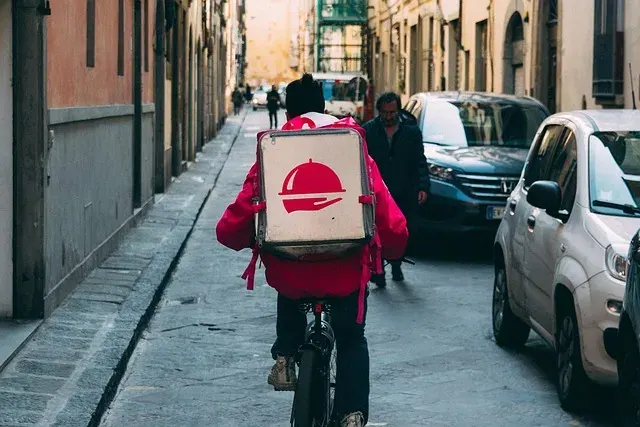
Akeed App
A modern mobile app designed for seamless food and grocery delivery experiences, offering real-time tracking, smart recommendations, and a sleek user interface.
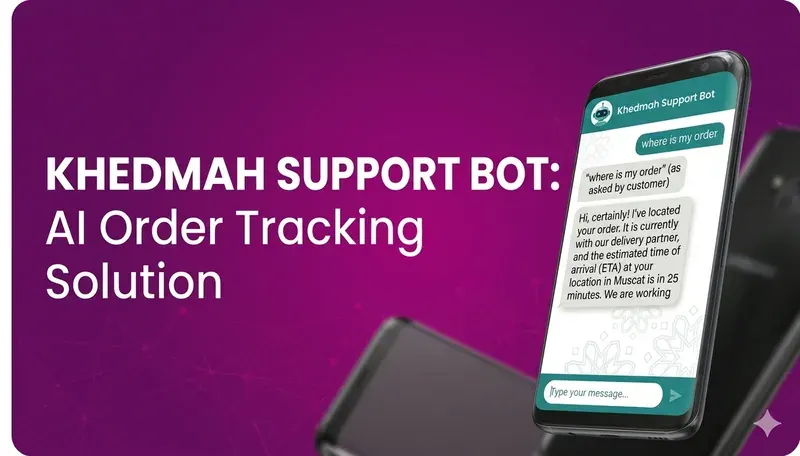
Khedmah - AI Chatbot
An AI-powered customer support chatbot built for Khedmah — Oman's trusted digital services platform. The chatbot assists customers with real-time order tracking and delivery support, providing instant, conversational help throughout the delivery experience.
READY TO START?Let's build
Let's build
your product.
Share your goals and technical requirements. We will propose the right scope, stack, and delivery schedule.