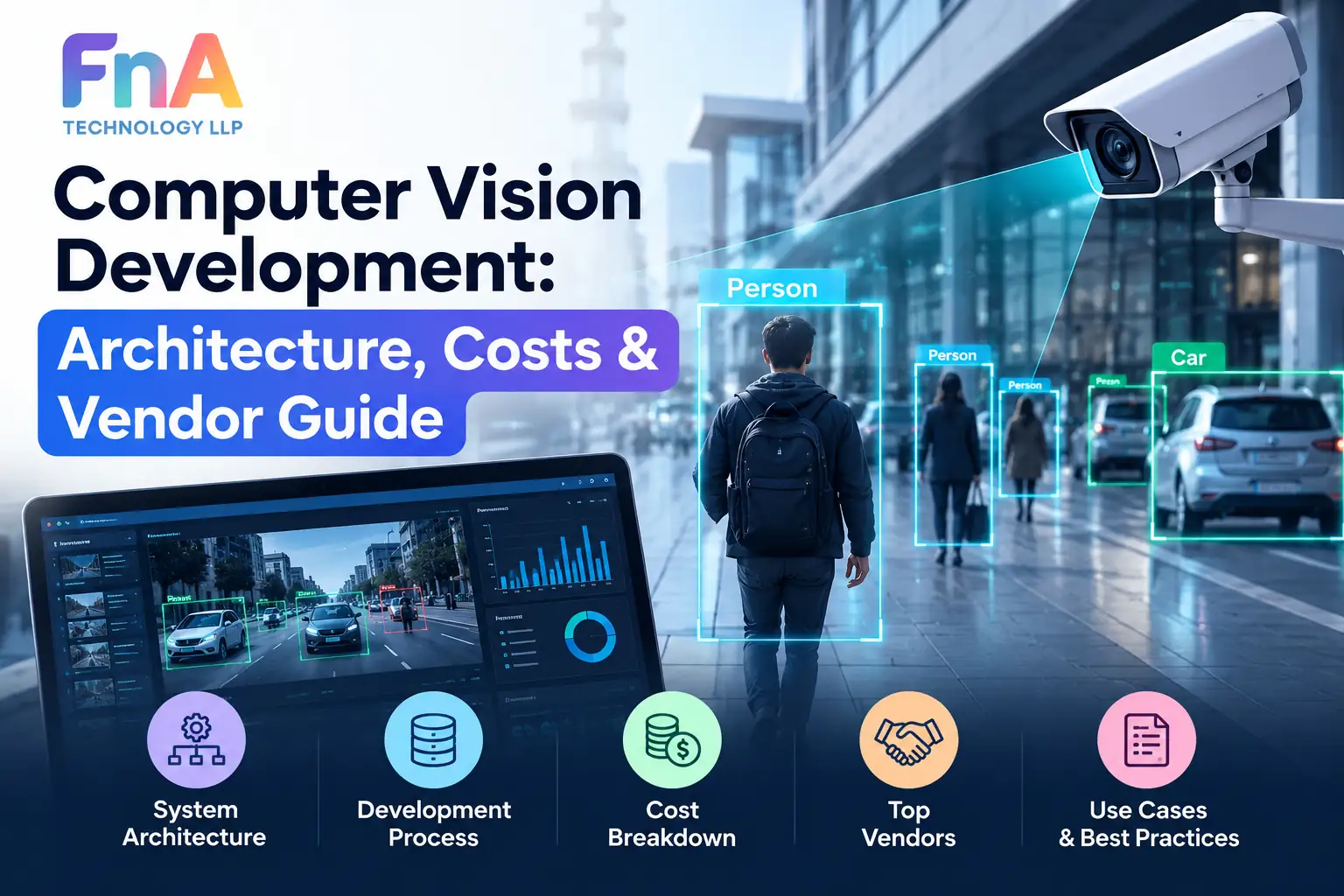
The short version: Production computer vision systems convert raw visual streams into structured business actions. Choosing between edge and cloud inference, bounding annotation expenses, and securing full model ownership determine your return on investment. Here is how engineering leaders evaluate custom vision pipelines, calculate costs, and assess specialized partners.
Off-the-shelf vision APIs work fine for basic OCR or generic tag recognition. But the moment an enterprise workflow requires detecting defects on a high-speed conveyor, matching faces across 50,000 event attendees, or calculating inventory counts under warehouse lighting, public cloud endpoints break down.
They break down on latency, recurring API bills, and accuracy.
Building a production-grade vision system requires answering hard infrastructure questions early. Should inference run on an embedded edge device or a centralized GPU cluster? How do you prevent model drift when camera optics or seasons shift? And what should you actually pay an outside partner to engineer it?
This guide breaks down what computer vision engineering delivers, how to calculate the real financial trade-offs, and how production platforms like Imageverse evaluate visual pipeline architecture.
What does computer vision development actually cover?
Computer vision engineering means designing, training, and deploying algorithms that extract high-level understanding from digital images or videos. In an enterprise system, this requires structuring distinct pipeline stages rather than executing a single standalone model.
A complete visual pipeline interfaces directly with camera hardware, hardware acceleration engines, and business databases:
+--------------------------------------------------------------+
|                     Frame Ingestion Layer                    |
|       RTSP Streams / USB Grabbers    Mobile Camera Feeds     |
+--------------------------------------------------------------+
|                   Pre-Processing & Filtering                 |
|       Lens Correction / Deblur       Resolution Matrix Scale |
+--------------------------------------------------------------+
|                  Inference & Detection Layer                 |
|       YOLOv10 / RT-DETR Detection    Instance Segmentation   |
+--------------------------------------------------------------+
|                   Embedding & Vector Search                  |
|       512D Vector Embeddings         HNSW Index (Qdrant)     |
+--------------------------------------------------------------+
|                  Hardware Execution Runtime                  |
|       TensorRT (NVIDIA Jetson)       CoreML / TFLite (ARM)   |
+--------------------------------------------------------------+
When you choose a custom engineering path, you gain direct architectural control over four core capabilities:
- Deterministic processing latency: By deploying models directly to target hardware using engines like TensorRT or ONNX Runtime, inference executes in fixed time windows (often 12ms to 35ms per frame) without unpredictable cloud round-trip delays.
- Precision on non-standard objects: Commercial cloud vision APIs recognize dogs, cars, and laptops. They cannot identify proprietary turbine blade fractures, custom electronic connectors, or agricultural crop diseases under specific field conditions. Custom training targets your exact visual domain.
- Bandwidth and privacy isolation: Processing high-resolution video streams locally means gigabytes of raw footage never travel across public internet connections. Only extracted metadata, bounding boxes, or verification events leave the local boundary.
- Permanent asset ownership: You own the annotated datasets, neural network weights, and export artifacts. Your platform never risks sudden vendor price increases or deprecated API versions.
What realistic benchmarks should you expect?
Marketing materials often claim that commercial cloud vision endpoints work out of the box with zero custom tuning. In routine tests with stock photography, that claim holds up. But under production lighting variation, sensor vibration, or high frame rates, general models fail rapidly.
The table below outlines typical ranges from our engineering projects and benchmark evaluations when comparing off-the-shelf cloud APIs (such as AWS Rekognition and Google Cloud Vision) against dedicated custom vision pipelines on enterprise hardware:
| Operational Metric | Generic Cloud Vision API | Custom Dedicated Pipeline | Production Impact |
|---|---|---|---|
| Query Latency | 220ms - 550ms | 18ms - 65ms | Eliminates processing bottlenecks at verification checkpoints |
| Domain Accuracy | 76% - 84% on custom items | 94.5% - 98.8% | Prevents false rejects and manual operator overrides |
| Recurring Cost (100k frames) | $120 - $250 | $8 - $18 (amortized GPU) | 85%+ decrease in cloud infrastructure spend at scale |
| Offline Execution | Impossible (requires internet) | Full offline / air-gapped | Ensures 100% uptime during network dropouts |
| Data Boundary | Shared public cloud tenancy | Private VPC or local device | Complies with strict healthcare and enterprise privacy rules |
| Model Adaptability | Zero (black-box API) | High (retrainable on edge cases) | Continuous performance improvements on new failure modes |
Note: Benchmarks reflect typical ranges observed across our production client projects and test runs on edge devices (NVIDIA Jetson, Apple Silicon) and dedicated GPU instances compared to commercial cloud vision endpoints.
The inference latency and cost metrics diverge drastically as transaction volumes grow. A facility processing 50 camera streams at 15 frames per second generates millions of frames daily. Paying cloud API call rates on that volume bankrupts an initiative within months. Dedicated pipelines running on edge accelerators or self-hosted GPU nodes turn that variable operational expense into fixed compute costs.
Production context: Computer vision in live platforms
Architecture decisions show their real value when put under sustained production load. At FNA Technology, we engineer custom machine learning and vision systems across demanding operational settings. Looking at live deployments illustrates how these design choices work in practice.
1. Imageverse: Real-time facial recognition across 20,000+ event photos
In large-scale public events and multi-day conferences, photographers upload tens of thousands of high-resolution images. Finding personal photographs in unorganized cloud galleries was historically an agonizing manual task for attendees.
To solve this, we engineered Imageverse, our AI-driven photo distribution platform:
- The Challenge: Attendees upload a single selfie and expect their personalized gallery immediately. Searching through 20,000+ 24-megapixel images using generic cloud face APIs created 4-second wait times and cost hundreds of dollars per event.
- The Pipeline: We structured a dedicated vision pipeline. Faces are detected locally upon photo upload, normalized, and converted into 512-dimensional vector embeddings. These vectors are indexed into an approximate nearest neighbor (ANN) vector database using HNSW indexing.
- The Outcome: Query times dropped to under 400 milliseconds per attendee search across 20,000 images, while eliminating per-image commercial API fees through a self-hosted vector pipeline. For full technical details on embedding generation and vector search, read our deep-dive on how AI facial recognition powers event photo distribution.
2. Edge-AI mobile vision: Low-latency on-device inference
For mobile-first applications, transmitting video feeds from consumer phones to backend servers introduces noticeable lag and drains user data plans.
By quantizing convolutional and transformer backbones down to INT8 precision and compiling them through platform-specific runtimes (CoreML for iOS and TensorFlow Lite for Android), we run real-time object tracking directly on user smartphones. For an engineering walkthrough on setting up mobile neural engines, see our guide on Edge AI: ML in Mobile Apps with TensorFlow & CoreML.
Who needs custom computer vision?
Custom computer vision is not a universal recommendation. We routinely guide clients to use basic off-the-shelf tools when testing early product concepts. However, custom computer vision development is the right investment if your product meets any of the following criteria:
- Your transaction volume exceeds 25,000 images daily: When query volume scales, the per-call pricing of commercial cloud APIs quickly eclipses the one-time development cost of a dedicated pipeline.
- Your product demands sub-50ms inference latency: Robotics, sports tracking, factory sorting, and live camera overlays cannot tolerate cloud round-trip transport delays.
- You are detecting proprietary or unusual objects: If you inspect industrial welds, agricultural plants, or custom product packaging, off-the-shelf models lack the labels needed to recognize your assets.
- Regulatory standards mandate air-gapped data isolation: Healthcare facilities, defense sites, and corporate campuses that forbid video streams from leaving the physical building must run inference on local hardware.
Decision Rule:
                                  Does your system need:
                     Domain-specific items, sub-50ms latency,
                       or high-volume continuous video streams?
                                    /         \
                                  YES          NO
                                  /             \
                       Build Custom Vision    Use Off-The-Shelf
                        (Dedicated Pipeline)   (Cloud Vision APIs)
If you are weighing pipeline options, consult our engineering guide on custom ML models vs off-the-shelf APIs for face recognition to review detailed architectural cost models.
Who is custom computer vision NOT for?
Transparency matters in machine learning engineering. Building custom models when standard software suffices drains engineering capital that should fund core business priorities.
You should not invest in custom computer vision development if:
- You are processing standard invoices and receipts: Pre-trained document OCR tools like AWS Textract, Google Document AI, and Azure Form Recognizer already solve standard document extraction with exceptional accuracy. Building custom models here reinvents the wheel.
- Your volume is under 1,000 requests per day: At under 1,000 requests daily (~30,000 monthly), commercial cloud API charges stay under ~$75/mo (or under $15/mo for a few hundred weekly requests). Spending $35,000+ on custom model development makes no financial sense at this scale.
- You have fewer than 1,000 representative training images: Neural networks require sufficient visual variety to generalize across real-world conditions. Without representative data or a viable plan to capture it, training will underperform.
- Environmental conditions are completely uncontrolled: If target objects appear in unpredictable angles, severe physical occlusion, or total darkness, pairing optical cameras with non-visual sensors (LiDAR, ultrasonic, thermal, or RFID) often provides far higher reliability than pure vision models.
What drives custom computer vision development costs?
Custom vision development budgets reflect five major technical components. Knowing how these drivers break down helps engineering leaders budget accurately and evaluate technical proposals:
+--------------------------------------------------------------+
|             COMPUTER VISION BUDGET DISTRIBUTION              |
+--------------------------------------------------------------+
| Data Curation & Expert Annotation  | [==== 30% ====]         |
| Neural Backbone Architecture       | [=== 25% ===]           |
| Edge / Hardware Quantization       | [=== 20% ===]           |
| Validation & Field Testing         | [== 15% ==]             |
| Deployment & Drift Monitoring      | [= 10% =]               |
+--------------------------------------------------------------+
Cost Ranges by Project Scope
- Feasibility Proof of Concept (4–6 weeks): $15,000 – $25,000. Collects and annotates 1,000 sample images, trains a baseline detector, and validates feasibility on target hardware.
- Production MVP (10–14 weeks): $35,000 – $60,000. Full dataset collection, targeted model fine-tuning, automated pre-processing pipelines, custom API integration, and basic drift monitoring.
- Enterprise Multi-Stream System (16–24 weeks): $75,000 – $130,000+. Multi-camera RTSP ingestion, hardware-accelerated edge inference, custom annotation infrastructure, automated retraining loops, and enterprise ERP integration.
How should you evaluate computer vision development companies?
Selecting an engineering partner for visual machine learning requires looking beyond marketing claims. You must verify whether the team understands hardware constraints, loss functions, and production data pipelines.
Here is how to evaluate technical partners:
1. Confirm complete IP and model weights ownership
Demand clear contract language guaranteeing that you own the raw dataset annotations, trained model weights, quantization scripts, and deployment pipelines. If a vendor insists on keeping model weights locked in their proprietary cloud runtime, you are buying vendor lock-in, not an enterprise asset.
2. Verify edge hardware deployment experience
Ask the partner to show examples of models they have deployed to resource-constrained hardware such as NVIDIA Jetson Orin, Raspberry Pi, Apple Silicon, or Android chipsets. Running uncompressed models on cloud GPUs is simple; quantizing models to run at 30 FPS on embedded edge devices requires deep systems engineering.
3. Review their strategy for model drift
In production, camera lenses collect dust, lighting shifts between seasons, and physical workflows evolve. Ask prospective partners how their pipeline captures low-confidence detections, routes them to human reviewers, and schedules automated retraining without interrupting live operations.
4. Check team composition and direct engineer access
Ensure your project is led by experienced computer vision engineers rather than general web developers relying on automated training tools. Demand direct communication with the engineers designing your tensor architectures, loss functions, and hardware acceleration layers.
How we build computer vision systems at FNA Technology
At FNA Technology, we approach vision engineering with an engineering-first mentality. We do not maintain account management layers or rotate junior staff onto production builds. When you engage our computer vision development company, you work directly with senior software and ML engineers.
Here is how we deliver computer vision engagements:
- Pipeline architecture planning: We define input frame resolutions, target latency budgets, inference hardware specifications, and data boundaries before training any model.
- Dataset curation and annotation: We build targeted annotation schemas and data augmentation routines, ensuring your models train on the real-world edge cases specific to your operational environment.
- Model training and quantization: We train state-of-the-art vision architectures, pruning and quantizing weights for maximum throughput on your chosen deployment hardware (TensorRT, CoreML, ONNX).
- Integration, CI/CD, and drift monitoring: We embed the vision pipeline into your broader software infrastructure, establishing automated evaluation suites and drift detection alerts so accuracy stays high long after deployment.
Knowing when to choose custom vision pipelines versus cloud APIs before writing the first line saves months of wasted engineering effort.
Explore Our Machine Learning & Vision Services
Computer Vision Development
Custom detection, segmentation, and vector search pipelines engineered for edge devices, mobile hardware, and private cloud clusters.
Custom AI & Machine Learning
Full-stack AI architectures, autonomous agents, and custom neural networks engineered to automate complex business operations.
Frequently Asked Questions
Evaluating custom computer vision architecture for your product? Discuss your technical requirements with our engineering team to get a straightforward architectural recommendation and timeline.