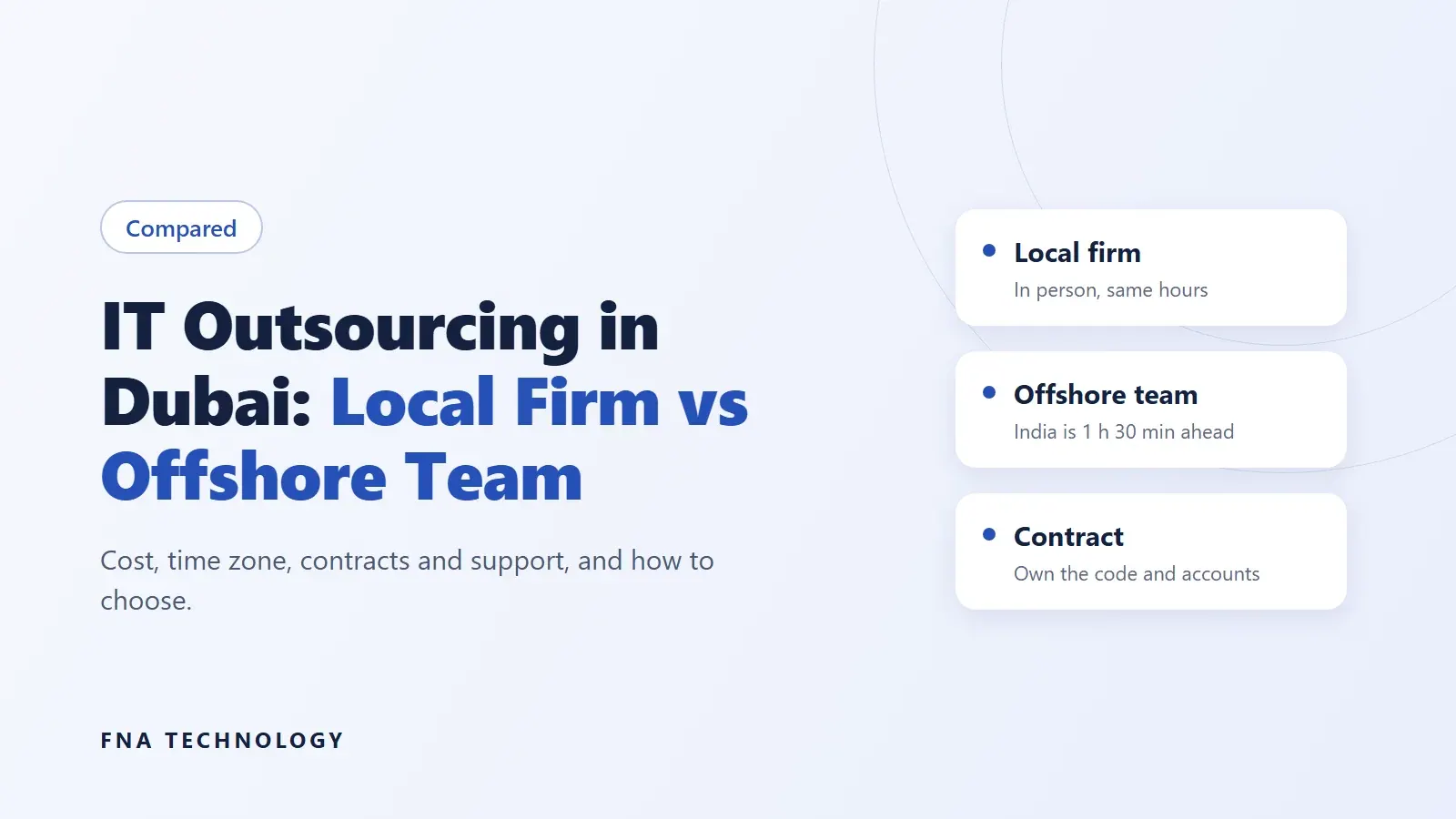
The short version: Among IT outsourcing companies in Dubai, you are choosing between a local firm and an offshore team. Choose a Dubai-based firm when you need people in your office, a UAE-registered supplier or work that cannot be written down yet. Choose an offshore team when the scope is clear and you can review work every week. Many businesses combine the two, and whoever you pick, own the code and accounts.
This guide is for UAE businesses deciding who should build or look after their software: a firm based in Dubai, a team in another country, or a mix of the two. It compares them on cost, time zone, contracts, data and support, and covers how to compare quotes fairly and what to put in the contract.
We should say where we stand. We are FNA Technology, a software development company with our team in Mumbai, India, and we work with UAE businesses remotely, so we are one of the offshore options this guide describes. We have tried to be fair about when a local firm is the better choice. If you already know you want software built, see our custom software development for Dubai businesses.
First, which kind of IT outsourcing do you need?
"IT outsourcing" covers two quite different jobs, and the right answer differs for each.
- Managed IT: helpdesk, laptops and phones, office networks, email accounts, backups and security monitoring. Much of this needs someone who can come to your office, so a local managed IT provider usually fits best.
- Software development: websites, web apps, mobile apps, customer portals, internal systems and integrations. This work can be done well from anywhere, as long as it is scoped, reviewed and handed over properly.
The rest of this guide is about the second kind. Many businesses use a local provider for day-to-day IT and a separate team for software, rather than expecting one company to do both well.
Local firm, offshore team or both: side by side
| Dubai-based firm | Offshore team | |
|---|---|---|
| Meetings | In person whenever needed | Video calls; travel for big workshops |
| Time zone | Same hours | India is 1 hour 30 minutes ahead; most of the day overlaps |
| Cost | Usually higher rates; ask for an itemised quote | Often lower rates; compare the total, not the rate |
| Procurement | Easiest when a UAE-registered supplier is required | Check whether your buyers accept a foreign supplier |
| Contract | You sign with a UAE company | You sign with a company abroad; agree which law applies |
| Support after launch | Can visit your office | Remote; check hours and reply times in your time zone |
| Who writes the code | Ask: it may be an offshore team | The team you meet, if you check |
| Best for | Work that needs people on site, or is still unclear | Well-defined builds and long product roadmaps |
A hybrid sits in between: a local lead meets you and the build team joins calls. It suits larger projects with many stakeholders, but make one side accountable.
When a Dubai-based firm is the better choice
- Your buyer or a government client requires a UAE-registered supplier
- You need people in your office every week, for workshops, training or on-site systems
- The work is still vague and will be worked out in meetings rather than in writing
- Your data or systems must stay in the UAE and the work needs physical access to them
- Nobody in your business has time to review progress every week
If several of these are true, paying more for a local firm is usually money well spent.
When an offshore team works well
- The scope can be written down: users, features, systems to connect and what "done" means
- Someone in your business can review a demo every week or two and answer questions quickly
- You want more engineering for the same budget, or a team that stays with the product for years
- The work does not need anyone in your office
If the software is core to your business for years and you can hire and manage developers, building your own team may be better; many companies use an outside team for the first version and hire later. Offshore works badly when nobody owns the project on your side. Distance makes unclear decisions slower, whoever the team is.
Ask who will actually write the code
The line between local and offshore is blurrier than it looks. Some software companies in Dubai keep sales, account management and sometimes design in Dubai, and build with a team in India, Eastern Europe or elsewhere. That can work well, but you should know it before you sign, because it changes what you are paying for.
Ask every company you speak to:
- Who will write, review and test the code, and where are they?
- Are they employees, or subcontracted to another company?
- Can we meet the tech lead before signing?
- What happens if a key person leaves halfway through?
How to compare the cost fairly
Offshore teams usually charge lower rates, but the saving varies so much with scope, seniority and how well the work is managed that no single percentage is reliable. Compare total cost, not hourly rates:
- Send every company the same one-page brief and ask for an itemised quote
- Check that discovery, design, testing, deployment and support are included in each
- Count your own team's time: reviews, feedback and approvals take longer when communication is poor
- Ask for the running costs after launch, such as hosting and support, next to the build price
- Ask each company what the other quote has left out
A cheap quote that leaves out testing or support is not cheaper. A local quote that includes on-site workshops you will never use is not better value.
Put these in the contract
Whichever you choose, these protect you if things go wrong:
- Which company you sign with: check it is the one that builds the software, not a reseller that passes the work on
- Which country's law applies, and where disputes are settled (ask your lawyer)
- You own the code, designs and documentation once paid, and the code repository, cloud, domain and app store accounts are in your company's name
- Payments are tied to milestones you can test, not to time passing
- A written process for changes, with the effect on price and dates agreed before work starts
- A support period after launch, and what support costs after that
- A handover package if either side ends the contract: code, credentials, documents and how to deploy
- How personal data is handled, and which data protection rules apply to you (check this with a legal advisor)
Support after launch
Software needs fixes and updates after it goes live. A local firm can send someone to your office. An offshore team supports you remotely, which suits most software but not hardware or networks. Ask any company who fixes bugs and how fast for an urgent one, what hours support is available in your time zone, whether security updates are included, and what support costs each month. After launch, our support and maintenance service covers bug fixes, security updates, monitoring and new features.
Making a remote team work
- Agree the overlapping hours for calls and quick questions
- Have one named contact on each side
- See working software every week or two, not only status reports
- Keep decisions in writing, in one place both sides can see
- Test on a separate environment before anything goes live
How we work with UAE businesses
Our team is in Mumbai, which is 1 hour 30 minutes ahead of Dubai, so most of your working day overlaps with ours. We work with UAE clients remotely through video calls and regular progress updates, with an account manager as your point of contact, and we have shipped software for clients in India and the GCC. Most clients start with a fixed-scope project; we also work on time and materials or as a dedicated team. Our projects typically cost USD 5,000 to USD 200,000 (about AED 18,400 to AED 734,500), depending on size, and you see the price before development starts. FNA signs the contract with you directly, we quote clients outside India in USD or AED, and you own the source code. If you need a team that sits in your Dubai office every day, we are not the right fit.
Software for UAE Businesses
Custom Software Development in Dubai
Operations systems, customer portals, dashboards and integrations for UAE businesses, built remotely from Mumbai.
Web Development in Dubai
Websites, web apps and customer portals in English and Arabic.
Mobile App Development in Dubai
iOS and Android apps for UAE businesses, with Arabic right-to-left layouts.
Frequently Asked Questions
Hire locally when you need people in your office every week, a UAE-registered supplier for procurement, or the work cannot be written down clearly. Go offshore when the scope can be written down, you can give weekly feedback, and you want more engineering for the same budget. Many businesses do both: a local lead for workshops and an offshore team for the build.
Yes. India is 1 hour 30 minutes ahead of the UAE and neither changes its clocks, so most of the working day overlaps all year round. A morning call in Dubai is late morning in India, and an Indian team's afternoon is still your working day.
There is no reliable single percentage, so be wary of anyone who quotes one before seeing your scope. Compare the total cost on the same brief, including discovery, testing, support and the time your own team spends managing the work, not only the hourly rate.
Not always. Some keep sales and project management in Dubai and the engineering team in India or elsewhere. Ask who will write and test your code, where they are, and whether they are employees or subcontractors.
Usually not. Day-to-day IT support, networks, devices and office equipment need someone who can come on site, so a local managed IT provider fits that work better. Offshore teams suit software you can build and support remotely.
It should say who owns the code, designs and documents, and that the repository, cloud and app store accounts are in your name. Also milestone payments tied to working software, a change process, a support period after launch, and what you receive if either side ends the contract.
Outsourcing means another company delivers the work for you, wherever it is based, and offshoring means the work is done in another country. Staff augmentation means you add outside developers to your own team and manage them day to day. An offshore outsourcing partner is both: another company, in another country.
Talk to us about your project
Tell us what you need built and how your team likes to work, and we will tell you honestly whether a remote team like ours fits, or whether a local firm would serve you better.