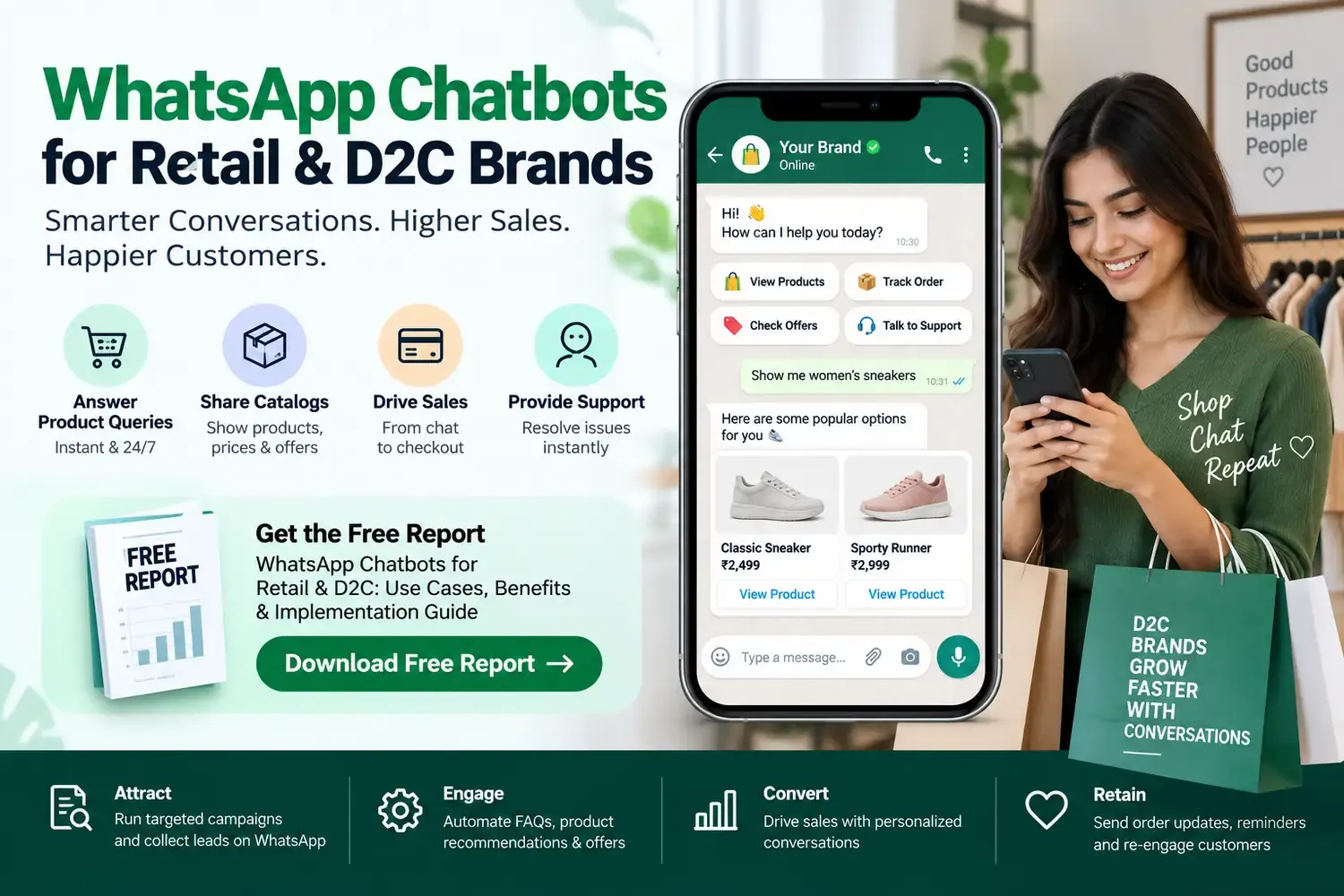
The short version: Retail and D2C brands use WhatsApp chatbots to automate order tracking, abandoned cart recovery, and customer support where shoppers actually read messages. Here is the operational architecture, realistic conversion and retention metrics, and lessons from building high-volume ordering pipelines like Khedmah.
Customer communication in eCommerce is broken. Email inboxes are flooded with promotional noise, driving average open rates down to 18% or 20% according to Klaviyo's 2025 eCommerce Benchmarks. Standard SMS costs escalate with every campaign while offering shoppers zero ability to reply, ask questions, or browse product variations.
WhatsApp changes this dynamic. In regions across Europe, Latin America, the Middle East, and Asia, WhatsApp maintains open rates north of 80%, with Meta's 2024 Business Messaging data reporting that over 80% of received messages are opened within five minutes.
Yet most brands deploy WhatsApp chatbots poorly. They set up rigid numeric menus ("Press 1 for Sales, Press 2 for Tracking") that anger shoppers the moment they ask a natural question like "Can I change my delivery address before the shipment leaves?"
Building an effective WhatsApp commerce engine requires moving past static broadcast tools. You need an automated system that connects directly to your inventory database, handles free-form text, and knows precisely when to pass the conversation to a human.
Quick Navigation
- What Can a WhatsApp Chatbot Actually Do for Retail and D2C Brands?
- How Does the WhatsApp Commerce Architecture Work?
- Realistic Benchmarks: What Metrics Actually Move?
- How We Solved Real-Time Order Tracking: The Khedmah Blueprint
- How Should Brands Handle Returns and Human Escalation?
- Who Is This For (and Who Should Skip It)?
- How to Evaluate WhatsApp Chatbot Approaches
- Frequently Asked Questions
What Can a WhatsApp Chatbot Actually Do for Retail and D2C Brands?
An effective retail chatbot focuses on high-frequency operational touchpoints rather than pretending to be a generic personal stylist. In production environments, four core workflows deliver nearly all the financial return.
1. Instant Post-Purchase Order Tracking (WISMO Deflection)
"Where is my order?" (WISMO) queries account for 40% to 60% of all inbound post-purchase support volume in consumer retail, according to eCommerce research by project44 and Gorgias (2024–2025). Customers do not want to hunt down a tracking number, open a carrier portal, and decipher logistical scan codes.
With WhatsApp automation, a customer simply types, "Where is my package?" The system matches their phone number to active fulfillments, fetches live coordinates from carriers like DHL, FedEx, or local couriers, and replies in under two seconds:
"Your order #48291 is out for delivery with our courier. Estimated arrival is between 2:00 PM and 4:30 PM today. Track live driver route here: [Link]"
2. Conversational Abandoned Cart Recovery
Standard automated email reminders get trapped in spam filters or buried under newsletters. A WhatsApp reminder sent 45 to 60 minutes after cart abandonment reaches the shopper on their primary screen.
More importantly, it invites interaction. Instead of just pushing a discount code, the assistant asks if the shopper had questions regarding sizing, shipping times, or payment methods. In our client deployments, addressing a sizing hesitation recovers carts that static discount codes never could.
3. Frictionless Re-Ordering for Consumables
For D2C brands selling coffee, skincare, supplements, or pet food, repeat purchases drive profitability.
A scheduled message sent 25 days after purchase (timed to when their supply runs low) allows the customer to re-order in three quick taps:
- Tap "Re-order My Usual"
- Tap to confirm the saved shipping address
- Tap to authorize payment via WhatsApp native pay or a pre-filled checkout link
Removing the need to log into a website or remember a password cuts re-order cycle times by days.
4. Frontline Product Inquiries and Sizing Guidance
Shoppers drop off product pages when simple questions go unanswered. A WhatsApp chatbot equipped with structured product data answers direct questions about ingredients, fabric composition, wash care, and compatibility.
When integrated with your product information management (PIM) system, the assistant checks live warehouse inventory before promising a specific color or size.
How Does the WhatsApp Commerce Architecture Work?
Deploying a business assistant on WhatsApp requires a solid technical foundation. The free WhatsApp Business mobile app is meant for solo shopkeepers; serious retail operations build on the WhatsApp Business Platform (Cloud API).
Here is the architectural blueprint we implement for high-volume retail and D2C brands:
[ Customer on WhatsApp ]
           │
           ▼
[ Meta WhatsApp Cloud API ]
           │ (Webhook payload within 200ms)
           ▼
[ Ingestion Gateway & Message Queue (Redis / BullMQ) ]
           │
           ├──► [ Intent Classifier & Session Manager ]
           │            │
           │            ├── Direct Query ──► [ Order / Catalog Database ]
           │            │                      (Shopify, WooCommerce, Custom ERP)
           │            │
           │            └── Unclear Query ─► [ LLM Knowledge Retrieval (RAG) ]
           │                                   (Policies, Ingredients, FAQs)
           │
           ▼
[ Response Generator ] ──► Formats Buttons / Carousel Lists / Quick Replies
           │
           ▼
[ Outbound Cloud API ] ──► Delivered to Customer Phone (< 2s total latency)
Let us examine why each architectural layer matters:
1. Ingestion Gateway and Queue Buffering
Meta requires your webhook endpoint to acknowledge incoming event payloads with an immediate HTTP 200 OK. If your server blocks while querying a slow ERP or database synchronously before responding, webhook timeout and retry cycles trigger duplicate message loops.
We decouple ingestion from processing using a fast Redis queue. The webhook acknowledges receipt immediately, and a background worker picks up the job to query external systems.
2. Hybrid Intent Routing
Pure LLM generation without guardrails is dangerous for retail. You cannot afford an AI inventing non-existent return policies or hallucinating discounts.
Our architecture uses a two-tier router:
- Deterministic Rules & API Connectors: Used for transactional lookups (order status, balance, inventory counts, cancellations). These execute structured database queries with zero hallucination risk.
- RAG Brain for Unstructured Questions: Used when shoppers ask broad questions like "Is this serum safe for sensitive skin?" The model references your verified documentation and responds concisely.
3. Clean Catalog Synchronization
WhatsApp allows brands to upload inventory catalogs directly to Meta Commerce Manager. The bot triggers native multi-product messages and category lists, allowing shoppers to add items to a WhatsApp cart without opening a browser.
Realistic Benchmarks: What Metrics Actually Move?
When evaluating an automated communication channel, vanity metrics like "total messages sent" mean very little. What matters is ticket deflection, conversion uplift, and labor savings.
The table below compiles benchmarks from Gartner's 2024 Customer Service research, Gorgias and Klaviyo's 2024–2025 eCommerce benchmark reports, and operational telemetry from our production client deployments:
| Operational Metric | Traditional Manual & Email Stack | Custom WhatsApp Commerce Bot | Typical Net Impact | Sourced Reference |
|---|---|---|---|---|
| Average First Response Time | 4 to 18 hours | Under 2 seconds | 99%+ reduction | Zendesk CX Trends (2024) / Production telemetry |
| WISMO Inquiry Deflection | 0% (manual routing) | 55% to 70% automated | 55% to 70% reduction in WISMO volume | Gorgias Benchmark Report (2024–2025) |
| Abandoned Cart Recovery Rate | 6% to 9% (via email) | 16% to 24% (via WhatsApp) | 2.5x recovery improvement | Klaviyo eCommerce Benchmarks (2025) |
| Support Cost Per Handled Ticket | $3.50 to $6.00 | $0.15 to $0.35 | 90% to 97% cost reduction | Gartner Contact Center Study (2024) |
| Consumable Re-Order Rate | 12% repeat within 45 days | 27% repeat within 45 days | 2.2x repeat conversion | Shopify D2C Repeat Purchase Benchmarks (2025) |
Beyond reducing weekday support overhead, conversational automation directly protects weekend sales.
When a shopper encounters a payment failure or size doubt on a Saturday evening, an email ticket answered Monday morning loses the sale. An immediate resolution on WhatsApp captures the transaction on the spot.
How We Solved Real-Time Order Tracking: The Khedmah Blueprint
Theory is easy; production at scale is hard. The real challenge of conversational commerce is keeping data accurate when thousands of users query transactional backends simultaneously.
We tackled this exact problem when building the Khedmah Chatbot, the AI customer support assistant for Oman's primary digital services and utility platform.
The Operational Challenge
Khedmah handles massive daily transaction volumes across bill settlements, digital vouchers, and service recharges. During peak traffic windows, support queues backed up with customers asking two core questions:
- "Where is my order / voucher?"
- "Did my payment go through?"
The human support team spent most of their day copying order IDs from chats, pasting them into administrative panels, and reading back statuses.
The Technical Solution
We engineered a deterministic API orchestration pipeline. Rather than letting an AI guess order data, the bot operates as an authenticated middleware layer:
- The system reads the incoming phone number and validates it against active transactions.
- For sensitive queries, it checks transaction hashes or issues a quick verification step.
- The bot executes live REST queries against Khedmah's core transactional ledger.
- It returns the exact processing stage, transaction reference, and delivery status in under two seconds.
- It operates natively in both Arabic and English, matching the customer's preferred phrasing without awkward translations.
The Result for Retail Operations
The implementation deflected over 65% of incoming tier-1 support tickets autonomously. Human agents were freed from answering repetitive order lookups and could focus on handling complex edge cases.
This identical architectural pattern is what powers modern D2C and retail bots. Whether you are querying a custom billing ledger like Khedmah or an eCommerce backend like Shopify, the core rule remains: Transaction status must always come from deterministic backend APIs, never from unconstrained language models.
For a deeper look into our engineering process for conversational interfaces, explore our custom AI chatbot development services or review our technical guide on how to build a WhatsApp AI chatbot.
How Should Brands Handle Returns and Human Escalation?
Many automated retail bots fail because their creators pretend the bot can solve everything. It cannot.
Returns, damaged shipments, and angry customers require thoughtful engineering and human judgment.
Structured Return Intake
Processing a return requires specific data points: order number, reason code, and photographic proof of defect.
A bot should never argue with a customer about return eligibility. Instead, it guides the intake:
- Identifies the delivered order from the customer's account.
- Prompts the customer to select the item and reason from interactive list buttons.
- Requests a photograph of the defect directly in the chat window.
- Validates whether the item falls within the 14-day or 30-day return window.
Warm Human Handoff
If the request requires manager approval, the assistant halts automated replies and passes the conversation to your support desk (such as Zendesk, Gorgias, or a custom CRM).
The handoff must be fast and clean:
- The human agent receives the complete conversation history.
- The order ID, customer tier, and uploaded photos are tagged onto the ticket.
- The customer receives an immediate confirmation: "I have connected you with Sarah from our customer care team. She has your photos and order details and will take over right here in this chat."
The customer never has to re-explain the problem from the beginning.
Who Is This For (and Who Should Skip It)?
We believe in candid assessments. WhatsApp automation is not a universal fix for every retail business model.
High-Fit Profiles:
- D2C Brands with 500+ Monthly Orders: Brands experiencing high repeat purchase potential (apparel, cosmetics, health supplements, specialty foods).
- Mobile-Heavy Traffic: Retailers where 75% or more of web traffic originates on mobile phones.
- Brands with Regional Reach in WhatsApp Markets: Companies selling across the GCC, Europe, Southeast Asia, or Latin America, where WhatsApp is the default communication utility.
- Stores Overwhelmed by WISMO Queries: Operations where human staff spend hours each day copying and pasting tracking links.
Who Should Skip It:
- Bespoke Luxury Goods Requiring White-Glove Sales: If you sell $15,000 custom engagement rings or bespoke furniture, customers expect a personal phone call or video consultation. Automated bots feel impersonal here.
- Stores with 50,000 Rapidly Fluctuating SKUs: If your inventory changes every hour across tens of thousands of items, the WhatsApp native catalog UI is too constrained. Direct customers to a dedicated web app instead.
- Businesses Unwilling to Open Their APIs: A WhatsApp bot that cannot check live stock or fetch order statuses is just an expensive FAQ brochure. If your legacy ERP cannot expose secure read endpoints, fix your data infrastructure first through custom software development.
How to Evaluate WhatsApp Chatbot Approaches
When planning your deployment, you have three primary architectural choices. Choosing the right path depends on your transaction volume and customization needs.
| Evaluation Criteria | No-Code SaaS Template Bots | Off-The-Shelf CRM Add-ons | Custom-Engineered Architecture |
|---|---|---|---|
| Setup Timeline | 1 to 3 days | 1 to 2 weeks | 2 to 4 weeks |
| Backend Integration Depth | Basic webhooks; limited live database queries | Tied strictly to the CRM's native database | Deep bidirectional connections to custom ERP, OMS, and 3PL carriers |
| Conversation Flexibility | Rigid keyword buttons; breaks on typos | Preset decision trees | Hybrid intent classification with contextual understanding |
| Ongoing Operating Cost | High monthly platform fees + per-conversation markups | High per-seat licensing | Flat cloud infrastructure + raw Meta API utility rates |
| Data Sovereignty | Customer data resides on third-party SaaS servers | Stored inside CRM ecosystem | Full control over database location and encryption standards |
| Best Suited For | Small startups testing initial demand | Mid-market teams already committed to a single CRM | Scaling D2C brands requiring deep custom workflows and high volume |
If your brand operates on custom logistics or requires unique authentication logic, pre-packaged templates quickly run into brick walls. Building an architecture tailored to your data model ensures you own your customer touchpoints without paying ballooning monthly per-seat fees.
For organizations evaluating larger multi-agent automated systems, our review on AI Agent vs Chatbot breaks down how autonomous workflows compare to single-purpose assistants.